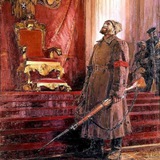
“In the first place, at the very outset of his argument, Engels says that, in seizing state power, the proletariat thereby "abolishes the state as state". It is not done to ponder over over the meaning of this. Generally, it is either ignored altogether, or is considered to be something in the nature of "Hegelian weakness" on Engels' part. As a matter of fact, Engels speaks here of the proletariat revolution "abolishing" the bourgeois state, while the words about the state withering away refer to the remnants of the proletarian state after the socialist revolution. According to Engels, the bourgeois state does not "wither away", but is "abolished" by the proletariat in the course of the revolution. What withers away after this revolution is the proletarian state or semi-state.”
- V. I. Lenin, State and Revolution.
💯1
Media is too big
VIEW IN TELEGRAM
It's vital that workers understand that the US empire never invades a country to help the population, but to help itself to the country's resources.
Forwarded from The Communists
HANDS OFF IRAN! Party statement
As west-backed provocateurs unleashed violence and tried to create social breakdown, huge numbers of people turned out to show their support for the government and the revolution in the face of outside attack.
The funeral of three-year-old Melina Asadi, who was murdered during during one such terrorist shooting spree, attracted a massive crowd, while a government-called mobilisation on 15 January brought at least one million Iranians to the streets in defence of their country’s sovereignty and independence.
Aiming to fragment the population and cause chaos, the imperialists have instead promoted the cause of national unity.
https://thecommunists.org/2026/01/17/news/hands-off-iran-oppose-anglo-american-regime-change-psyops/
As west-backed provocateurs unleashed violence and tried to create social breakdown, huge numbers of people turned out to show their support for the government and the revolution in the face of outside attack.
The funeral of three-year-old Melina Asadi, who was murdered during during one such terrorist shooting spree, attracted a massive crowd, while a government-called mobilisation on 15 January brought at least one million Iranians to the streets in defence of their country’s sovereignty and independence.
Aiming to fragment the population and cause chaos, the imperialists have instead promoted the cause of national unity.
https://thecommunists.org/2026/01/17/news/hands-off-iran-oppose-anglo-american-regime-change-psyops/
🔥1
Forwarded from Marx Engels Lenin Institute
Victory to the Islamic Republic against imperialist aggression!
🔥3
I might share the odd local and/or independent band on here in the future. There are so many good bands out there just gigging around, while we are fed this utter dross by the mainstream media.
👍4❤1
Forwarded from The Communists
A pivot to the western hemisphere does not, as some wishful thinkers have suggested, reflect an acceptance of China’s rise and the inevitability of a multipolar world order.
On the contrary, the purpose of aiming to achieve hemispheric hegemony is to establish a stronger base from which to confront China – and Russia, and Iran, and the DPRK, and any other state that seriously pursues sovereignty and independence.
https://thecommunists.org/2026/01/01/news/trump-national-security-strategy-blueprint-hegemony/
On the contrary, the purpose of aiming to achieve hemispheric hegemony is to establish a stronger base from which to confront China – and Russia, and Iran, and the DPRK, and any other state that seriously pursues sovereignty and independence.
https://thecommunists.org/2026/01/01/news/trump-national-security-strategy-blueprint-hegemony/
The Communists
Trump’s national security strategy, a blueprint for hegemony
How the US imperialists plan to make good on their longstanding aim of ‘pivoting to Asia’.
💯1
Forwarded from Marx Engels Lenin Institute
121 years ago, on January 9 (January 22 according to the new style), 1905, the tsarist troops fired on a peaceful demonstration of workers who were heading to the Winter Palace to present a petition to Tsar Nicholas II complaining about their disenfranchised existence. The First Russian Revolution began with Bloody Sunday.
The reason for the workers' protest was a lost strike that began on January 3 at the Putilov Factory and spread to all the factories and plants of St. Petersburg. The march was organized by the monarchist organization "Assembly of Russian Factory and Plant Workers of St. Petersburg", founded by the priest G. A. Gapon. The main demand of the petition was the immediate convening of a Constituent Assembly on the basis of universal, secret, and equal suffrage. In addition, a series of political and economic demands were put forward, such as amnesty for political prisoners, expansion of citizens' rights and freedoms, replacement of indirect taxes with progressive income tax, introduction of an 8-hour workday, etc. During the discussion of the petition at workers' meetings, the Bolsheviks explained that only through revolutionary struggle could the proletariat achieve their rights. However, faith in the tsar was still strong and the march could not be stopped. The Bolsheviks decided to participate in the demonstration.
To reinforce the St. Petersburg garrison, the government called in troops from Pskov, Tallinn, Narva, Peterhof, and Tsarskoe Selo and concentrated over 40,000 soldiers and police in St. Petersburg by January 9. The plan to disperse the march was approved by the government on January 8 at a meeting of the Minister of Internal Affairs P. D. Sviatopolk-Mirsky. The troops (a total of over 18 battalions, 21 squadrons, 8 companies) were concentrated in eight combat sectors into which the city was divided.
The priest George Gapon, leading the march, was practically an instigator and provocateur of the unsuspecting workers - he convinced them that the petition would certainly be accepted by the tsar. On Sunday, January 9, early in the morning, people dressed festively (over 140,000 people), including old people, women, and children, carrying icons and portraits of the tsar, moved towards Palace Square from all districts of St. Petersburg.
By order of the St. Petersburg Governor-General, Grand Duke Vladimir Alexandrovich, the workers were fired on by the troops; about 4,600 people were killed and wounded. January 9, 1905 went down in history as "Bloody Sunday".
The news of the bloody crackdown on St. Petersburg workers sparked a wave of strikes across the country under the slogan "Down with the autocracy!". In the evening of January 9, barricades began to be erected in the working-class districts. The workers realized that only through struggle could they achieve their rights.
The tragic events of January 9 sparked an outburst of indignation throughout the world and numerous mass protests across Russia, marking the beginning of the First Russian Revolution. V.I. Lenin wrote that on January 9 "the working class received a great lesson in civil war; the revolutionary education of the proletariat took a step forward in one day that it could not have taken in months and years of gray, everyday, oppressed life".
Source
The reason for the workers' protest was a lost strike that began on January 3 at the Putilov Factory and spread to all the factories and plants of St. Petersburg. The march was organized by the monarchist organization "Assembly of Russian Factory and Plant Workers of St. Petersburg", founded by the priest G. A. Gapon. The main demand of the petition was the immediate convening of a Constituent Assembly on the basis of universal, secret, and equal suffrage. In addition, a series of political and economic demands were put forward, such as amnesty for political prisoners, expansion of citizens' rights and freedoms, replacement of indirect taxes with progressive income tax, introduction of an 8-hour workday, etc. During the discussion of the petition at workers' meetings, the Bolsheviks explained that only through revolutionary struggle could the proletariat achieve their rights. However, faith in the tsar was still strong and the march could not be stopped. The Bolsheviks decided to participate in the demonstration.
To reinforce the St. Petersburg garrison, the government called in troops from Pskov, Tallinn, Narva, Peterhof, and Tsarskoe Selo and concentrated over 40,000 soldiers and police in St. Petersburg by January 9. The plan to disperse the march was approved by the government on January 8 at a meeting of the Minister of Internal Affairs P. D. Sviatopolk-Mirsky. The troops (a total of over 18 battalions, 21 squadrons, 8 companies) were concentrated in eight combat sectors into which the city was divided.
The priest George Gapon, leading the march, was practically an instigator and provocateur of the unsuspecting workers - he convinced them that the petition would certainly be accepted by the tsar. On Sunday, January 9, early in the morning, people dressed festively (over 140,000 people), including old people, women, and children, carrying icons and portraits of the tsar, moved towards Palace Square from all districts of St. Petersburg.
By order of the St. Petersburg Governor-General, Grand Duke Vladimir Alexandrovich, the workers were fired on by the troops; about 4,600 people were killed and wounded. January 9, 1905 went down in history as "Bloody Sunday".
The news of the bloody crackdown on St. Petersburg workers sparked a wave of strikes across the country under the slogan "Down with the autocracy!". In the evening of January 9, barricades began to be erected in the working-class districts. The workers realized that only through struggle could they achieve their rights.
The tragic events of January 9 sparked an outburst of indignation throughout the world and numerous mass protests across Russia, marking the beginning of the First Russian Revolution. V.I. Lenin wrote that on January 9 "the working class received a great lesson in civil war; the revolutionary education of the proletariat took a step forward in one day that it could not have taken in months and years of gray, everyday, oppressed life".
Source
❤2
Forwarded from Class Consciousness Project
The U.S. Empire.
Grease on its hands. Blood on its flags. Chains for anyone who won’t submit.
Grease on its hands. Blood on its flags. Chains for anyone who won’t submit.
❤2
Forwarded from Palestinian Commie
This media is not supported in your browser
VIEW IN TELEGRAM
Please open Telegram to view this post
VIEW IN TELEGRAM
❤2
Forwarded from Joti Brar
Wrangling over who should pay for the next subsidy to Kiev shows a dawning realisation that no ‘lender’ can expect to be repaid.
With the battlefield frontlines creeping inexorably westward, the fractures between the various Nato and EU member states are continuing to grow as the aggressors look for ways to pass the buck of the economic and geopolitical disaster they have created.
https://thecommunists.org/2026/01/20/news/collapsing-ukraine-reparation-bond-irreparable-divides-europe/
With the battlefield frontlines creeping inexorably westward, the fractures between the various Nato and EU member states are continuing to grow as the aggressors look for ways to pass the buck of the economic and geopolitical disaster they have created.
https://thecommunists.org/2026/01/20/news/collapsing-ukraine-reparation-bond-irreparable-divides-europe/
The Communists
Collapse of Ukraine reparation bond signals irreparable divides within Europe
The true fallout from Nato’s military defeat against Russia is only just beginning.
Forwarded from Beorn and The Shieldmaiden
Vaccinate your mind. Read Lenin!
«The State and Revolution»
The Marxist theory of the state and the tasks of the proletariat in the revolution. Written by Lenin in August - September 1917, first published in 1918.
Enjoy!
@BeornAndTheShieldmaiden
🚀 Boost🚀
«The State and Revolution»
The Marxist theory of the state and the tasks of the proletariat in the revolution. Written by Lenin in August - September 1917, first published in 1918.
Enjoy!
@BeornAndTheShieldmaiden
Please open Telegram to view this post
VIEW IN TELEGRAM
👌3❤2