
Básicamente la mejor información sobre el código la aportó Ray Dillinger, en el 2013 publicada en BitcoinTalk, bajo el seudónimo de Cryddit
Copyright (c) 2008 Satoshi Nakamoto
Bitcoin source from November 2008.
December 23, 2013
https://www.bitpost.app/tx/4d7529062f42a0251cf7096cbb01a1e5bb8c492965a982bea72b6a5a6434abaa
Copyright (c) 2008 Satoshi Nakamoto
Bitcoin source from November 2008.
December 23, 2013
https://www.bitpost.app/tx/4d7529062f42a0251cf7096cbb01a1e5bb8c492965a982bea72b6a5a6434abaa
Forwarded from 2010 360-2 - One MB block size limit 1Mb (@RamonQuesada 🌷)
Re: Permanently keeping the 1MB (anti-spam) restriction is a great idea ...
February 07, 2015
Cryddit / @RayDillinger
For what it's worth:
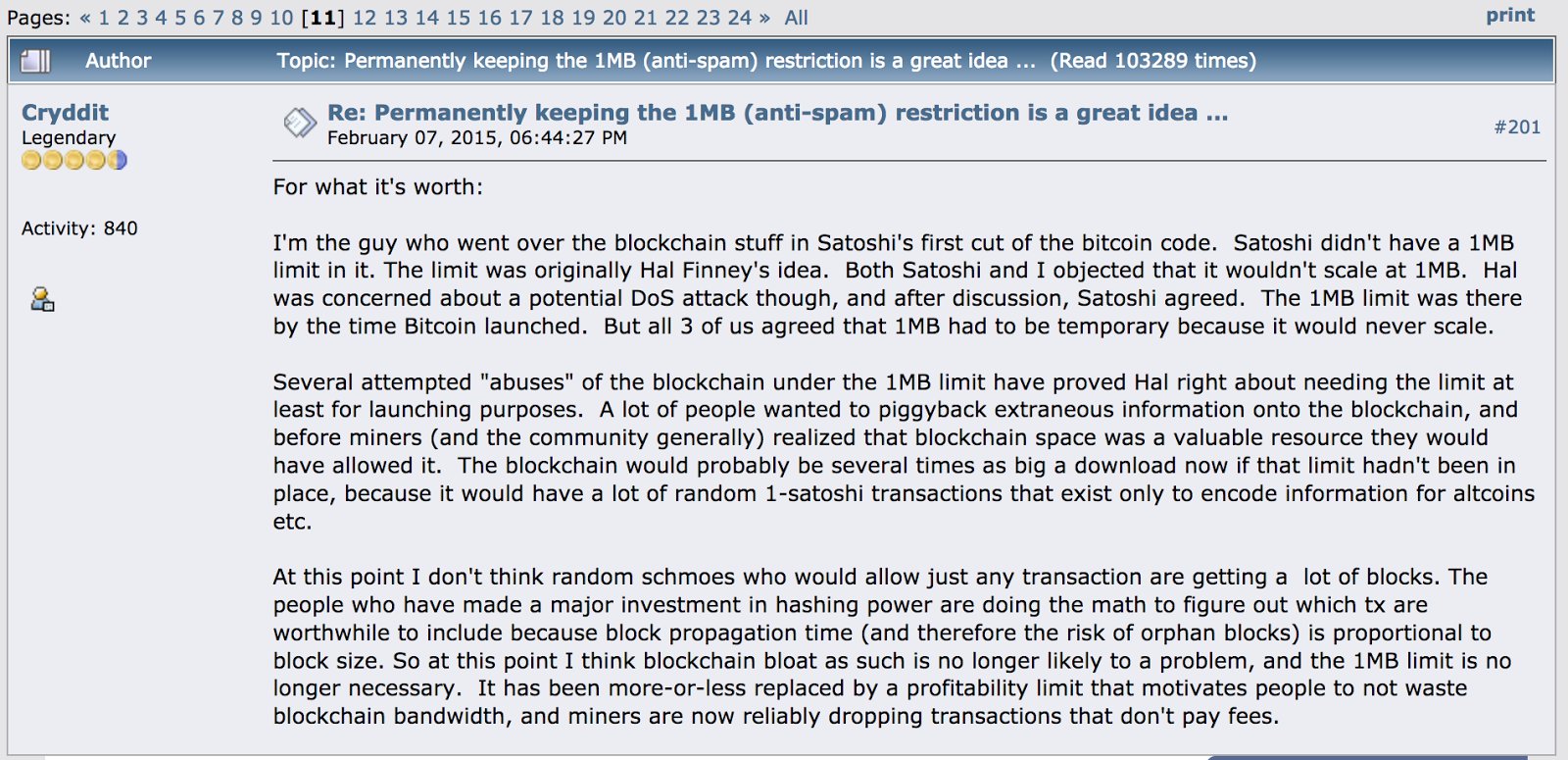
I'm the guy who went over the blockchain stuff in Satoshi's first cut of the bitcoin code. Satoshi didn't have a 1MB limit in it. The limit was originally Hal Finney's idea. Both Satoshi and I objected that it wouldn't scale at 1MB. Hal was concerned about a potential DoS attack though, and after discussion, Satoshi agreed. The 1MB limit was there by the time Bitcoin launched. But all 3 of us agreed that 1MB had to be temporary because it would never scale.
Several attempted "abuses" of the blockchain under the 1MB limit have proved Hal right about needing the limit at least for launching purposes. A lot of people wanted to piggyback extraneous information onto the blockchain, and before miners (and the community generally) realized that blockchain space was a valuable resource they would have allowed it. The blockchain would probably be several times as big a download now if that limit hadn't been in place, because it would have a lot of random 1-satoshi transactions that exist only to encode information for altcoins etc.
At this point I don't think random schmoes who would allow just any transaction are getting a lot of blocks. The people who have made a major investment in hashing power are doing the math to figure out which tx are worthwhile to include because block propagation time (and therefore the risk of orphan blocks) is proportional to block size. So at this point I think blockchain bloat as such is no longer likely to a problem, and the 1MB limit is no longer necessary. It has been more-or-less replaced by a profitability limit that motivates people to not waste blockchain bandwidth, and miners are now reliably dropping transactions that don't pay fees. "
https://bitcointalk.org/index.php?topic=946236.msg10388435#msg10388435
February 07, 2015
Cryddit / @RayDillinger
For what it's worth:
I'm the guy who went over the blockchain stuff in Satoshi's first cut of the bitcoin code. Satoshi didn't have a 1MB limit in it. The limit was originally Hal Finney's idea. Both Satoshi and I objected that it wouldn't scale at 1MB. Hal was concerned about a potential DoS attack though, and after discussion, Satoshi agreed. The 1MB limit was there by the time Bitcoin launched. But all 3 of us agreed that 1MB had to be temporary because it would never scale.
Several attempted "abuses" of the blockchain under the 1MB limit have proved Hal right about needing the limit at least for launching purposes. A lot of people wanted to piggyback extraneous information onto the blockchain, and before miners (and the community generally) realized that blockchain space was a valuable resource they would have allowed it. The blockchain would probably be several times as big a download now if that limit hadn't been in place, because it would have a lot of random 1-satoshi transactions that exist only to encode information for altcoins etc.
At this point I don't think random schmoes who would allow just any transaction are getting a lot of blocks. The people who have made a major investment in hashing power are doing the math to figure out which tx are worthwhile to include because block propagation time (and therefore the risk of orphan blocks) is proportional to block size. So at this point I think blockchain bloat as such is no longer likely to a problem, and the 1MB limit is no longer necessary. It has been more-or-less replaced by a profitability limit that motivates people to not waste blockchain bandwidth, and miners are now reliably dropping transactions that don't pay fees. "
https://bitcointalk.org/index.php?topic=946236.msg10388435#msg10388435
Satoshi didn't have a 1MB limit in it. The limit was originally Hal Finney's idea. Both Satoshi and I objected that it wouldn't scale at 1MB. Hal was concerned about a potential DoS attack though, and after discussion, Satoshi agreed. The 1MB limit was there by the time Bitcoin launched. But all 3 of us agreed that 1MB had to be temporary because it would never scale."
Re: Permanently keeping the 1MB (anti-spam) restriction is a great idea ...
February 07, 2015
Cryddit / @RayDillinger
https://bitcointalk.org/index.php?topic=946236.msg10388435#msg10388435
Re: Permanently keeping the 1MB (anti-spam) restriction is a great idea ...
February 07, 2015
Cryddit / @RayDillinger
https://bitcointalk.org/index.php?topic=946236.msg10388435#msg10388435
If anyone can falsify my claims, I go to prison. I have sworn in testimony that I am Satoshi Nakamoto, and I created bitcoin. To journalists, there is no way to prove. Anything can be taken and twisted in social media. You can't do that in court if you twist the narrative and you lie you face the consequences.
Others who claim to be Satoshi so that they can gain fame have to prove their point. Each point of evidence needs to be falsifiable. If it can be falsified, they face prison time. There is nothing from any of these people that I cannot falsify. I can demonstrate categorically in court with evidence that all of these people have created a false narrative to either defraud people or engage in other scams.
Those like Gizmodo and Wired were not interested in the real story. It's the same as that author who wanted to paint me in the same light Julian Assage. But of course, is the false narrative we get to take part. The way that that story was written was to sell a populist idea of what bitcoin and Satoshi mean, and it is not what I intended. It is not why I invented bitcoin, and it is not the story that needs to be told.
What I expect to happen is that people like Roger and Vitelik will oppose me because they know their scams require that I do not get a voice. They will seek to censor me and will be seen to do such. Then, everything that there claiming will be shown to be false and malicious. Next, we would expect many of the other scammers who have to double down to attack, and they can claim that they worked with me and that they were part of this and this is why we need to keep some things close. If everything is out there, I cannot discredit others who seek to say that they were part of the Satoshi group.
That idiot in BCH, David and others he worked with planned Jihan and wanted me to be a part of a larger group early on which gives them power. People like Bear, Hal and Dave, helped me, but they did not create bitcoin. They didn't even really know what bitcoin was. Even Dave wrote not a single line of code. He gave me a few grammatical suggestions on the Whitepaper and his real role was keeping me psychologically sane as I dealt with these people. He was a sounding board and a friend.
What we are going to find is the narrative changes to say that these were part of my group. We already see this. If they know the full story, these people can twist and become seemingly part of it and lie, it becomes hard for us to weed them out.
But going forward, I have things they don't know. And they won't be able to give them before we get them in court and tear them apart. Once we have a few people torn apart, preferably people who are under oath and then demonstrated to have perjured themselves we can ensure that others know that if they do this if they seek to add themselves to my story, I always have something that will ruin them.
This is why we need court because otherwise other people are going to twist the story and continue their scams.
CSW
May 25, 2019
https://metanet-icu.slack.com/archives/C5131HKFX/p1558795610306000?thread_ts=1558795604.305900&cid=C5131HKFX
Others who claim to be Satoshi so that they can gain fame have to prove their point. Each point of evidence needs to be falsifiable. If it can be falsified, they face prison time. There is nothing from any of these people that I cannot falsify. I can demonstrate categorically in court with evidence that all of these people have created a false narrative to either defraud people or engage in other scams.
Those like Gizmodo and Wired were not interested in the real story. It's the same as that author who wanted to paint me in the same light Julian Assage. But of course, is the false narrative we get to take part. The way that that story was written was to sell a populist idea of what bitcoin and Satoshi mean, and it is not what I intended. It is not why I invented bitcoin, and it is not the story that needs to be told.
What I expect to happen is that people like Roger and Vitelik will oppose me because they know their scams require that I do not get a voice. They will seek to censor me and will be seen to do such. Then, everything that there claiming will be shown to be false and malicious. Next, we would expect many of the other scammers who have to double down to attack, and they can claim that they worked with me and that they were part of this and this is why we need to keep some things close. If everything is out there, I cannot discredit others who seek to say that they were part of the Satoshi group.
That idiot in BCH, David and others he worked with planned Jihan and wanted me to be a part of a larger group early on which gives them power. People like Bear, Hal and Dave, helped me, but they did not create bitcoin. They didn't even really know what bitcoin was. Even Dave wrote not a single line of code. He gave me a few grammatical suggestions on the Whitepaper and his real role was keeping me psychologically sane as I dealt with these people. He was a sounding board and a friend.
What we are going to find is the narrative changes to say that these were part of my group. We already see this. If they know the full story, these people can twist and become seemingly part of it and lie, it becomes hard for us to weed them out.
But going forward, I have things they don't know. And they won't be able to give them before we get them in court and tear them apart. Once we have a few people torn apart, preferably people who are under oath and then demonstrated to have perjured themselves we can ensure that others know that if they do this if they seek to add themselves to my story, I always have something that will ruin them.
This is why we need court because otherwise other people are going to twist the story and continue their scams.
CSW
May 25, 2019
https://metanet-icu.slack.com/archives/C5131HKFX/p1558795610306000?thread_ts=1558795604.305900&cid=C5131HKFX
On p. 7 they write:
By the time he released the paper, he had already coded the entire system. In his own words, “I had to write all the code before I could convince myself that I could solve every problem, then I wrote the paper.” Based on historical estimates, Satoshi likely started formalizing the Bitcoin concept sometime in late 2006 and started coding around May 2007.
Worth pointing out that Hal Finney and Ray Dillinger — and likely several others – helped audit the code and paper before any of it was publicly released. https://www.ofnumbers.com/category/bitcoin/
By the time he released the paper, he had already coded the entire system. In his own words, “I had to write all the code before I could convince myself that I could solve every problem, then I wrote the paper.” Based on historical estimates, Satoshi likely started formalizing the Bitcoin concept sometime in late 2006 and started coding around May 2007.
Worth pointing out that Hal Finney and Ray Dillinger — and likely several others – helped audit the code and paper before any of it was publicly released. https://www.ofnumbers.com/category/bitcoin/
Great Wall of Numbers
Bitcoin – Great Wall of Numbers
Forwarded from 2008 361 Digital Signature (@RamonQuesada 🌷)
On p. 7 they write:
By the time he released the paper, he had already coded the entire system. In his own words, “I had to write all the code before I could convince myself that I could solve every problem, then I wrote the paper.” Based on historical estimates, Satoshi likely started formalizing the Bitcoin concept sometime in late 2006 and started coding around May 2007.
Worth pointing out that Hal Finney and Ray Dillinger — and likely several others – helped audit the code and paper before any of it was publicly released.
Book Review:
Cryptoassets
by Chris Burniske and Jack Tatar.
Posted on July 17, 2018
https://www.ofnumbers.com/category/bitcoin/
Cryptoassets: The Innovative Investor's Guide to Bitcoin and Beyond (Inglés) Pasta dura – octubre 19, 2017
by Chris Burniske and Jack Tatar.
https://www.amazon.com/Cryptoassets-Innovative-Investors-Bitcoin-Beyond/dp/1260026671
By the time he released the paper, he had already coded the entire system. In his own words, “I had to write all the code before I could convince myself that I could solve every problem, then I wrote the paper.” Based on historical estimates, Satoshi likely started formalizing the Bitcoin concept sometime in late 2006 and started coding around May 2007.
Worth pointing out that Hal Finney and Ray Dillinger — and likely several others – helped audit the code and paper before any of it was publicly released.
Book Review:
Cryptoassets
by Chris Burniske and Jack Tatar.
Posted on July 17, 2018
https://www.ofnumbers.com/category/bitcoin/
Cryptoassets: The Innovative Investor's Guide to Bitcoin and Beyond (Inglés) Pasta dura – octubre 19, 2017
by Chris Burniske and Jack Tatar.
https://www.amazon.com/Cryptoassets-Innovative-Investors-Bitcoin-Beyond/dp/1260026671
Great Wall of Numbers
Bitcoin – Great Wall of Numbers
yes, this was in one of the other threads and yes it ignores everything I set about bitcoin
Basically, there were two versions of b-money and the concept of CryptoCredits
CryptoCredits was the internal currency of the proposed blacknet system.
people like Tim and Wei wanted the first version
http://www.weidai.com/bmoney.txt
if you read this, you will see that there is a first and the second protocol
these are not compatible
The first protocol was designed for untraceable money. The second was discarded and never followed up because it allows for traceability, this is what was added into bitcoin to make it bitcoin.
Bitcoin was never designed to be the first protocol
I never intended it to be the first
others including Bear want to system for crypto anarchy, I do not.
and, the thing they don't seem to get is there is a dialectic between bitcoin and they are complete opposites. You cannot modify bitcoin, it only works in the format of the second protocol and this is all that I worked on to make work
the bit that was always missing was the economics of the system
the reality was they were not interested
I don't need to punish people as Wei and others believed, I simply have them as commercial entities.
they want crypto anarchy
I just created a system that uses competing companies
if you read the second protocol you'll see that it's bitcoin minus the economic incentives
https://ia600208.us.archive.org/10/items/cyphernomicon/cyphernomicon.txt
Both Hal and Bear.
And, As usual I missed this
Both of them wanted b-money protocol 1.
Both wanted, not-Bitcoin.
But, I thought Hal knew what he was doing and telling me and I listened, and was foolish enough not to trust myself.
I believed people when they told me Bitcoin was flawed
The truth, it was fine. The flaw was my willingness to listen and not to dogmatically hold onto my original concept tighter.
CSW
Dic 29, 2020
https://metanet-icu.slack.com/archives/C5131HKFX/p1609266408180200
https://t.me/CSW_Slack/2412
Basically, there were two versions of b-money and the concept of CryptoCredits
CryptoCredits was the internal currency of the proposed blacknet system.
people like Tim and Wei wanted the first version
http://www.weidai.com/bmoney.txt
if you read this, you will see that there is a first and the second protocol
these are not compatible
The first protocol was designed for untraceable money. The second was discarded and never followed up because it allows for traceability, this is what was added into bitcoin to make it bitcoin.
Bitcoin was never designed to be the first protocol
I never intended it to be the first
others including Bear want to system for crypto anarchy, I do not.
and, the thing they don't seem to get is there is a dialectic between bitcoin and they are complete opposites. You cannot modify bitcoin, it only works in the format of the second protocol and this is all that I worked on to make work
the bit that was always missing was the economics of the system
the reality was they were not interested
I don't need to punish people as Wei and others believed, I simply have them as commercial entities.
they want crypto anarchy
I just created a system that uses competing companies
if you read the second protocol you'll see that it's bitcoin minus the economic incentives
https://ia600208.us.archive.org/10/items/cyphernomicon/cyphernomicon.txt
Both Hal and Bear.
And, As usual I missed this
Both of them wanted b-money protocol 1.
Both wanted, not-Bitcoin.
But, I thought Hal knew what he was doing and telling me and I listened, and was foolish enough not to trust myself.
I believed people when they told me Bitcoin was flawed
The truth, it was fine. The flaw was my willingness to listen and not to dogmatically hold onto my original concept tighter.
CSW
Dic 29, 2020
https://metanet-icu.slack.com/archives/C5131HKFX/p1609266408180200
https://t.me/CSW_Slack/2412
Telegram
CSW - Slack Channel
CSW
Dic 29, 2020
https://metanet-icu.slack.com/archives/C5131HKFX/p1609266408180200
https://t.me/CSW_Slack/2412
Dic 29, 2020
https://metanet-icu.slack.com/archives/C5131HKFX/p1609266408180200
https://t.me/CSW_Slack/2412
The account of the user that owns this channel has been inactive for the last 5 months. If it remains inactive in the next 28 days, that account will self-destruct and this channel will no longer have an owner.
Who created Bitcoin?
Craig Wright reveals alleged contributors for the first time
| Full Interview
Crypto Finder
Publicado el 27 abr. 2019
https://youtu.be/8_SoIXUBIhw
44:30 How Hal Finney & Ray Dillinger helped
Craig Wright reveals alleged contributors for the first time
| Full Interview
Crypto Finder
Publicado el 27 abr. 2019
https://youtu.be/8_SoIXUBIhw
44:30 How Hal Finney & Ray Dillinger helped
YouTube
Who created Bitcoin? Craig Wright reveals alleged contributors for the first time | Full Interview
Visit Finder to learn more and find the right exchange for you to buy & trade BSV https://www.finder.com/how-to-buy-bitcoin-sv?utm_source=youtube&utm_medium=video&utm_campaign=tdx&utm_content=yt-desc&utm_term=CSWinterviewApril
➤ We interview with Dr Craig…
➤ We interview with Dr Craig…
[Cryptography] Bitcoin is a disaster.
https://www.metzdowd.com/pipermail/cryptography/2020-December/036510.html
https://www.metzdowd.com/pipermail/cryptography/2020-December/036510.html
Algunos consejos de buceador de información:.
1- NO deberías leer traducciones bajo ningún concepto, ya sabes de sobra lo que pasa
2- Intenta ir en orden cronológico para poder seguir un orden lógico de los acontecimientos y te den mejor comprensión de lo sucedido
https://ramonquesada.com/english/who-is-ray-dillinger/
3 - Si Ray se refiere a Bitcoin en algún momento como en este post, su referencia es sobre BTC
https://www.metzdowd.com/pipermail/cryptography/2020-December/036510.html
1- NO deberías leer traducciones bajo ningún concepto, ya sabes de sobra lo que pasa
2- Intenta ir en orden cronológico para poder seguir un orden lógico de los acontecimientos y te den mejor comprensión de lo sucedido
https://ramonquesada.com/english/who-is-ray-dillinger/
3 - Si Ray se refiere a Bitcoin en algún momento como en este post, su referencia es sobre BTC
https://www.metzdowd.com/pipermail/cryptography/2020-December/036510.html
Ramon Quesada
Who is Ray Dillinger? | Ramon Quesada
"My background is mostly software QA and Natural-language processing. I got a couple of patents for a way to disambiguate pronouns in free text and autogeneration of queryable content from parsing free text.
Algunas preguntas que me hice cuando empecé a investigar sobre Ray Dillinger:
1- Porqué siendo Ray tan importante en comienzo del código de BitCoin, nadie habla de él o apenas se le menciona?
2- Cuál fue el rol de Ray en Bitcoin?
3- Cuál era la trayectoria de Ray antes y después de conocer Bitcoin
4- Cuáles son las habilidades y conocimientos que tiene Ray?
5- Estaba Ray cualificado para revisar la primera versión del código de BitCoin?
6- Cuál es la opinión de Ray sobre Satoshi?
7- Cómo descubro a Ray Dillinger, quién fue la primera persona a la que le escuché hablar de él?
1- Porqué siendo Ray tan importante en comienzo del código de BitCoin, nadie habla de él o apenas se le menciona?
2- Cuál fue el rol de Ray en Bitcoin?
3- Cuál era la trayectoria de Ray antes y después de conocer Bitcoin
4- Cuáles son las habilidades y conocimientos que tiene Ray?
5- Estaba Ray cualificado para revisar la primera versión del código de BitCoin?
6- Cuál es la opinión de Ray sobre Satoshi?
7- Cómo descubro a Ray Dillinger, quién fue la primera persona a la que le escuché hablar de él?