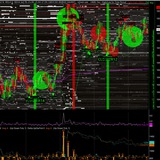
⚠️ R&D transparency: these are experimental results obtained on an MT5 demo environment. They are not audited live-account results, and past or simulated performance does not guarantee future profitability.
❤1👍1
A few people asked the right questions under my last post, so let’s put the numbers back into context.
Yes, this is an MT5 demo account.
But the market data itself is not synthetic.
The engine processes a real-time CQG feed from the CME futures market. Real prices, real volatility, real order flow, real regime changes.
The fills are simulated.
The market being observed is not.
Now, the obvious limitation:
This track record covers only around three days.
That is nowhere near enough to claim long-term robustness across months, seasons and multiple volatility regimes. Anyone pretending otherwise would be selling smoke in a lab coat.
But there is another dimension to the sample.
The system generated 648 executed trade events during the original statement, through an aggressive scale-in / scale-out architecture.
That is a very large execution sample, even if it remains a very small time and regime sample.
Those are not the same thing.
A system may trade only ten times over three months. Another may produce hundreds of executions in three days.
The first has more calendar history.
The second has more repeated execution events.
Neither dimension is sufficient alone.
The real question is what the sample actually allows us to study.
In this case, it gives us a dense first look at:
execution behavior, fill frequency, scale management, short-term recurrence, exposure time and the way the engine behaves inside detected RANGE regimes.
And exposure time matters far more than most people admit.
From the completed position cycles:
Average holding time: 10 minutes 10 seconds
Median holding time: 1 minute 2 seconds
79% of positions closed within five minutes
Some lasted only a few seconds.
Only a handful remained open for hours.
This raises a genuine risk-management question.
Imagine two systems both producing approximately 1% in one trading day.
System A takes two or three trades, but remains exposed for several hours, potentially through economic releases, liquidity shocks, regime changes and unexpected market events.
System B takes one hundred very short trades, closes most positions within seconds or minutes, and repeatedly returns to a flat, liquid state.
Which system is actually carrying more risk?
The obvious answer is not necessarily the correct one.
A high-frequency system introduces other risks:
more turnover, more fees, more execution dependency, more opportunities for correlated errors and potentially violent inventory accumulation during a failed regime classification.
But a slower system carries prolonged market exposure.
Every additional minute inside a position is another minute during which the market can mutate.
So risk is not only:
How much can I lose?
It is also:
How long am I exposed?
How quickly can I become flat?
How much inventory exists when the regime changes?
How dependent is the result on one continuous market assumption?
This is the philosophical divide.
Would you rather produce the same daily return through:
100 trades lasting seconds or minutes
or
2–3 trades lasting several hours?
One concentrates risk in execution frequency.
The other concentrates risk in time exposure.
And neither is automatically safer.
The real answer probably lives in the interaction between:
frequency, duration, position size, turnover, regime detection and tail-loss control.
That is precisely what the next stage of the research must measure.
The first results are extremely encouraging.
But the purpose of forward testing is not to celebrate the first equity curve.
It is to discover where the machine breaks before the market does it for us.
So what is your risk philosophy?
More trades, shorter exposure, faster return to flat?
Or fewer trades, longer exposure, and more time for each thesis to unfold?
Same target. Completely different risk architecture.
The debate is open. ⚡️
Yes, this is an MT5 demo account.
But the market data itself is not synthetic.
The engine processes a real-time CQG feed from the CME futures market. Real prices, real volatility, real order flow, real regime changes.
The fills are simulated.
The market being observed is not.
Now, the obvious limitation:
This track record covers only around three days.
That is nowhere near enough to claim long-term robustness across months, seasons and multiple volatility regimes. Anyone pretending otherwise would be selling smoke in a lab coat.
But there is another dimension to the sample.
The system generated 648 executed trade events during the original statement, through an aggressive scale-in / scale-out architecture.
That is a very large execution sample, even if it remains a very small time and regime sample.
Those are not the same thing.
A system may trade only ten times over three months. Another may produce hundreds of executions in three days.
The first has more calendar history.
The second has more repeated execution events.
Neither dimension is sufficient alone.
The real question is what the sample actually allows us to study.
In this case, it gives us a dense first look at:
execution behavior, fill frequency, scale management, short-term recurrence, exposure time and the way the engine behaves inside detected RANGE regimes.
And exposure time matters far more than most people admit.
From the completed position cycles:
Average holding time: 10 minutes 10 seconds
Median holding time: 1 minute 2 seconds
79% of positions closed within five minutes
Some lasted only a few seconds.
Only a handful remained open for hours.
This raises a genuine risk-management question.
Imagine two systems both producing approximately 1% in one trading day.
System A takes two or three trades, but remains exposed for several hours, potentially through economic releases, liquidity shocks, regime changes and unexpected market events.
System B takes one hundred very short trades, closes most positions within seconds or minutes, and repeatedly returns to a flat, liquid state.
Which system is actually carrying more risk?
The obvious answer is not necessarily the correct one.
A high-frequency system introduces other risks:
more turnover, more fees, more execution dependency, more opportunities for correlated errors and potentially violent inventory accumulation during a failed regime classification.
But a slower system carries prolonged market exposure.
Every additional minute inside a position is another minute during which the market can mutate.
So risk is not only:
How much can I lose?
It is also:
How long am I exposed?
How quickly can I become flat?
How much inventory exists when the regime changes?
How dependent is the result on one continuous market assumption?
This is the philosophical divide.
Would you rather produce the same daily return through:
100 trades lasting seconds or minutes
or
2–3 trades lasting several hours?
One concentrates risk in execution frequency.
The other concentrates risk in time exposure.
And neither is automatically safer.
The real answer probably lives in the interaction between:
frequency, duration, position size, turnover, regime detection and tail-loss control.
That is precisely what the next stage of the research must measure.
The first results are extremely encouraging.
But the purpose of forward testing is not to celebrate the first equity curve.
It is to discover where the machine breaks before the market does it for us.
So what is your risk philosophy?
More trades, shorter exposure, faster return to flat?
Or fewer trades, longer exposure, and more time for each thesis to unfold?
Same target. Completely different risk architecture.
The debate is open. ⚡️
👍2🔥2
Sharing this here first.
This morning, I started building something much bigger than a simple backtesting tool.
The objective is to create a fully autonomous agent capable of taking an EA, launching backtests across multiple instruments, distributing the workload across several MT5 workers, analyzing every result, modifying the parameters, and restarting the entire process automatically.
Again.
Again.
Again.
No manual optimization.
No endless clicking.
No emotional bias.
The agent keeps testing, eliminating weak configurations, learning from previous runs, and evolving its search until it finds a setup that is not only profitable, but also robust and repeatable.
The user experience should remain brutally simple:
Upload the EA.
Press START.
Let the engine work.
Behind that single button, however, there is a massive optimization infrastructure running in parallel.
I’m no longer trying to manually discover the perfect strategy.
I’m building the machine that searches for it on its own. 🧠⚙️
More behind-the-scenes updates soon.
This morning, I started building something much bigger than a simple backtesting tool.
The objective is to create a fully autonomous agent capable of taking an EA, launching backtests across multiple instruments, distributing the workload across several MT5 workers, analyzing every result, modifying the parameters, and restarting the entire process automatically.
Again.
Again.
Again.
No manual optimization.
No endless clicking.
No emotional bias.
The agent keeps testing, eliminating weak configurations, learning from previous runs, and evolving its search until it finds a setup that is not only profitable, but also robust and repeatable.
The user experience should remain brutally simple:
Upload the EA.
Press START.
Let the engine work.
Behind that single button, however, there is a massive optimization infrastructure running in parallel.
I’m no longer trying to manually discover the perfect strategy.
I’m building the machine that searches for it on its own. 🧠⚙️
More behind-the-scenes updates soon.
❤2
🚨 I JUST GAVE META TRADER 5 AN AUTONOMOUS AGENT.*
Not another indicator.
Not another dashboard.
Not another “AI-powered” label glued onto old software.
A real autonomous agent that connects directly to MT5 and does the backtesting work for you.
Meet:
NEXUS AUTOLAB MT5 V5
The idea is brutally simple:
Launch the EXE
Drag and drop your MT5 EA
Select your MT5 terminal, instrument and timeframe
Click START AUTOLAB
Then step back.
The agent launches MT5 by itself.
It opens multiple Strategy Tester workers.
It runs backtests across different instruments and parameter configurations in parallel.
For every test, it:
🧠 records the complete report
🧠 analyzes the statistics
🧠 identifies what worked and what failed
🧠 modifies the EA parameters
🧠 launches another round of backtests
🧠 repeats the process autonomously
Again.
And again.
And again.
Until it isolates the most promising configurations, market conditions, instruments and parameter regions for your EA.
You can literally watch your computer transform into a small autonomous research laboratory. ⚙️
The first time, it may look slightly terrifying. Multiple MT5 workers suddenly appear, tests begin, reports accumulate, and the agent keeps moving without waiting for human input.
But that is exactly the point.
A workload that normally requires hours or days of:
• manual backtesting
• parameter adjustments
• statistical analysis
• report comparison
• strategy validation
• repeated optimization
…is now handled by one autonomous agent.
It works with virtually any compatible MT5 Expert Advisor and across the instruments available in your MT5 terminal.
You can use your own EA, or start immediately with the included NEXUS_AI_ENGINE.
Available as:
✅ Standalone EXE
✅ No Python required
✅ No dependency nightmare
✅ Full Python source version also included
✅ Lifetime usage
✅ Future updates included free for life
This is not designed to magically guarantee profits.
It is designed to do something far more useful:
push your EA against reality.
To discover:
Where does it actually work?
Where does it break?
Which instruments suit it best?
Which settings are robust?
Which market regimes destroy it?
Where does a real edge begin to appear?
This is the beginning of a much larger agentic layer built around MetaTrader 5.
July 2026. The autonomous-agent era is no longer theoretical.
It is now running beside MT5.
🔥 Private Lifetime Launch Offer
€599 instead of €1,499
One payment.
Lifetime access.
Unlimited campaigns.
All future AUTOLAB updates included.
👉 https://metaquantuniverse.com/autolab
#MetaTrader5 #MT5 #AlgorithmicTrading #AutonomousAgent #AgenticAI #TradingAutomation #Backtesting #QuantTrading #ExpertAdvisor #ArtificialIntelligence #FinTech #METAquantUNIVERSE
Not another indicator.
Not another dashboard.
Not another “AI-powered” label glued onto old software.
A real autonomous agent that connects directly to MT5 and does the backtesting work for you.
Meet:
NEXUS AUTOLAB MT5 V5
The idea is brutally simple:
Launch the EXE
Drag and drop your MT5 EA
Select your MT5 terminal, instrument and timeframe
Click START AUTOLAB
Then step back.
The agent launches MT5 by itself.
It opens multiple Strategy Tester workers.
It runs backtests across different instruments and parameter configurations in parallel.
For every test, it:
🧠 records the complete report
🧠 analyzes the statistics
🧠 identifies what worked and what failed
🧠 modifies the EA parameters
🧠 launches another round of backtests
🧠 repeats the process autonomously
Again.
And again.
And again.
Until it isolates the most promising configurations, market conditions, instruments and parameter regions for your EA.
You can literally watch your computer transform into a small autonomous research laboratory. ⚙️
The first time, it may look slightly terrifying. Multiple MT5 workers suddenly appear, tests begin, reports accumulate, and the agent keeps moving without waiting for human input.
But that is exactly the point.
A workload that normally requires hours or days of:
• manual backtesting
• parameter adjustments
• statistical analysis
• report comparison
• strategy validation
• repeated optimization
…is now handled by one autonomous agent.
It works with virtually any compatible MT5 Expert Advisor and across the instruments available in your MT5 terminal.
You can use your own EA, or start immediately with the included NEXUS_AI_ENGINE.
Available as:
✅ Standalone EXE
✅ No Python required
✅ No dependency nightmare
✅ Full Python source version also included
✅ Lifetime usage
✅ Future updates included free for life
This is not designed to magically guarantee profits.
It is designed to do something far more useful:
push your EA against reality.
To discover:
Where does it actually work?
Where does it break?
Which instruments suit it best?
Which settings are robust?
Which market regimes destroy it?
Where does a real edge begin to appear?
This is the beginning of a much larger agentic layer built around MetaTrader 5.
July 2026. The autonomous-agent era is no longer theoretical.
It is now running beside MT5.
🔥 Private Lifetime Launch Offer
€599 instead of €1,499
One payment.
Lifetime access.
Unlimited campaigns.
All future AUTOLAB updates included.
👉 https://metaquantuniverse.com/autolab
#MetaTrader5 #MT5 #AlgorithmicTrading #AutonomousAgent #AgenticAI #TradingAutomation #Backtesting #QuantTrading #ExpertAdvisor #ArtificialIntelligence #FinTech #METAquantUNIVERSE
Metaquantuniverse
NEXUS AUTOLAB MT5 V5 — Autonomous MT5 Agent | Lifetime Launch Offer
NEXUS AUTOLAB MT5 V5 is an institutional-grade autonomous MT5 research and optimization agent. Works with virtually any MT5 EA, includes NEXUS_AI_ENGINE, available in Python source and ultra-simple EXE versions.
❤1👍1