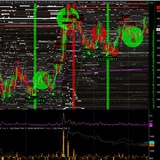
🚨 New educational video is ready.
Today, we go deep into one of the most powerful tools for orderflow traders:
How to Read an Orderbook Heatmap 📊🔥
This is not a basic “support and resistance” lesson.
We break down what is really happening inside the orderbook:
✅ displayed liquidity
✅ buy walls / sell walls
✅ absorption
✅ icebergs
✅ stacking & pulling
✅ stop runs
✅ failed breakouts
✅ breakout acceptance
✅ scalping entries, stops, and targets
The goal is to stop guessing and start reading the live battle between aggressive orders and passive liquidity.
Especially useful for futures traders on ES, NQ, and Gold.
https://www.youtube.com/watch?v=ujT-dAIZmAc
Watch it carefully, take notes, and replay the examples. This one can seriously upgrade the way you read price. 🧠⚡️
Today, we go deep into one of the most powerful tools for orderflow traders:
How to Read an Orderbook Heatmap 📊🔥
This is not a basic “support and resistance” lesson.
We break down what is really happening inside the orderbook:
✅ displayed liquidity
✅ buy walls / sell walls
✅ absorption
✅ icebergs
✅ stacking & pulling
✅ stop runs
✅ failed breakouts
✅ breakout acceptance
✅ scalping entries, stops, and targets
The goal is to stop guessing and start reading the live battle between aggressive orders and passive liquidity.
Especially useful for futures traders on ES, NQ, and Gold.
https://www.youtube.com/watch?v=ujT-dAIZmAc
Watch it carefully, take notes, and replay the examples. This one can seriously upgrade the way you read price. 🧠⚡️
YouTube
How to Read an Orderbook Heatmap Like a Pro Trader using 3D_NEXUS_META & NEXUS_DOM_HEATMAP_MT5
How to Read an Orderbook Heatmap | Orderflow Scalping Futures, Indices & Gold
https://metaquantuniverse.com/nexus
In this video, we break down how to read an orderbook heatmap like a professional orderflow trader.
If you trade futures, indices, gold,…
https://metaquantuniverse.com/nexus
In this video, we break down how to read an orderbook heatmap like a professional orderflow trader.
If you trade futures, indices, gold,…
🔥2❤1
BTCUSD is not moving.
It’s being engineered.
Spoofing. Icebergs. Absorption. HFT signals.
The order book is screaming manipulation.
Watch: https://youtu.be/rGhNSLtddFw
#BTCUSD #Bitcoin #Orderflow #HFT
It’s being engineered.
Spoofing. Icebergs. Absorption. HFT signals.
The order book is screaming manipulation.
Watch: https://youtu.be/rGhNSLtddFw
#BTCUSD #Bitcoin #Orderflow #HFT
YouTube
BTCUSD Price Is Being Engineered: HFT Signals, Spoofing & Absorption
In this BTCUSD Sunday afternoon session, we break down how the order book reveals much more than simple buying and selling.
https://metaquantuniverse.com/nexus
This video illustrates several key microstructure signals triggered in real time through 3D_NEXUS_META…
https://metaquantuniverse.com/nexus
This video illustrates several key microstructure signals triggered in real time through 3D_NEXUS_META…
GO WITH or FADE?
That’s the only question that matters in scalping.
Follow aggression when it moves price.
Fade it when it gets absorbed.
Most traders react to delta.
Pros read the result.
Watch: https://www.youtube.com/watch?v=DJbYk9vzunU
#Orderflow #Scalping #Liquidity
That’s the only question that matters in scalping.
Follow aggression when it moves price.
Fade it when it gets absorbed.
Most traders react to delta.
Pros read the result.
Watch: https://www.youtube.com/watch?v=DJbYk9vzunU
#Orderflow #Scalping #Liquidity
YouTube
GO WITH vs FADE is one of the most important decisions in market microstructure scalping.
Should you follow the aggressive orderflow, or should you fade it?
In this video, we break down the core logic behind GO WITH and FADE setups using the 3D_NEXUS_META liquidity terrain.
The key is not simply seeing aggressive buying or selling.
The real…
In this video, we break down the core logic behind GO WITH and FADE setups using the 3D_NEXUS_META liquidity terrain.
The key is not simply seeing aggressive buying or selling.
The real…
❤2🔥1
QUOTE STUFFING IN 2026: Microstructure Warfare Inside the Order Book
Quote stuffing is not simply “too many cancelled orders”.
It is an information-distortion technique applied directly to the order book.
The basic structure:
The objective is not necessarily to push price directly.
The objective may be to distort the signals read by algorithmic systems:
The order book acts as an information layer.
Quote stuffing attacks that layer.
Main Variants
1. Symmetric Saturation
Massive quote flow on both sides of the book.
Purpose: reduce book readability, increase noise, degrade depth signals.
2. Directional Stuffing
A burst concentrated on one side of the book to create apparent buying or selling pressure.
The pattern becomes suspicious if the displayed depth disappears without real execution and profitable execution appears elsewhere.
3. Layered Stuffing
False depth distributed across several price levels.
The objective is to avoid the obvious “single fake wall” pattern.
4. Touch-Level Stuffing
Activity concentrated around the best bid / best ask.
Potential impact:
5. Latency Stuffing
Here, the target is technical asymmetry.
Not all participants consume market data with the same latency:
A message burst can create relative advantage if some systems become slower at interpreting the book.
6. Cross-Venue Stuffing
Critical pattern in fragmented markets:
Highly relevant in:
Core Detection Metrics
Key Point
A high cancellation rate is not proof.
A legitimate market maker cancels constantly to manage:
Real detection depends on the sequence:
The most toxic signal is the combination of:
Final Thought
Modern quote stuffing does not only manipulate the market.
It manipulates the algorithms interpreting the market.
The order book becomes an attack surface.
Quotes become decoys.
Liquidity becomes contaminated signal.
And the real question is no longer:
“What is the price?”
But:
“Who manufactured the signal the machines just read?”
Quote stuffing is not simply “too many cancelled orders”.
It is an information-distortion technique applied directly to the order book.
The basic structure:
High order submission rate
High modification rate
High cancellation rate
Low genuine execution intent
Temporary distortion of displayed liquidity
Possible monetization elsewhere
The objective is not necessarily to push price directly.
The objective may be to distort the signals read by algorithmic systems:
best bid / best ask
spread
depth
order book imbalance
queue position
cancellation velocity
quote lifetime
liquidity half-life
cross-venue divergence
The order book acts as an information layer.
Quote stuffing attacks that layer.
Main Variants
1. Symmetric Saturation
Massive quote flow on both sides of the book.
Purpose: reduce book readability, increase noise, degrade depth signals.
High message intensity
High cancel-to-fill
Low execution participation
Short quote lifetime
2. Directional Stuffing
A burst concentrated on one side of the book to create apparent buying or selling pressure.
Bid-side quote burst → apparent buying pressure
Ask-side quote burst → apparent selling pressure
The pattern becomes suspicious if the displayed depth disappears without real execution and profitable execution appears elsewhere.
3. Layered Stuffing
False depth distributed across several price levels.
The objective is to avoid the obvious “single fake wall” pattern.
Multiple price levels
Short-lived displayed size
Repeated cancel / replace
Low fill ratio
Contra-side execution
4. Touch-Level Stuffing
Activity concentrated around the best bid / best ask.
Potential impact:
spread distortion
router reaction
queue reshuffling
NBBO / top-of-book signal pollution
short-term alpha model reaction
5. Latency Stuffing
Here, the target is technical asymmetry.
Not all participants consume market data with the same latency:
direct exchange feed
consolidated feed
broker API
retail dashboard
smart order router
surveillance engine
A message burst can create relative advantage if some systems become slower at interpreting the book.
6. Cross-Venue Stuffing
Critical pattern in fragmented markets:
Venue A: displayed quote noise
Venue B: real execution
Instrument C: hedge / monetization
Highly relevant in:
spot vs perp
ETF vs futures
options vs underlying
lit venue vs dark pool
CEX vs DEX
Core Detection Metrics
Message intensity =
submissions + modifications + cancellations / Δt

Cancel-to-fill =
cancelled orders / executed orders

Quote lifetime =
cancel timestamp - entry timestamp

Displayed liquidity half-life =
median survival time of displayed size

Distance from touch =
distance between order price and best bid / best ask

OBI_k =
(sum bid depth 1..k - sum ask depth 1..k)
/
(sum bid depth 1..k + sum ask depth 1..k)

Post-cancel reaction =
mid_price(t+h) - mid_price(t_cancel)

Cross-venue correlation =
quote bursts on Venue A vs executions on Venue B
Key Point
A high cancellation rate is not proof.
A legitimate market maker cancels constantly to manage:
inventory risk
adverse selection
spread changes
fair value updates
volatility shocks
Real detection depends on the sequence:
display liquidity
create imbalance
trigger reaction
execute elsewhere
cancel displayed liquidity
repeat
The most toxic signal is the combination of:
short-lived quotes
low fill ratio
directional imbalance
repeated cancel / replace
beneficial contra-side execution
cross-venue monetization
Final Thought
Modern quote stuffing does not only manipulate the market.
It manipulates the algorithms interpreting the market.
The order book becomes an attack surface.
Quotes become decoys.
Liquidity becomes contaminated signal.
And the real question is no longer:
“What is the price?”
But:
“Who manufactured the signal the machines just read?”
👍1🔥1
🚨 BIG UPDATE — 3D_NEXUS_META is now live with a major visual upgrade.
You can now fully customize the colors of the 3D orderbook map:
✅ BID vertical bars
✅ ASK vertical bars
✅ Buy volume bubbles
✅ Sell volume bubbles
But the real beast is here:
🧠 SMART VIEW CAMERA
A new intelligent camera mode that automatically adjusts its viewpoint, movements, translations, zoom and dezoom based on real-time orderbook activity.
The camera now reacts to the market structure itself.
Orderbook pressure, liquidity shifts, volume bursts, structural manipulation… everything becomes more visible, more immersive, more alive.
This is not just a view mode.
It feels like the map is watching the market with you.
It’s a banger, friends.
Test it now:
https://nexus-meta-auth.3dnexusmeta.workers.dev/
#Trading #Orderflow #CryptoTrading #3DVisualization #MarketStructure #3DNexusMeta
You can now fully customize the colors of the 3D orderbook map:
✅ BID vertical bars
✅ ASK vertical bars
✅ Buy volume bubbles
✅ Sell volume bubbles
But the real beast is here:
🧠 SMART VIEW CAMERA
A new intelligent camera mode that automatically adjusts its viewpoint, movements, translations, zoom and dezoom based on real-time orderbook activity.
The camera now reacts to the market structure itself.
Orderbook pressure, liquidity shifts, volume bursts, structural manipulation… everything becomes more visible, more immersive, more alive.
This is not just a view mode.
It feels like the map is watching the market with you.
It’s a banger, friends.
Test it now:
https://nexus-meta-auth.3dnexusmeta.workers.dev/
#Trading #Orderflow #CryptoTrading #3DVisualization #MarketStructure #3DNexusMeta
👏2❤1
🔥 BIG UPDATE FOR 3D_NEXUS_META MEMBERS 🔥
My friends, this is a big one.
We have just completed and validated a brand-new CQG WebAPI Bridge for 3D_NEXUS_META.
This means NEXUS can now connect more directly to CQG market data, with a cleaner professional-grade feed, deeper market depth, smoother updates, and a much more fluid order flow experience inside the 3D cockpit.
The bridge is now running perfectly on the DATA / READ side:
✅ live liquidity visible inside the 3D map
✅ volume flowing into the Tape
✅ Depth of Market updates
✅ cleaner Level 2 structure
✅ smoother refresh
✅ more professional futures data pipeline
✅ fully integrated into 3D_NEXUS_META
✅ simple user GUI with credentials + START button
Technically, this new bridge acts as a local translator between CQG WebAPI and NEXUS.
CQG sends the market data through its WebAPI layer, the bridge receives and normalizes the book/trade updates, then NEXUS renders everything in real time inside the 3D order flow environment.
In simple words:
CQG WebAPI → Local CQG Bridge → 3D_NEXUS_META → full 3D DOM / Tape / liquidity map.
This opens a new level for NEXUS.
More direct connection.
More depth.
More updates per second.
More fluidity.
More professional futures order flow.
The bridge is available now for all 3D_NEXUS_META members.
Download the CQG NEXUS Bridge here:
https://metaquantuniverse.com/download/CQG_NEXUS_BRIDGE_v3.zip
You just enter your CQG credentials in the small GUI, click START, open NEXUS online, select CQG Futures, and enjoy the flow.
Of course, your CQG account still needs the required market data / WebAPI permissions from your broker or CQG provider, but on the NEXUS side, the integration is ready.
Enjoy it my freros.
This is the next level opening for 3D_NEXUS_META. 🚀
My friends, this is a big one.
We have just completed and validated a brand-new CQG WebAPI Bridge for 3D_NEXUS_META.
This means NEXUS can now connect more directly to CQG market data, with a cleaner professional-grade feed, deeper market depth, smoother updates, and a much more fluid order flow experience inside the 3D cockpit.
The bridge is now running perfectly on the DATA / READ side:
✅ live liquidity visible inside the 3D map
✅ volume flowing into the Tape
✅ Depth of Market updates
✅ cleaner Level 2 structure
✅ smoother refresh
✅ more professional futures data pipeline
✅ fully integrated into 3D_NEXUS_META
✅ simple user GUI with credentials + START button
Technically, this new bridge acts as a local translator between CQG WebAPI and NEXUS.
CQG sends the market data through its WebAPI layer, the bridge receives and normalizes the book/trade updates, then NEXUS renders everything in real time inside the 3D order flow environment.
In simple words:
CQG WebAPI → Local CQG Bridge → 3D_NEXUS_META → full 3D DOM / Tape / liquidity map.
This opens a new level for NEXUS.
More direct connection.
More depth.
More updates per second.
More fluidity.
More professional futures order flow.
The bridge is available now for all 3D_NEXUS_META members.
Download the CQG NEXUS Bridge here:
https://metaquantuniverse.com/download/CQG_NEXUS_BRIDGE_v3.zip
You just enter your CQG credentials in the small GUI, click START, open NEXUS online, select CQG Futures, and enjoy the flow.
Of course, your CQG account still needs the required market data / WebAPI permissions from your broker or CQG provider, but on the NEXUS side, the integration is ready.
Enjoy it my freros.
This is the next level opening for 3D_NEXUS_META. 🚀
❤1👍1🔥1