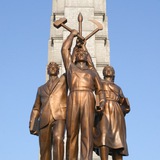
KCNA: Speakers at the ceremonies said that the revolution for regional development has entered a new high stage under the outstanding and experienced guidance of the respected Comrade Kim Jong Un who has opened up an era of transformation, the greatest ever since the founding of the nation, regarding it as the supreme principle of activities of the Party and the state to actualize the ideal of the people.
Proving the truthfulness and vitality of the regional revolution guided by the WPK, light industrial factories, hospitals and leisure complexes will spring up in Hwaphyong, Phyonggang, Myonggan and Samsu counties and a modern offshore farm will be built in Riwon County, they noted.
Saying that regional development will bring bigger transformation and the vigorous advance of the country toward a rosy future will be accelerated under the leadership of Kim Jong Un, they called upon all the people to dedicate their patriotic strength and enthusiasm to the prosperity of the country.
Proving the truthfulness and vitality of the regional revolution guided by the WPK, light industrial factories, hospitals and leisure complexes will spring up in Hwaphyong, Phyonggang, Myonggan and Samsu counties and a modern offshore farm will be built in Riwon County, they noted.
Saying that regional development will bring bigger transformation and the vigorous advance of the country toward a rosy future will be accelerated under the leadership of Kim Jong Un, they called upon all the people to dedicate their patriotic strength and enthusiasm to the prosperity of the country.
❤🔥3
KCNA:Pencil Drawing Festival Opens in DPRK
The 11th National Pencil Drawing Festival opened in the DPRK to celebrate the 84th birth anniversary of Chairman Kim Jong Il.
Presented to the festival are more than 390 pencil drawings with diverse themes and forms created by artists, amateurs and schoolchildren in different parts of the country.
On display at the festival venue are drawings dealing with the noble revolutionary career and immortal exploits of Kim Jong Il.
Among the exhibits are drawings of people enjoying new life and new civilization to their heart's content in the picturesque villages, precious fruits of the regional development policy, which have been built all over the country year after year under the wise leadership of the great Workers' Party of Korea Central Committee.
The 11th National Pencil Drawing Festival opened in the DPRK to celebrate the 84th birth anniversary of Chairman Kim Jong Il.
Presented to the festival are more than 390 pencil drawings with diverse themes and forms created by artists, amateurs and schoolchildren in different parts of the country.
On display at the festival venue are drawings dealing with the noble revolutionary career and immortal exploits of Kim Jong Il.
Among the exhibits are drawings of people enjoying new life and new civilization to their heart's content in the picturesque villages, precious fruits of the regional development policy, which have been built all over the country year after year under the wise leadership of the great Workers' Party of Korea Central Committee.
❤🔥4
Admin’s note: does DPRK want communism?
-Kim Jong Il in the volume 12 of his Selected Works
An interesting question must be raised: how does Juche idea envision a communist society?
We can categorize these in the two parts :
Politics
As Marx and Engels believe, DPRK plans the withering away of the state when it will be no more threatened by capitalist encirclement (like USSR, Albania or China).
This withering away is explained by Engels in Anti-Duhring as the replacement of "government of people" by the "administration of things" after State seizes all property in the name of society.
But DPRK asks the question: what is this administration of things? Is it a technocratic power, without any kind of political lines? No.
-Pak Yong Gon, in The World Outlook of Juche
What can we deduce from this quote? Simply that, by intense socialization of all aspects of society, the men will become managers of themselves and their common good (in short starting an ideological revolution). A communist being is someone who becomes a new human being, a genius in both manual and intellectual labor, capable of mastering himself and society, without use of a class dictatorship and a party exercising it.
Economics
The goal of a communist society, outside of continuing complete socialist society (all-people ownership, abolition of commodity production and money) is mostly production to each according to his needs. This is based on higher productivity and advancement of ideological Revolution.
-Juche Political Economy Textbook.
So we can conclude by stating that communist society as envisioned by DPRK is at the same time very similar to the orthodox Marxist idea (classless society, withering away of state, abolition of mental/labor differences, to each according to his needs) while removing the technocratic and economist ideas of Marxism.
This is up to you to see if this is compatible with what you would call a communist society.
In short, a communist society is a society in which the popular masses are guaranteed full independence
-Kim Jong Il in the volume 12 of his Selected Works
An interesting question must be raised: how does Juche idea envision a communist society?
We can categorize these in the two parts :
Politics
As Marx and Engels believe, DPRK plans the withering away of the state when it will be no more threatened by capitalist encirclement (like USSR, Albania or China).
This withering away is explained by Engels in Anti-Duhring as the replacement of "government of people" by the "administration of things" after State seizes all property in the name of society.
But DPRK asks the question: what is this administration of things? Is it a technocratic power, without any kind of political lines? No.
When an ideal society comes into being, the tendency to monopolize political power and politics will vanish forever on the basis of the complete socialization of the economy, culture and all other spheres of social life, and the overall socialization of political power and politics will be realized both in name and reality. The socialization of political power and politics in a future society means not that they wither away but that all the members of society become full-fledged masters of them. Only then will political power become fully the power of command of society and politics, the work of administering people in conformity with joint requirements and interests of society.
-Pak Yong Gon, in The World Outlook of Juche
What can we deduce from this quote? Simply that, by intense socialization of all aspects of society, the men will become managers of themselves and their common good (in short starting an ideological revolution). A communist being is someone who becomes a new human being, a genius in both manual and intellectual labor, capable of mastering himself and society, without use of a class dictatorship and a party exercising it.
Economics
The goal of a communist society, outside of continuing complete socialist society (all-people ownership, abolition of commodity production and money) is mostly production to each according to his needs. This is based on higher productivity and advancement of ideological Revolution.
The most important economic problem that must be solved in order to consolidate and develop a completely victorious socialist society and transition to communism is, above all, to create conditions for distribution based on demand.
We must accelerate the technological revolution and elevate production to a high scientific and technological level. To this end, production processes must be mechanized, automated, robotized and computerized. This will eliminate the distinction between mental and physical labor by reducing people’s physical strength in production. Furthermore, by ensuring that the economy can be managed and operated only by producers with high levels of knowledge and skill, it will stimulate the improvement of producers’ technical skills, making physical labor no different from the mental labor of engineers and specialists.
-Juche Political Economy Textbook.
So we can conclude by stating that communist society as envisioned by DPRK is at the same time very similar to the orthodox Marxist idea (classless society, withering away of state, abolition of mental/labor differences, to each according to his needs) while removing the technocratic and economist ideas of Marxism.
This is up to you to see if this is compatible with what you would call a communist society.
❤🔥4
DPRK News
Admin’s note: does DPRK want communism? In short, a communist society is a society in which the popular masses are guaranteed full independence -Kim Jong Il in the volume 12 of his Selected Works An interesting question must be raised: how does Juche idea…
Admin’s note: how does DPRK differentiate complete socialism from communism and from the socialist state it currently is? Why does DPRK believe class struggle is still continuing, contrary to Stalin ? (Originally a reply to a follower of this channel, Renee, that I thank for her question!)
To be honest, the fact that Stalin declared the end of class struggle is a common misconception used by Trotskyites, Khrushevites and Maoists that I myself don’t believe in, but since they are common thesis I preferred to use them without elaborating, simplifying the real critique DPRK has about Stalin.
Basically their argument is this quote in 1939, 18th party Congress of CPSU(B):
Unfortunately for them this contradicts everything Stalin explained about the intensification of class struggle under socialism (see his works against "right deviation" in 1928-1929), the evolution of socialism (see "economic problems of socialism" where he clearly talks about restauration of capitalism if economists’ lines triumph) or even the necessary struggle against bureaucracy (see "Mastering Bolshevism").
What is true is that Stalin claimed to reach socialism, first-stage communism, which is criticized by DPRK as a mistake that leads to revisionism, but this needs a long explanation : normally, the basis of socialism are socialization of means of production, distribution according to labor and central planning for social need. Yes, they were reached, this is why Soviet Union was a socialist society which abolished exploitation of man by man and where production was done to satisfy the cultural and material interests of the people.
But according to President Kim Il-Sung in his work "On the Questions of the Period of Transition From Capitalism to Socialism and the Dictatorship of the Proletariat",the first-stage socialism will be attained only when the entirety of means of production, including agriculture, will be socialized, and money, law of value and commodity production abolished.
For Kim Il-Sung (he doesn’t mention directly Stalin or Soviets in this work, this is DPRK economists and philosophers who will build on it), Stalin mixed up two concepts : dictatorship of proletariat and transition period towards socialism. The dictatorship of the prolerariat indeed lasts from first basis of socialism towards final state communism, while transition is from the basis towards first-stage socialism.
By this logic, due to Stalin’s mistake, Soviet leaders after him will logically regard socialism reached and give up dictatorship of prolerariat, using this mix up to its fullest conclusion.
Meanwhile, DPRK, despite, having exactly the same economic principles as Soviet 1936 constitution, doesn’t proclaim having attained first-stage socialism, for them, it is supposed to be reached when money-system is abolished and farms are socialized. To quote Juche Political Economy Textbook:
To be honest, the fact that Stalin declared the end of class struggle is a common misconception used by Trotskyites, Khrushevites and Maoists that I myself don’t believe in, but since they are common thesis I preferred to use them without elaborating, simplifying the real critique DPRK has about Stalin.
Basically their argument is this quote in 1939, 18th party Congress of CPSU(B):
The feature that distinguishes Soviet society today from any capitalist society is that it no longer contains antagonistic, hostile classes; that the exploiting classes have been eliminated, while the workers, peasants and intellectuals, who make up Soviet society, live and work in friendly collaboration. Whereas capitalist society is torn by irreconcilable antagonisms between workers and capitalists and between peasants and landlords -- resulting in its internal instability -- Soviet society, liberated from the yoke of exploitation, knows no such antagonisms, is free of class conflicts, and presents a picture of friendly collaboration between workers, peasants and intellectuals. It is this community of interest which has formed the basis for the development of such motive forces as the moral and political unity of Soviet society (…).
Unfortunately for them this contradicts everything Stalin explained about the intensification of class struggle under socialism (see his works against "right deviation" in 1928-1929), the evolution of socialism (see "economic problems of socialism" where he clearly talks about restauration of capitalism if economists’ lines triumph) or even the necessary struggle against bureaucracy (see "Mastering Bolshevism").
What is true is that Stalin claimed to reach socialism, first-stage communism, which is criticized by DPRK as a mistake that leads to revisionism, but this needs a long explanation : normally, the basis of socialism are socialization of means of production, distribution according to labor and central planning for social need. Yes, they were reached, this is why Soviet Union was a socialist society which abolished exploitation of man by man and where production was done to satisfy the cultural and material interests of the people.
But according to President Kim Il-Sung in his work "On the Questions of the Period of Transition From Capitalism to Socialism and the Dictatorship of the Proletariat",the first-stage socialism will be attained only when the entirety of means of production, including agriculture, will be socialized, and money, law of value and commodity production abolished.
For Kim Il-Sung (he doesn’t mention directly Stalin or Soviets in this work, this is DPRK economists and philosophers who will build on it), Stalin mixed up two concepts : dictatorship of proletariat and transition period towards socialism. The dictatorship of the prolerariat indeed lasts from first basis of socialism towards final state communism, while transition is from the basis towards first-stage socialism.
By this logic, due to Stalin’s mistake, Soviet leaders after him will logically regard socialism reached and give up dictatorship of prolerariat, using this mix up to its fullest conclusion.
Meanwhile, DPRK, despite, having exactly the same economic principles as Soviet 1936 constitution, doesn’t proclaim having attained first-stage socialism, for them, it is supposed to be reached when money-system is abolished and farms are socialized. To quote Juche Political Economy Textbook:
The first characteristic of economic relations in a completely victorious socialist society is that they are based on the sole control of the entire people over the means of production. (…) cooperative ownership is transformed into all-people ownership.
❤🔥2❤1
DPRK News
Admin’s note: does DPRK want communism? In short, a communist society is a society in which the popular masses are guaranteed full independence -Kim Jong Il in the volume 12 of his Selected Works An interesting question must be raised: how does Juche idea…
(…) The second characteristic (…) is that the relationship of comradely cooperation and assistance among people in economic activities is further strengthened and developed.(…) class differences between the working class and the peasantry disappear, and the technological revolution is carried out at a higher level, greatly reducing the differences in physical labor. (…) Thirdly, the characteristic the demand for the law of distribution according to labor is realized in a new form. (…) And unlike the previous period when distribution according to labor was ultimately realized through commerce, it will be realized through a complete supply system. (…) With the sole dominance of ownership by the entire people, commodity production and exchange cease, and the economic categories that reflect the law of value and commodity-money relations in their own sense cease to function. On the other hand, the economic laws and economic categories that reflect the nature of the socialist economic system come into play more comprehensively, and its demands are more thoroughly implemented.
This is also why DPRK is currently developing countryside as the news I post since I have started this channel show, because DPRK plans to modernize agriculture and prepare for nationalization of all means of production alongside end of commodity production soon. Kim Jong-Un recently claimed to reach socialism, first-stage communism, by 10 years (2035), if no accident happens on the road.
❤🔥4