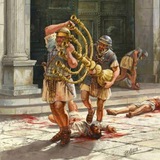
Forwarded from 70 A.D.
The suovetaurilia or suovitaurilia was one of the most sacred and traditional rites of Roman religion: the sacrifice of a pig (sus), a sheep (ovis) and a bull (taurus) to the deity Mars to bless and purify land (Lustratio).
If a temple were destroyed, the site of the temple must be purified by a suovetaurilia.
According to Professor Watts, professor of New Testament at Regent College, “No Roman tomb was legally protected without a pig being sacrificed.” Obviously, the Temple in Jerusalem was littered with the bodies of dead Roman soldiers in A.D. 70. Also citing K.M.T. Atkinson, Brain Incigneri points out “that the Romans would sacrifice a pig before the standards [ensigns] at the taking of a military oath, sacramentum militare, shown in coins of the first century BCE.” The sacramentum militare was the oath taken by soldiers to pledge their loyalty to the emperor.
If a temple were destroyed, the site of the temple must be purified by a suovetaurilia.
According to Professor Watts, professor of New Testament at Regent College, “No Roman tomb was legally protected without a pig being sacrificed.” Obviously, the Temple in Jerusalem was littered with the bodies of dead Roman soldiers in A.D. 70. Also citing K.M.T. Atkinson, Brain Incigneri points out “that the Romans would sacrifice a pig before the standards [ensigns] at the taking of a military oath, sacramentum militare, shown in coins of the first century BCE.” The sacramentum militare was the oath taken by soldiers to pledge their loyalty to the emperor.
❤1
Forwarded from 70 A.D.
"And now the Romans, upon the flight of the seditious into the city, and upon the burning of the holy house itself, and of all the buildings round about it, brought their ensigns to the temple. . .and there did they offer sacrifices to them, and there did they make Titus imperator." (Wars 6.6.1.)
"This is the wicked Titus, who insulted and blasphemed God on High. What did Titus do when he conquered the Temple? He took a prostitute with his hand, and entered the Holy of Holies with her. He then spread out a Torah scroll underneath him and committed a sin, i.e., engaged in sexual intercourse, on it. Afterward he took a sword and cut into the curtain separating between the Sanctuary and the Holy of Holies. And a miracle was performed and blood spurted forth. Seeing the blood, he mistakenly thought that he had killed God. Titus saw blood issuing forth from the curtain in God’s meeting place, the Temple, and he took it as a sign that he had succeeded in killing God Himself. As it is stated: “Your enemies roar in the midst of Your meeting place; they have set up their own signs for signs” - Babylonian Talmud: Gittin 56b
"After this, the Romans quenched the fire, and set up their idols and images in the temple, offering burnt-offerings unto them, and blaspheming, mocking and railing at the jews, and their laws, in prefence of their idols." - Joseph Ben Gorion's Yosippon
"This is the wicked Titus, who insulted and blasphemed God on High. What did Titus do when he conquered the Temple? He took a prostitute with his hand, and entered the Holy of Holies with her. He then spread out a Torah scroll underneath him and committed a sin, i.e., engaged in sexual intercourse, on it. Afterward he took a sword and cut into the curtain separating between the Sanctuary and the Holy of Holies. And a miracle was performed and blood spurted forth. Seeing the blood, he mistakenly thought that he had killed God. Titus saw blood issuing forth from the curtain in God’s meeting place, the Temple, and he took it as a sign that he had succeeded in killing God Himself. As it is stated: “Your enemies roar in the midst of Your meeting place; they have set up their own signs for signs” - Babylonian Talmud: Gittin 56b
"After this, the Romans quenched the fire, and set up their idols and images in the temple, offering burnt-offerings unto them, and blaspheming, mocking and railing at the jews, and their laws, in prefence of their idols." - Joseph Ben Gorion's Yosippon
👍7
The word Preterism is from the Latin "prae" (before) and "ire" (to go), whose past participle is "praeteritus," meaning the subject has gone past. The word occurs in the future tense in the Latin Vulgate at Matt. 24:34 thus: "non praeteribit haec generatio donec omnia haec fiant" ("this generation shall not pass until all these things be fulfilled"). Preterism takes a contemporary-historical view of eschatology, holding that Revelation and related prophecies describe events contemporary to those to whom they were addressed. Specifically, Preterism views the latter days and second coming as being bound up in the world events marked by the persecution of Nero Caesar (AD 64-68), the Roman civil wars that erupted upon Nero's death ("the year of four emperors") (AD 68-70), and the destruction of Jerusalem by Rome (AD 67-70).
❤7👍1
70 A.D.
Photo
The “times of the Gentiles” spoke to the dominion of unbelievers over the Israel of God. Gentile dominion began with the captivity in Babylon and continued for more than 500 years until the destruction of the Jewish state at the close of the Mosaic economy in A.D. 70. The times of the Gentiles expired where the kingdom of Christ began. In Christ the kingdom is restored to Israel and the throne to the house of David. Because the kingdom of God is spiritual and is not nationally constituted, none can conquer or have dominion over it, but Christ alone. “And the kingdom and dominion, and the greatness of the kingdom under the whole heaven, shall be given to the people of the saints of the most High, whose kingdom is an everlasting kingdom, and all dominions shall serve and obey him.” (Daniel 7:27)
❤15👍1
For then must he often have suffered since the foundation of the world: but now once in the end of the world hath he appeared to put away sin by the sacrifice of himself. And as it is appointed unto men once to die, but after this the judgment: so Christ was once offered to bear the sins of many; and unto them that look for him shall he appear the second time without sin unto salvation. Hebrews 9:26 - 28
Jesus died at the end of the world (age). Salvation wasn't complete until his second coming.
If Christ's second coming is still future, how are you saved?
Jesus died at the end of the world (age). Salvation wasn't complete until his second coming.
If Christ's second coming is still future, how are you saved?
👍14🔥3
Forwarded from 70 A.D.
According to 1 Enoch 10.12, the judgement was to occur seventy generations from Enoch, during which time the angels who sinned against God were to be kept in bonds until the day of consummation, the great judgement in which the age shall be consummated. 16.1-2
It should be noted that according to Luke, who claims to have "traced the course of all things accurately from the first", there are exactly seventy generations from Enoch to Jesus Christ. In other words, it would not have been presumptuous for Jude to claim that 1 Enoch addressed the concerns of the Christians to whom he wrote. The generation of Jesus Christ had not yet passed away. 70 AD was within that context. (See Jude 1:6; 14-15)
"And all these things as types did happen to those persons, and they were written for our admonition, upon whom the consummation of the ages did come." (1 Corinthians 10:11)
"Know ye not that we shall judge angels? how much more things that pertain to this life?" (1 Corinthians 6:3)
It should be noted that according to Luke, who claims to have "traced the course of all things accurately from the first", there are exactly seventy generations from Enoch to Jesus Christ. In other words, it would not have been presumptuous for Jude to claim that 1 Enoch addressed the concerns of the Christians to whom he wrote. The generation of Jesus Christ had not yet passed away. 70 AD was within that context. (See Jude 1:6; 14-15)
"And all these things as types did happen to those persons, and they were written for our admonition, upon whom the consummation of the ages did come." (1 Corinthians 10:11)
"Know ye not that we shall judge angels? how much more things that pertain to this life?" (1 Corinthians 6:3)
👍9❤2
"Strictly speaking, it is incorrect to call an ancient Israelite a "jew" or to call a contemporary jew an "Israelite" or a "Hebrew."
- jewish Almanac, October 1980, pg.3 "Identity Crisis"
- jewish Almanac, October 1980, pg.3 "Identity Crisis"
👍20👏3
Foundations of Fullfilled Eschatology .pdf
510.2 KB
The Sword and the Plow: Foundations of Fulfilled Eschatology, Newsletter, 2014
❤5
AnteNiceneFathers - Volume I.pdf
55.2 MB
The Ante-Nicene Fathers, Translations of the Writings of the Fathers Down to A.D. 325, Volume I, 1887
AnteNiceneFathers - Volume II.pdf
50.8 MB
The Ante-Nicene Fathers, Translations of the Writings of the Fathers Down to A.D. 325, Volume II
AnteNiceneFathers - Volume III.pdf
73 MB
The Ante-Nicene Fathers, Translations of the Writings of the Fathers Down to A.D. 325, Volume III
AnteNiceneFathers - Volume IV.pdf
64.7 MB
The Ante-Nicene Fathers, Translations of the Writings of the Fathers Down to A.D. 325, Volume IV