Forwarded from 70 A.D.
First century Laodicea was a renowned centre of banking, finance, fashion, and pharmaceuticals. However, in spite of its great wealth, the city had one major problem. It had no ready source of water.
As such, water had to be piped in through aqueducts from two different sources.
One came from the hot springs in Hierapolis six miles to the north. The other came from a cooler source in Colossae, which was located 10 miles to the east. But, regardless of whether the original water source was hot or cold, it was lukewarm by the time it reached the city of Laodicea.
"So then because thou art lukewarm, and neither cold nor hot, I will spew thee out of my mouth. Because thou sayest, I am rich, and increased with goods, and have need of nothing." Revelation 3:16-17
Laodicea was destroyed by a disastrous earthquake in 62 AD (Tacitus, Annals, 14.27), under the reign of Nero. The only other cities to sustain significant damage, were Colossae and Hierapolis. (Eusebius, Chron. Olymp. 210.4).
As such, water had to be piped in through aqueducts from two different sources.
One came from the hot springs in Hierapolis six miles to the north. The other came from a cooler source in Colossae, which was located 10 miles to the east. But, regardless of whether the original water source was hot or cold, it was lukewarm by the time it reached the city of Laodicea.
"So then because thou art lukewarm, and neither cold nor hot, I will spew thee out of my mouth. Because thou sayest, I am rich, and increased with goods, and have need of nothing." Revelation 3:16-17
Laodicea was destroyed by a disastrous earthquake in 62 AD (Tacitus, Annals, 14.27), under the reign of Nero. The only other cities to sustain significant damage, were Colossae and Hierapolis. (Eusebius, Chron. Olymp. 210.4).
🔥2👍1🤔1
Forwarded from 70 A.D.
“For behold, the Lord will come in fire and His chariots like the whirlwind, to render His anger with fury, and His rebuke with flames of fire.” Isaiah 66:15
“This will happen when the Lord Jesus is revealed from heaven in blazing fire with his powerful angels.” 2 Thessalonians 1:7
"And I saw, and behold a white horse: and he that sat on him had a bow; and a crown was given unto him: and he went forth conquering, and to conquer."
Revelation 6:2
"And I saw heaven opened, and behold a white horse; and he that sat upon him was called Faithful and True, and in righteousness he doth judge and make war. And the armies which were in heaven followed him upon white horses, clothed in fine linen, white and clean."
Revelation 19:11, 14
Be sure and read those historic accounts. Fascinating stuff.
“This will happen when the Lord Jesus is revealed from heaven in blazing fire with his powerful angels.” 2 Thessalonians 1:7
"And I saw, and behold a white horse: and he that sat on him had a bow; and a crown was given unto him: and he went forth conquering, and to conquer."
Revelation 6:2
"And I saw heaven opened, and behold a white horse; and he that sat upon him was called Faithful and True, and in righteousness he doth judge and make war. And the armies which were in heaven followed him upon white horses, clothed in fine linen, white and clean."
Revelation 19:11, 14
Be sure and read those historic accounts. Fascinating stuff.
❤2🔥1
Forwarded from 70 A.D.
The third oldest Bible in the world features the four Gospels written in Koine Greek. It is known as the Codex Washingtonianus, the Codex Freerianus or the Washington Gospels, and is over 1,600 years old.
What makes this Codex special, is the passage inserted at the end of the gospel of Mark, known as the "Freer Logion".
In this passage, Jesus tells the disciples that the term of years of satan's power has been fulfilled, but that other terrible things draw near.
St. Jerome not only quoted this passage, but also reported that the Freer Logion appeared in the Gospel of Mark after 16:14 “especially in Greek codices.”
The number of these manuscripts that exist today and which are known to contain this interpolation is exactly one: Codex Washingtonianus
"Now is the judgment of this world: now shall the prince of this world be cast out."
(John 12:31)
What makes this Codex special, is the passage inserted at the end of the gospel of Mark, known as the "Freer Logion".
In this passage, Jesus tells the disciples that the term of years of satan's power has been fulfilled, but that other terrible things draw near.
St. Jerome not only quoted this passage, but also reported that the Freer Logion appeared in the Gospel of Mark after 16:14 “especially in Greek codices.”
The number of these manuscripts that exist today and which are known to contain this interpolation is exactly one: Codex Washingtonianus
"Now is the judgment of this world: now shall the prince of this world be cast out."
(John 12:31)
👍6🤔1
The Habakkuk Commentary or Pesher Habakkuk, labelled 1QpHab
The main character of the commentary is the "Teacher of Righteousness" who is contrasted and attacked by the "Wicked Priest."
Pesher - "explanation"
Preshru - "they explain"
Peshru about the priests of Jerusalem, The final (end time) ones who gather up wealth and take a cut from the spoils of the peoples, and for the Last Days they give their wealth with spoil into the hands of the Roman army. (spatium) Because they (the spoils) are that which remains of the peoples.
-------------------------
Go to now, ye rich men, weep and howl for your miseries that shall come upon you. Your riches are corrupted, and your garments are moth-eaten. Your gold and silver is cankered; and the rust of them shall be a witness against you, and shall eat your flesh as it were fire. Ye have heaped treasure together for the last days.
James 5:1 - 3
The main character of the commentary is the "Teacher of Righteousness" who is contrasted and attacked by the "Wicked Priest."
Pesher - "explanation"
Preshru - "they explain"
Peshru about the priests of Jerusalem, The final (end time) ones who gather up wealth and take a cut from the spoils of the peoples, and for the Last Days they give their wealth with spoil into the hands of the Roman army. (spatium) Because they (the spoils) are that which remains of the peoples.
-------------------------
Go to now, ye rich men, weep and howl for your miseries that shall come upon you. Your riches are corrupted, and your garments are moth-eaten. Your gold and silver is cankered; and the rust of them shall be a witness against you, and shall eat your flesh as it were fire. Ye have heaped treasure together for the last days.
James 5:1 - 3
👍1🔥1
70 A.D.
The Habakkuk Commentary or Pesher Habakkuk, labelled 1QpHab The main character of the commentary is the "Teacher of Righteousness" who is contrasted and attacked by the "Wicked Priest." Pesher - "explanation" Preshru - "they explain" Peshru about the…
I find it interesting that the translator states "the conclusions of some, linking this work to early Christian beginnings, is very speculative indeed."
Not speculative at all. At the end of the commentary is this quote... "Peshru about the "Priest" who is more proud of his shame than of his glory because he is not circumcised with the circumcision of his heart and he goes on his way."
Not speculative at all. At the end of the commentary is this quote... "Peshru about the "Priest" who is more proud of his shame than of his glory because he is not circumcised with the circumcision of his heart and he goes on his way."
👍1
Forwarded from 70 A.D.
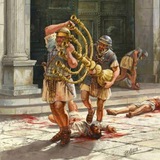
The suovetaurilia or suovitaurilia was one of the most sacred and traditional rites of Roman religion: the sacrifice of a pig (sus), a sheep (ovis) and a bull (taurus) to the deity Mars to bless and purify land (Lustratio).
If a temple were destroyed, the site of the temple must be purified by a suovetaurilia.
According to Professor Watts, professor of New Testament at Regent College, “No Roman tomb was legally protected without a pig being sacrificed.” Obviously, the Temple in Jerusalem was littered with the bodies of dead Roman soldiers in A.D. 70. Also citing K.M.T. Atkinson, Brain Incigneri points out “that the Romans would sacrifice a pig before the standards [ensigns] at the taking of a military oath, sacramentum militare, shown in coins of the first century BCE.” The sacramentum militare was the oath taken by soldiers to pledge their loyalty to the emperor.
If a temple were destroyed, the site of the temple must be purified by a suovetaurilia.
According to Professor Watts, professor of New Testament at Regent College, “No Roman tomb was legally protected without a pig being sacrificed.” Obviously, the Temple in Jerusalem was littered with the bodies of dead Roman soldiers in A.D. 70. Also citing K.M.T. Atkinson, Brain Incigneri points out “that the Romans would sacrifice a pig before the standards [ensigns] at the taking of a military oath, sacramentum militare, shown in coins of the first century BCE.” The sacramentum militare was the oath taken by soldiers to pledge their loyalty to the emperor.
❤1
Forwarded from 70 A.D.
"And now the Romans, upon the flight of the seditious into the city, and upon the burning of the holy house itself, and of all the buildings round about it, brought their ensigns to the temple. . .and there did they offer sacrifices to them, and there did they make Titus imperator." (Wars 6.6.1.)
"This is the wicked Titus, who insulted and blasphemed God on High. What did Titus do when he conquered the Temple? He took a prostitute with his hand, and entered the Holy of Holies with her. He then spread out a Torah scroll underneath him and committed a sin, i.e., engaged in sexual intercourse, on it. Afterward he took a sword and cut into the curtain separating between the Sanctuary and the Holy of Holies. And a miracle was performed and blood spurted forth. Seeing the blood, he mistakenly thought that he had killed God. Titus saw blood issuing forth from the curtain in God’s meeting place, the Temple, and he took it as a sign that he had succeeded in killing God Himself. As it is stated: “Your enemies roar in the midst of Your meeting place; they have set up their own signs for signs” - Babylonian Talmud: Gittin 56b
"After this, the Romans quenched the fire, and set up their idols and images in the temple, offering burnt-offerings unto them, and blaspheming, mocking and railing at the jews, and their laws, in prefence of their idols." - Joseph Ben Gorion's Yosippon
"This is the wicked Titus, who insulted and blasphemed God on High. What did Titus do when he conquered the Temple? He took a prostitute with his hand, and entered the Holy of Holies with her. He then spread out a Torah scroll underneath him and committed a sin, i.e., engaged in sexual intercourse, on it. Afterward he took a sword and cut into the curtain separating between the Sanctuary and the Holy of Holies. And a miracle was performed and blood spurted forth. Seeing the blood, he mistakenly thought that he had killed God. Titus saw blood issuing forth from the curtain in God’s meeting place, the Temple, and he took it as a sign that he had succeeded in killing God Himself. As it is stated: “Your enemies roar in the midst of Your meeting place; they have set up their own signs for signs” - Babylonian Talmud: Gittin 56b
"After this, the Romans quenched the fire, and set up their idols and images in the temple, offering burnt-offerings unto them, and blaspheming, mocking and railing at the jews, and their laws, in prefence of their idols." - Joseph Ben Gorion's Yosippon
👍7
The word Preterism is from the Latin "prae" (before) and "ire" (to go), whose past participle is "praeteritus," meaning the subject has gone past. The word occurs in the future tense in the Latin Vulgate at Matt. 24:34 thus: "non praeteribit haec generatio donec omnia haec fiant" ("this generation shall not pass until all these things be fulfilled"). Preterism takes a contemporary-historical view of eschatology, holding that Revelation and related prophecies describe events contemporary to those to whom they were addressed. Specifically, Preterism views the latter days and second coming as being bound up in the world events marked by the persecution of Nero Caesar (AD 64-68), the Roman civil wars that erupted upon Nero's death ("the year of four emperors") (AD 68-70), and the destruction of Jerusalem by Rome (AD 67-70).
❤7👍1
70 A.D.
Photo
The “times of the Gentiles” spoke to the dominion of unbelievers over the Israel of God. Gentile dominion began with the captivity in Babylon and continued for more than 500 years until the destruction of the Jewish state at the close of the Mosaic economy in A.D. 70. The times of the Gentiles expired where the kingdom of Christ began. In Christ the kingdom is restored to Israel and the throne to the house of David. Because the kingdom of God is spiritual and is not nationally constituted, none can conquer or have dominion over it, but Christ alone. “And the kingdom and dominion, and the greatness of the kingdom under the whole heaven, shall be given to the people of the saints of the most High, whose kingdom is an everlasting kingdom, and all dominions shall serve and obey him.” (Daniel 7:27)
❤15👍1