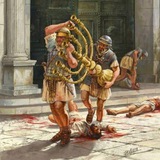
Forwarded from 70 A.D.
THE SIGN OF THE SON OF MAN
At the birth of Christ, a star [Greek: aster] was seen in the east, which traveled west and stood over Bethlehem.
In 66 AD, Josephus records a star resembling a sword, which stood over Jerusalem. He also mentions the appearance of Halley's comet, which "continued for a year."
Halley's comet was also seen around the time of Christ's birth (11 BC). The Chinese also record a comet in the sky in 5 BC, which was seen for over 70 days.
And behold, the star which they saw in the east went before them until it had come and stood over where the child was. (Matthew 2:1-2, 2:9-10)
So it was when a star, resembling a sword, stood over the city, and a comet which continued for a year." (War 6.5.4)
This star and/or comet not only signified the first coming of Christ, but also his second coming, in 66 AD.
Then the sign of the Son of Man will appear in heaven, and all the tribes of the earth will mourn. (Matthew 24:29-30)
At the birth of Christ, a star [Greek: aster] was seen in the east, which traveled west and stood over Bethlehem.
In 66 AD, Josephus records a star resembling a sword, which stood over Jerusalem. He also mentions the appearance of Halley's comet, which "continued for a year."
Halley's comet was also seen around the time of Christ's birth (11 BC). The Chinese also record a comet in the sky in 5 BC, which was seen for over 70 days.
And behold, the star which they saw in the east went before them until it had come and stood over where the child was. (Matthew 2:1-2, 2:9-10)
So it was when a star, resembling a sword, stood over the city, and a comet which continued for a year." (War 6.5.4)
This star and/or comet not only signified the first coming of Christ, but also his second coming, in 66 AD.
Then the sign of the Son of Man will appear in heaven, and all the tribes of the earth will mourn. (Matthew 24:29-30)
❤7👍1
70 A.D.
Let scripture interpret scripture.
Are The Creeds Inspired: Yes or No…A Critical Question
We have a serious question to pose for those appealing to the creeds over the scripture: Are they willing to affirm the following:
“Allscripture creeds are given by inspiration of God, and are profitable for doctrine, for reproof, for correction, for instruction in righteousness: That the man of God may be perfect, throughly furnished unto all good works.”
If one says that, “No, only scripture is inspired of God, infallible and authoritative,” then this means that anyone disagreeing with scriptures, including the historical church and the creeds, is in error.
It means that the church is not authoritative– and is this not the Reformed position after all?
It means that church history is not authoritative.
It means that creeds are not determinative.
On the other hand, if one argues that the creeds are the arbiters of orthodoxy, this means that you are in fact in violation of the creeds! The Westminster Confession of Faith says that the final authority, the ultimate authority, the only authority in all matters of faith is the scripture. It says that all creeds, councils and assemblies must bow to the authority of Scripture. Period!
So, to argue for the ultimate authority of the creeds is anti-creedal.
It is being argued that all of the creeds agree on a futurist eschatology. Well, okay, do not all the creeds likewise, in the final analysis, agree that the final authority in theology lies in scripture, and not in the creeds? So, if the creeds agree that the scriptures are the final authority, and if the scriptures determine that the church has been wrong in its futurist eschatology, then a person is following the creeds to reject the man-made futurist eschatology! To accept the ultimate authority of the scripture opens the door for the possibility that the church has been in error, for it is not the church that is the arbiter of truth, but scripture alone.
Sola Scriptura
We have a serious question to pose for those appealing to the creeds over the scripture: Are they willing to affirm the following:
“All
If one says that, “No, only scripture is inspired of God, infallible and authoritative,” then this means that anyone disagreeing with scriptures, including the historical church and the creeds, is in error.
It means that the church is not authoritative– and is this not the Reformed position after all?
It means that church history is not authoritative.
It means that creeds are not determinative.
On the other hand, if one argues that the creeds are the arbiters of orthodoxy, this means that you are in fact in violation of the creeds! The Westminster Confession of Faith says that the final authority, the ultimate authority, the only authority in all matters of faith is the scripture. It says that all creeds, councils and assemblies must bow to the authority of Scripture. Period!
So, to argue for the ultimate authority of the creeds is anti-creedal.
It is being argued that all of the creeds agree on a futurist eschatology. Well, okay, do not all the creeds likewise, in the final analysis, agree that the final authority in theology lies in scripture, and not in the creeds? So, if the creeds agree that the scriptures are the final authority, and if the scriptures determine that the church has been wrong in its futurist eschatology, then a person is following the creeds to reject the man-made futurist eschatology! To accept the ultimate authority of the scripture opens the door for the possibility that the church has been in error, for it is not the church that is the arbiter of truth, but scripture alone.
Sola Scriptura
👍2🔥2
The events of 1948 have nothing to do with the fulfillment of Bible prophecy, contrary to the empty claims of Zionism in its various forms. Neither modern-day Judaism nor Islam has any religious right to “holy land” in the Middle East or the planet today.
The Bible does not support a Messianic Kingdom or paradise on earth. Jesus taught that when He would be revealed from heaven like the sun shining from the east to the west, His Kingdom would not be seen with one’s eyes, but rather would be realized “within the heart of a person” (Lk. 17:20-37). It is more than ironic that people refer to Islam, Talmudic Zionism, and Evangelical Zionism as the “three Abrahamic faiths.” This is odd since Hebrews makes it abundantly clear that Abraham’s faith was not in an earthly country or city but a spiritual or heavenly one, “For we have not here an abiding city [a city named Jerusalem on earth], but we are seeking the one [city / New Jerusalem] about to [‘mello’ in Greek] come” (Heb. 11:10-16; 13:14). This is consistent with the “Jerusalem from above” being the new covenant (Gal. 4:26) which Revelation teaches is the New Jerusalem which was in the process of coming down and did “shortly” arrive in AD 70 when the earthly Jerusalem/Babylon was destroyed (Rev. 1:1; 3:12; 22:7, 10, 20 NIV).
- Michael Sullivan
The Bible does not support a Messianic Kingdom or paradise on earth. Jesus taught that when He would be revealed from heaven like the sun shining from the east to the west, His Kingdom would not be seen with one’s eyes, but rather would be realized “within the heart of a person” (Lk. 17:20-37). It is more than ironic that people refer to Islam, Talmudic Zionism, and Evangelical Zionism as the “three Abrahamic faiths.” This is odd since Hebrews makes it abundantly clear that Abraham’s faith was not in an earthly country or city but a spiritual or heavenly one, “For we have not here an abiding city [a city named Jerusalem on earth], but we are seeking the one [city / New Jerusalem] about to [‘mello’ in Greek] come” (Heb. 11:10-16; 13:14). This is consistent with the “Jerusalem from above” being the new covenant (Gal. 4:26) which Revelation teaches is the New Jerusalem which was in the process of coming down and did “shortly” arrive in AD 70 when the earthly Jerusalem/Babylon was destroyed (Rev. 1:1; 3:12; 22:7, 10, 20 NIV).
- Michael Sullivan
❤11👍3
Forwarded from 70 A.D.
I've read almost every version/translation of the Wars of the Judeans, including the Slavonic. This is by far the most descriptive, and also my favorite. It is the only translation that says that Nero was killed by fire from the Lord, while hunting in the country. I've uploaded the 1706 and 1567 translations.
The Wonderful and Most Deplorable History of the Later Times of the Jews
(James Howell's edition of Peter Morwen's translation of Abraham ben David's abstract of Joseph Ben Gorion's Yosippon)
https://archive.org/details/wonderful-most-deplorable
The Wonderful and Most Deplorable History of the Later Times of the Jews
(James Howell's edition of Peter Morwen's translation of Abraham ben David's abstract of Joseph Ben Gorion's Yosippon)
https://archive.org/details/wonderful-most-deplorable
👍4
Forwarded from 70 A.D.
Julian the Apostate and the Rebuilding of the Third Temple - in Three Parts
When Flavius Claudius Julianus, Emperor Julian, the Apostate, died in Persia, his supporters failed to maintain support for Hellenism (paganism) as the official state religion, and Christianity re-emerged as dominant.
Julian (born A.D. 332), the nephew of the first Christian emperor, Constantine, was trained as a Christian, yet he is known as the apostate because when he became emperor (A.D. 360) he opposed Christianity.
In his attempt to revive Hellenism, he promised the jews to help rebuild the temple. They hoped by this means to falsify the prophecies of Christ (since Jesus in the New Testament had prophesied the destruction of the Temple, its rebuilding would make of him a false prophet and a liar, thus, proving Christianity to be false).
When Flavius Claudius Julianus, Emperor Julian, the Apostate, died in Persia, his supporters failed to maintain support for Hellenism (paganism) as the official state religion, and Christianity re-emerged as dominant.
Julian (born A.D. 332), the nephew of the first Christian emperor, Constantine, was trained as a Christian, yet he is known as the apostate because when he became emperor (A.D. 360) he opposed Christianity.
In his attempt to revive Hellenism, he promised the jews to help rebuild the temple. They hoped by this means to falsify the prophecies of Christ (since Jesus in the New Testament had prophesied the destruction of the Temple, its rebuilding would make of him a false prophet and a liar, thus, proving Christianity to be false).
👍5❤2
Forwarded from 70 A.D.
Though the emperor hated and oppressed the Christians, he manifested benevolence and humanity towards the jews. He wrote to the jewish patriarchs and leaders, as well as to the people, requesting them to pray for him,
and for the prosperity of the empire. In taking this step he was not actuated, I am convinced, by any respect for their religion; for he was aware that it is, so to speak, the mother of the Christian religion, and he knew that both religions rest upon the authority of the [biblical] patriarchs and the prophets; but he thought to grieve the Christians by favoring the jews, who are their most inveterate enemies. But perhaps he also calculated upon persuading the jews to embrace paganism and sacrifices; for they were only acquainted with the mere letter of Scripture, and could not, like the Christians and a few of the wisest among the Hebrews, discern the hidden meaning [the allegorical meaning, through which the Christians could prove the validity of Christianity from the OT].
Events proved that this was his real motive; for he sent for some of the chiefs of the race and exhorted them to return to the observance of the laws of Moses and the customs of their fathers. On their replying that because the Temple in Jerusalem was overturned, it was neither lawful nor ancestral to do this in another place than the metropolis out of which they had been cast, he gave them public money, commanded them to rebuild the Temple, and to practice the cult similar to that of their ancestors, by sacrificing after the ancient way.
The jews entered upon the undertaking, without reflecting that, according to the prediction of the holy prophets, it could not be accomplished. They sought for the most skillful artisans, collected materials, cleared the ground, and entered so earnestly upon the task, that even the women carried heaps of earth, and brought their necklaces and other female ornaments towards defraying the expense.
The emperor, the other pagans, and all the jews, regarded every other undertaking as secondary in importance to this.
Although the pagans were not well-disposed towards the jews, yet they assisted them in this enterprise, because they reckoned upon its ultimate success, and hoped by this means to falsify the prophecies of Christ.
Besides this motive, the jews themselves [relying on the sympathy of Julian] were impelled by the consideration that the time had arrived for rebuilding their Temple.
When they had removed the ruins of the former building, they dug up the ground and cleared away its foundation; it is said that on the following day when they were about to lay the first foundation, a great earthquake occurred, and by the violent agitation of the earth, stones were thrown up from the depths, by which those of the jews who were engaged in the work were wounded, as likewise those who were merely looking on. The houses and public porticos, near the site of the Temple, in which they had diverted themselves, were suddenly thrown down; many were caught thereby, some perished immediately, others were found half dead and mutilated of hands or legs, others were injured in other parts of the body. When God caused the earthquake to cease, the workmen who survived again returned to their task, partly because such was the edict of the emperor, and partly because they were themselves interested in the undertaking. Men often, in endeavoring to gratify their own passions, seek what is injurious to them, reject what would be truly advantageous, and are deluded by the idea that nothing is really useful except what is agreeable to them.
When once led astray by this error, they are no longer able to act in a manner conducive to their own interests, or to take warning by the calamities which are visited upon them.
The jews, I believe, were just in this state; for, instead of regarding this unexpected earthquake as a manifest indication that God was opposed to the re-erection of their Temple, they proceeded to recommence the work.
and for the prosperity of the empire. In taking this step he was not actuated, I am convinced, by any respect for their religion; for he was aware that it is, so to speak, the mother of the Christian religion, and he knew that both religions rest upon the authority of the [biblical] patriarchs and the prophets; but he thought to grieve the Christians by favoring the jews, who are their most inveterate enemies. But perhaps he also calculated upon persuading the jews to embrace paganism and sacrifices; for they were only acquainted with the mere letter of Scripture, and could not, like the Christians and a few of the wisest among the Hebrews, discern the hidden meaning [the allegorical meaning, through which the Christians could prove the validity of Christianity from the OT].
Events proved that this was his real motive; for he sent for some of the chiefs of the race and exhorted them to return to the observance of the laws of Moses and the customs of their fathers. On their replying that because the Temple in Jerusalem was overturned, it was neither lawful nor ancestral to do this in another place than the metropolis out of which they had been cast, he gave them public money, commanded them to rebuild the Temple, and to practice the cult similar to that of their ancestors, by sacrificing after the ancient way.
The jews entered upon the undertaking, without reflecting that, according to the prediction of the holy prophets, it could not be accomplished. They sought for the most skillful artisans, collected materials, cleared the ground, and entered so earnestly upon the task, that even the women carried heaps of earth, and brought their necklaces and other female ornaments towards defraying the expense.
The emperor, the other pagans, and all the jews, regarded every other undertaking as secondary in importance to this.
Although the pagans were not well-disposed towards the jews, yet they assisted them in this enterprise, because they reckoned upon its ultimate success, and hoped by this means to falsify the prophecies of Christ.
Besides this motive, the jews themselves [relying on the sympathy of Julian] were impelled by the consideration that the time had arrived for rebuilding their Temple.
When they had removed the ruins of the former building, they dug up the ground and cleared away its foundation; it is said that on the following day when they were about to lay the first foundation, a great earthquake occurred, and by the violent agitation of the earth, stones were thrown up from the depths, by which those of the jews who were engaged in the work were wounded, as likewise those who were merely looking on. The houses and public porticos, near the site of the Temple, in which they had diverted themselves, were suddenly thrown down; many were caught thereby, some perished immediately, others were found half dead and mutilated of hands or legs, others were injured in other parts of the body. When God caused the earthquake to cease, the workmen who survived again returned to their task, partly because such was the edict of the emperor, and partly because they were themselves interested in the undertaking. Men often, in endeavoring to gratify their own passions, seek what is injurious to them, reject what would be truly advantageous, and are deluded by the idea that nothing is really useful except what is agreeable to them.
When once led astray by this error, they are no longer able to act in a manner conducive to their own interests, or to take warning by the calamities which are visited upon them.
The jews, I believe, were just in this state; for, instead of regarding this unexpected earthquake as a manifest indication that God was opposed to the re-erection of their Temple, they proceeded to recommence the work.
Forwarded from 70 A.D.
But all parties relate that they had scarcely returned to the undertaking, when fire burst suddenly from the foundations of the Temple, and consumed several of the workmen.
This fact is fearlessly stated, & believed by all; the only discrepancy in the narrative is that some maintain that flame burst from the interior of the Temple, as the workmen were striving to force an entrance, while others say that the fire proceeded - directly from the earth.
In whichever way the phenomenon might have occurred, it is equally wonderful. A more tangible and still more extraordinary miracle ensued; suddenly the sign of the cross appeared spontaneously on the garments of the persons engaged in the undertaking.
These crosses looked like stars, and appeared the work of art. Many were hence led to confess that Christ is God, and that the rebuilding of the Temple was not pleasing to Him; others presented themselves in the church, were initiated, and besought Christ, with hymns and supplications, to pardon their transgression. If any one does not feel disposed to believe my narrative, let him go and be convinced by those who heard the facts I have related from the eyewitnesses of them, for they are still alive.
Let him inquire, also, of the jews and pagans who left the work in an incomplete state, or who, to speak more accurately, were unable to commence it.
The story of this attempted rebuilding of the Temple is found in the Ecclesiastical History written in Greek by Salamanius Hermias Sozomenus about 443-450. Sozomen was a native Palestinian and claimed to have his knowledge from eye-witnesses.
He was a conservative Christian without sympathy for the jews or for Julian.
The End
This fact is fearlessly stated, & believed by all; the only discrepancy in the narrative is that some maintain that flame burst from the interior of the Temple, as the workmen were striving to force an entrance, while others say that the fire proceeded - directly from the earth.
In whichever way the phenomenon might have occurred, it is equally wonderful. A more tangible and still more extraordinary miracle ensued; suddenly the sign of the cross appeared spontaneously on the garments of the persons engaged in the undertaking.
These crosses looked like stars, and appeared the work of art. Many were hence led to confess that Christ is God, and that the rebuilding of the Temple was not pleasing to Him; others presented themselves in the church, were initiated, and besought Christ, with hymns and supplications, to pardon their transgression. If any one does not feel disposed to believe my narrative, let him go and be convinced by those who heard the facts I have related from the eyewitnesses of them, for they are still alive.
Let him inquire, also, of the jews and pagans who left the work in an incomplete state, or who, to speak more accurately, were unable to commence it.
The story of this attempted rebuilding of the Temple is found in the Ecclesiastical History written in Greek by Salamanius Hermias Sozomenus about 443-450. Sozomen was a native Palestinian and claimed to have his knowledge from eye-witnesses.
He was a conservative Christian without sympathy for the jews or for Julian.
The End
👍7❤1🔥1