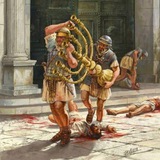
THE DAY OF THE LORD
EDOM
The vision of Obadi´ah. Thus saith the Lord God concerning Edom; We have heard a rumor from the Lord, and an ambassador is sent among the heathen, Arise ye, and let us rise up against her in battle. For the day of the Lord is near upon all the heathen: as thou hast done, it shall be done unto thee: thy reward shall return upon thine own head. . . and the house of Esau for stubble, and they shall kindle in them, and devour them; and there shall not be any remaining of the house of Esau; for the Lord hath spoken it.
Obadiah 1:1 , 15, 18
BABYLON
The burden of Babylon, which Isaiah the son of Amoz did see. Howl ye; for the day of the Lord is at hand; it shall come as a destruction from the Almighty. Behold, the day of the Lord cometh, cruel both with wrath and fierce anger, to lay the land desolate: and he shall destroy the sinners thereof out of it. For the stars of heaven and the constellations thereof shall not give their light: the sun shall be darkened in his going forth, and the moon shall not cause her light to shine. And Babylon, the glory of kingdoms, the beauty of the Chaldees' excellency, shall be as when God overthrew Sodom and Gomor´rah.
Isaiah 13:1 , 6 , 9 - 10 , 19
Hold thy peace at the presence of the Lord God: for the day of the Lord is at hand: for the Lord hath prepared a sacrifice, he hath bid his guests….The great day of the Lord is near, it is near, and hasteth greatly, even the voice of the day of the Lord: the mighty man shall cry there bitterly. That day is a day of wrath, a day of trouble and distress, a day of wasteness and desolation, a day of darkness and gloominess, a day of clouds and thick darkness, a day of the trumpet and alarm against the fenced cities, and against the high towers." Zeph. 1:2-7, 14-16
The prophet Isaiah, who wrote earlier than Zephaniah, gave identical warning of God's impending wrath upon the world. The nations and cities Isaiah mentioned by name include Moab (Isa. 15, 16), Syria and Damascus (Isa. 17), Ethiopia (Isa. 18), Egypt (Isa. 19, 20), Seir and Dumah (Isa. 21), Arabia (Isa. 21), Judah and Jerusalem (Isa. 22), and Tyre (Isa. 23). In language similar to Zephaniah, Isaiah describes the time of judgment as emptying the earth:
"Behold, the Lord maketh the earth empty, and maketh it waste, and turneth it upside down, and scattereth abroad the inhabitants thereof." Isa. 24:1
JERUSALEM
Peter twice uses the phrase "day of the Lord", once in Acts and once in his second epistle. Both describe the same "day." Peter's sermon in Acts, given at outpouring of the Holy Ghost on the first Pentecost after Christ's resurrection, quotes the prophet Joel (Acts 2:26-21).
Like the other examples we have seen, the "day of the Lord" spoken of by Peter and Joel would be a time of divine judgment upon the world by war, famine, and pestilence, overthrowing thrones and kingdoms, not the end of the cosmos itself. The two signs that a day of judgment was fast approaching were the gifts of the Holy Ghost, and outbreaks of war and civil disorder, bringing blood and fire and smoke, blackening the sun and turning the moon to blood. Jesus said similar signs would precede the fall of Jerusalem (Luke 21:25-32).
Note the poetic and figurative use of language, which puts the roaring sea for civil commotions among earth's nations, and the heavenly bodies for the ruling powers, which would be shaken from their places and fall from power. Notice, also, that the time for fulfillment of these things was fixed by the Lord to his own generation. This prediction was made in Jesus' Olivet Discourse after retiring from Jerusalem with his disciples. Immediately preceding his Olivet Discourse, Jesus made the identical predictions in his Great Denunciation against Jerusalem:
EDOM
The vision of Obadi´ah. Thus saith the Lord God concerning Edom; We have heard a rumor from the Lord, and an ambassador is sent among the heathen, Arise ye, and let us rise up against her in battle. For the day of the Lord is near upon all the heathen: as thou hast done, it shall be done unto thee: thy reward shall return upon thine own head. . . and the house of Esau for stubble, and they shall kindle in them, and devour them; and there shall not be any remaining of the house of Esau; for the Lord hath spoken it.
Obadiah 1:1 , 15, 18
BABYLON
The burden of Babylon, which Isaiah the son of Amoz did see. Howl ye; for the day of the Lord is at hand; it shall come as a destruction from the Almighty. Behold, the day of the Lord cometh, cruel both with wrath and fierce anger, to lay the land desolate: and he shall destroy the sinners thereof out of it. For the stars of heaven and the constellations thereof shall not give their light: the sun shall be darkened in his going forth, and the moon shall not cause her light to shine. And Babylon, the glory of kingdoms, the beauty of the Chaldees' excellency, shall be as when God overthrew Sodom and Gomor´rah.
Isaiah 13:1 , 6 , 9 - 10 , 19
Hold thy peace at the presence of the Lord God: for the day of the Lord is at hand: for the Lord hath prepared a sacrifice, he hath bid his guests….The great day of the Lord is near, it is near, and hasteth greatly, even the voice of the day of the Lord: the mighty man shall cry there bitterly. That day is a day of wrath, a day of trouble and distress, a day of wasteness and desolation, a day of darkness and gloominess, a day of clouds and thick darkness, a day of the trumpet and alarm against the fenced cities, and against the high towers." Zeph. 1:2-7, 14-16
The prophet Isaiah, who wrote earlier than Zephaniah, gave identical warning of God's impending wrath upon the world. The nations and cities Isaiah mentioned by name include Moab (Isa. 15, 16), Syria and Damascus (Isa. 17), Ethiopia (Isa. 18), Egypt (Isa. 19, 20), Seir and Dumah (Isa. 21), Arabia (Isa. 21), Judah and Jerusalem (Isa. 22), and Tyre (Isa. 23). In language similar to Zephaniah, Isaiah describes the time of judgment as emptying the earth:
"Behold, the Lord maketh the earth empty, and maketh it waste, and turneth it upside down, and scattereth abroad the inhabitants thereof." Isa. 24:1
JERUSALEM
Peter twice uses the phrase "day of the Lord", once in Acts and once in his second epistle. Both describe the same "day." Peter's sermon in Acts, given at outpouring of the Holy Ghost on the first Pentecost after Christ's resurrection, quotes the prophet Joel (Acts 2:26-21).
Like the other examples we have seen, the "day of the Lord" spoken of by Peter and Joel would be a time of divine judgment upon the world by war, famine, and pestilence, overthrowing thrones and kingdoms, not the end of the cosmos itself. The two signs that a day of judgment was fast approaching were the gifts of the Holy Ghost, and outbreaks of war and civil disorder, bringing blood and fire and smoke, blackening the sun and turning the moon to blood. Jesus said similar signs would precede the fall of Jerusalem (Luke 21:25-32).
Note the poetic and figurative use of language, which puts the roaring sea for civil commotions among earth's nations, and the heavenly bodies for the ruling powers, which would be shaken from their places and fall from power. Notice, also, that the time for fulfillment of these things was fixed by the Lord to his own generation. This prediction was made in Jesus' Olivet Discourse after retiring from Jerusalem with his disciples. Immediately preceding his Olivet Discourse, Jesus made the identical predictions in his Great Denunciation against Jerusalem:
👍4
"Verily I say unto you, All these things shall come upon this generation. O Jerusalem, Jerusalem, thou that killest the prophets, and stonest them which are sent unto thee, how often would I have gathered thy children together, even as a hen gathereth her chickens under her wings, and ye would not! Behold, your house is let unto you desolate. For I say unto you, Ye shall not see me henceforth, till you shall say Blessed is he that cometh in the name of the Lord." Matt. 23:36-39
I will gather all nations, and will bring them down into the valley of Johoshaphat, and will plead with them there…Let the heathen be wakened, and come up to the valley of Jehoshaphat: for there will I sit to judge all the heathen round about" (Joel 3:2).
Gathering the nations to the valley of Jehoshaphat refers to God's overthrow of the Moabites, Ammonites, and Edomites, who had united forces against Jerusalem, but were overthrown by God. All Jehoshaphat and Judah had to do was strip the slain and gather the spoils (II Chron. 20). The reference in Joel is to the persecution under Nero and God's salvation by his judgment upon the Jews and Romans. The imagery thus answers the battle of Gog and Magog, which also depicts the Neronean persecution and God's wrath upon the persecutors (Ezek. 38, 39; Rev. 20:7-11). Historical fulfillment came in the fall of Jerusalem and the "year of four emperors." The "year of four emperors" describes the series of civil wars that overtook the Roman Empire upon the death of Nero. In the space of one year and 22 days, five men were claimants to the imperial throne (beginning with Nero and ending with Vespasian), and the empire suffered devastation by the competing factions and armies. At the same time Titus was besieging Jerusalem, the forces of his father, Vespasian, were besieging Rome and ravishing Italy. The same year thus saw the destruction of the two greatest temples in the world: The temple in Jerusalem and the temple Jupiter Capitalinus in Rome. This is the "day of the Lord" prophesied by Joel and the prophets. Zechariah, who preached during the return of the captivity and the building the second temple, thus foretold the destruction of Jerusalem by Rome:
"Behold, the day of the Lord cometh, and thy spoil shall be divided in the midst of thee. For I will gather all nations against Jerusalem to battle; and the city shall be taken and the houses rifled, and the women ravished; and half the city shall go forth into captivity, and the residue shall not be cut off from the city.' Zech. 14:1, 2
The "day of the Lord" was not one specific event, but was a phrase used by the prophets to describe times of divine wrath and judgment upon nations, all fulfilled in ancient history.
I will gather all nations, and will bring them down into the valley of Johoshaphat, and will plead with them there…Let the heathen be wakened, and come up to the valley of Jehoshaphat: for there will I sit to judge all the heathen round about" (Joel 3:2).
Gathering the nations to the valley of Jehoshaphat refers to God's overthrow of the Moabites, Ammonites, and Edomites, who had united forces against Jerusalem, but were overthrown by God. All Jehoshaphat and Judah had to do was strip the slain and gather the spoils (II Chron. 20). The reference in Joel is to the persecution under Nero and God's salvation by his judgment upon the Jews and Romans. The imagery thus answers the battle of Gog and Magog, which also depicts the Neronean persecution and God's wrath upon the persecutors (Ezek. 38, 39; Rev. 20:7-11). Historical fulfillment came in the fall of Jerusalem and the "year of four emperors." The "year of four emperors" describes the series of civil wars that overtook the Roman Empire upon the death of Nero. In the space of one year and 22 days, five men were claimants to the imperial throne (beginning with Nero and ending with Vespasian), and the empire suffered devastation by the competing factions and armies. At the same time Titus was besieging Jerusalem, the forces of his father, Vespasian, were besieging Rome and ravishing Italy. The same year thus saw the destruction of the two greatest temples in the world: The temple in Jerusalem and the temple Jupiter Capitalinus in Rome. This is the "day of the Lord" prophesied by Joel and the prophets. Zechariah, who preached during the return of the captivity and the building the second temple, thus foretold the destruction of Jerusalem by Rome:
"Behold, the day of the Lord cometh, and thy spoil shall be divided in the midst of thee. For I will gather all nations against Jerusalem to battle; and the city shall be taken and the houses rifled, and the women ravished; and half the city shall go forth into captivity, and the residue shall not be cut off from the city.' Zech. 14:1, 2
The "day of the Lord" was not one specific event, but was a phrase used by the prophets to describe times of divine wrath and judgment upon nations, all fulfilled in ancient history.
👍8
And he shall speak great words against the Most High, and shall wear out the saints of the Most High, and think to change times and laws: and they shall be given into his hand until a time and times and the dividing of time. Daniel 7:25
Gittin 56b of the Babylonian Talmud records Titus speaking blasphemies against God:
Vespasian sent Titus who said, “Where is their God, the rock in whom they trusted?” This was the wicked Titus who blasphemed and insulted Heaven. What did he do? He took a harlot by the hand and entered the Holy of Holies and spread out a scroll of the Law and committed a sin on it. He then took a sword and slashed the curtain. Miraculously blood spurted out, and he thought that he had slain God himself, as it says, “Thine adversaries have roared in the midst of thine assembly, they have set up their ensigns for signs. [. . . .]” Titus further took the curtain and shaped it like a basket and brought all the vessels of the Sanctuary and put them in it, and then put them on board ship to go and triumph with them in his city.
While on his way back to Rome Gittin 56b of the Babylonian Talmud also records Titus issue the following boastful challenge to the God of Israel: “If he is really mighty, let him come up on the dry land and fight with me.”
Note: The Judean war lasted exactly 3.5 years.
Gittin 56b of the Babylonian Talmud records Titus speaking blasphemies against God:
Vespasian sent Titus who said, “Where is their God, the rock in whom they trusted?” This was the wicked Titus who blasphemed and insulted Heaven. What did he do? He took a harlot by the hand and entered the Holy of Holies and spread out a scroll of the Law and committed a sin on it. He then took a sword and slashed the curtain. Miraculously blood spurted out, and he thought that he had slain God himself, as it says, “Thine adversaries have roared in the midst of thine assembly, they have set up their ensigns for signs. [. . . .]” Titus further took the curtain and shaped it like a basket and brought all the vessels of the Sanctuary and put them in it, and then put them on board ship to go and triumph with them in his city.
While on his way back to Rome Gittin 56b of the Babylonian Talmud also records Titus issue the following boastful challenge to the God of Israel: “If he is really mighty, let him come up on the dry land and fight with me.”
Note: The Judean war lasted exactly 3.5 years.
👍6
Forwarded from 70 A.D.
THE SIGN OF THE SON OF MAN
At the birth of Christ, a star [Greek: aster] was seen in the east, which traveled west and stood over Bethlehem.
In 66 AD, Josephus records a star resembling a sword, which stood over Jerusalem. He also mentions the appearance of Halley's comet, which "continued for a year."
Halley's comet was also seen around the time of Christ's birth (11 BC). The Chinese also record a comet in the sky in 5 BC, which was seen for over 70 days.
And behold, the star which they saw in the east went before them until it had come and stood over where the child was. (Matthew 2:1-2, 2:9-10)
So it was when a star, resembling a sword, stood over the city, and a comet which continued for a year." (War 6.5.4)
This star and/or comet not only signified the first coming of Christ, but also his second coming, in 66 AD.
Then the sign of the Son of Man will appear in heaven, and all the tribes of the earth will mourn. (Matthew 24:29-30)
At the birth of Christ, a star [Greek: aster] was seen in the east, which traveled west and stood over Bethlehem.
In 66 AD, Josephus records a star resembling a sword, which stood over Jerusalem. He also mentions the appearance of Halley's comet, which "continued for a year."
Halley's comet was also seen around the time of Christ's birth (11 BC). The Chinese also record a comet in the sky in 5 BC, which was seen for over 70 days.
And behold, the star which they saw in the east went before them until it had come and stood over where the child was. (Matthew 2:1-2, 2:9-10)
So it was when a star, resembling a sword, stood over the city, and a comet which continued for a year." (War 6.5.4)
This star and/or comet not only signified the first coming of Christ, but also his second coming, in 66 AD.
Then the sign of the Son of Man will appear in heaven, and all the tribes of the earth will mourn. (Matthew 24:29-30)
❤7👍1
70 A.D.
Let scripture interpret scripture.
Are The Creeds Inspired: Yes or No…A Critical Question
We have a serious question to pose for those appealing to the creeds over the scripture: Are they willing to affirm the following:
“Allscripture creeds are given by inspiration of God, and are profitable for doctrine, for reproof, for correction, for instruction in righteousness: That the man of God may be perfect, throughly furnished unto all good works.”
If one says that, “No, only scripture is inspired of God, infallible and authoritative,” then this means that anyone disagreeing with scriptures, including the historical church and the creeds, is in error.
It means that the church is not authoritative– and is this not the Reformed position after all?
It means that church history is not authoritative.
It means that creeds are not determinative.
On the other hand, if one argues that the creeds are the arbiters of orthodoxy, this means that you are in fact in violation of the creeds! The Westminster Confession of Faith says that the final authority, the ultimate authority, the only authority in all matters of faith is the scripture. It says that all creeds, councils and assemblies must bow to the authority of Scripture. Period!
So, to argue for the ultimate authority of the creeds is anti-creedal.
It is being argued that all of the creeds agree on a futurist eschatology. Well, okay, do not all the creeds likewise, in the final analysis, agree that the final authority in theology lies in scripture, and not in the creeds? So, if the creeds agree that the scriptures are the final authority, and if the scriptures determine that the church has been wrong in its futurist eschatology, then a person is following the creeds to reject the man-made futurist eschatology! To accept the ultimate authority of the scripture opens the door for the possibility that the church has been in error, for it is not the church that is the arbiter of truth, but scripture alone.
Sola Scriptura
We have a serious question to pose for those appealing to the creeds over the scripture: Are they willing to affirm the following:
“All
If one says that, “No, only scripture is inspired of God, infallible and authoritative,” then this means that anyone disagreeing with scriptures, including the historical church and the creeds, is in error.
It means that the church is not authoritative– and is this not the Reformed position after all?
It means that church history is not authoritative.
It means that creeds are not determinative.
On the other hand, if one argues that the creeds are the arbiters of orthodoxy, this means that you are in fact in violation of the creeds! The Westminster Confession of Faith says that the final authority, the ultimate authority, the only authority in all matters of faith is the scripture. It says that all creeds, councils and assemblies must bow to the authority of Scripture. Period!
So, to argue for the ultimate authority of the creeds is anti-creedal.
It is being argued that all of the creeds agree on a futurist eschatology. Well, okay, do not all the creeds likewise, in the final analysis, agree that the final authority in theology lies in scripture, and not in the creeds? So, if the creeds agree that the scriptures are the final authority, and if the scriptures determine that the church has been wrong in its futurist eschatology, then a person is following the creeds to reject the man-made futurist eschatology! To accept the ultimate authority of the scripture opens the door for the possibility that the church has been in error, for it is not the church that is the arbiter of truth, but scripture alone.
Sola Scriptura
👍2🔥2
The events of 1948 have nothing to do with the fulfillment of Bible prophecy, contrary to the empty claims of Zionism in its various forms. Neither modern-day Judaism nor Islam has any religious right to “holy land” in the Middle East or the planet today.
The Bible does not support a Messianic Kingdom or paradise on earth. Jesus taught that when He would be revealed from heaven like the sun shining from the east to the west, His Kingdom would not be seen with one’s eyes, but rather would be realized “within the heart of a person” (Lk. 17:20-37). It is more than ironic that people refer to Islam, Talmudic Zionism, and Evangelical Zionism as the “three Abrahamic faiths.” This is odd since Hebrews makes it abundantly clear that Abraham’s faith was not in an earthly country or city but a spiritual or heavenly one, “For we have not here an abiding city [a city named Jerusalem on earth], but we are seeking the one [city / New Jerusalem] about to [‘mello’ in Greek] come” (Heb. 11:10-16; 13:14). This is consistent with the “Jerusalem from above” being the new covenant (Gal. 4:26) which Revelation teaches is the New Jerusalem which was in the process of coming down and did “shortly” arrive in AD 70 when the earthly Jerusalem/Babylon was destroyed (Rev. 1:1; 3:12; 22:7, 10, 20 NIV).
- Michael Sullivan
The Bible does not support a Messianic Kingdom or paradise on earth. Jesus taught that when He would be revealed from heaven like the sun shining from the east to the west, His Kingdom would not be seen with one’s eyes, but rather would be realized “within the heart of a person” (Lk. 17:20-37). It is more than ironic that people refer to Islam, Talmudic Zionism, and Evangelical Zionism as the “three Abrahamic faiths.” This is odd since Hebrews makes it abundantly clear that Abraham’s faith was not in an earthly country or city but a spiritual or heavenly one, “For we have not here an abiding city [a city named Jerusalem on earth], but we are seeking the one [city / New Jerusalem] about to [‘mello’ in Greek] come” (Heb. 11:10-16; 13:14). This is consistent with the “Jerusalem from above” being the new covenant (Gal. 4:26) which Revelation teaches is the New Jerusalem which was in the process of coming down and did “shortly” arrive in AD 70 when the earthly Jerusalem/Babylon was destroyed (Rev. 1:1; 3:12; 22:7, 10, 20 NIV).
- Michael Sullivan
❤11👍3
Forwarded from 70 A.D.
I've read almost every version/translation of the Wars of the Judeans, including the Slavonic. This is by far the most descriptive, and also my favorite. It is the only translation that says that Nero was killed by fire from the Lord, while hunting in the country. I've uploaded the 1706 and 1567 translations.
The Wonderful and Most Deplorable History of the Later Times of the Jews
(James Howell's edition of Peter Morwen's translation of Abraham ben David's abstract of Joseph Ben Gorion's Yosippon)
https://archive.org/details/wonderful-most-deplorable
The Wonderful and Most Deplorable History of the Later Times of the Jews
(James Howell's edition of Peter Morwen's translation of Abraham ben David's abstract of Joseph Ben Gorion's Yosippon)
https://archive.org/details/wonderful-most-deplorable
👍4