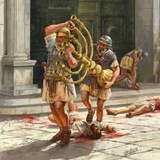
But every man is tempted, when he is drawn away of his own lust, and enticed. Then when lust hath conceived, it bringeth forth sin; and sin, when it is finished, bringeth forth death. James 1:14-15
It's not the devil. It's not satan. It is your OWN lust that causes you to sin.
It's not the devil. It's not satan. It is your OWN lust that causes you to sin.
👍12😁1
WHAT WAS THE MARK OF THE BEAST?
Was it an invisible sign of allegiance, a document, or currency (stamped with Caesar's image) that allowed citizens to buy and sell?
And he causeth all, both small and great, rich and poor, free and bond, to receive a mark in their right hand, or in their foreheads: and that no man might buy or sell, save he that had the mark, or the name of the beast, or the number of his name. Revelation 13:16-17
Roman citizens were required to publicly claim allegiance to Caesar by burning incense in his honor and proclaiming that “Caesar is Lord”. Those who did this received a document that allowed them to buy and sell in the marketplace. Without it, no one could purchase anything. Judeans were required to pay taxes to Caesar, and would eventually be required to offer sacrifices to him three times a year. The penalty for refusal was death. "We have no king but Caesar."
In the Old Testament, God marked His children on their hands and foreheads.
And it shall be for a sign unto thee upon thine hand, and for a memorial between thine eyes, that the Lord's law may be in thy mouth: for with a strong hand hath the Lord brought thee out of Egypt. Exodus 13:9
And it shall be for a token upon thine hand, and for frontlets between thine eyes: for by strength of hand the Lord brought us forth out of Egypt. Exodus 13:16
And these words, which I command thee this day, shall be in thine heart: And thou shalt bind them for a sign upon thine hand, and they shall be as frontlets between thine eyes. Deuteronomy 6:6 , 8
Therefore shall ye lay up these my words in your heart and in your soul, and bind them for a sign upon your hand, that they may be as frontlets between your eyes. Deuteronomy 11:18
Let's not forget that first century Christians were also sealed with an invisible mark on their foreheads.
And I heard the number of them which were sealed: and there were sealed a hundred and forty and four thousand of all the tribes of the children of Israel. Revelation 7:4 (See also: Revelation 14:1)
And the Lord said unto him, Go through the midst of the city, through the midst of Jerusalem, and set a mark upon the foreheads of the men that sigh and that cry for all the abominations that be done in the midst thereof. Ezekiel 9:4
Some translations use the collective "man".
Wycliffe "Here is wisdom; he that hath understanding, acount the number of the beast; for it is the number of man, and his number is six hundred sixty and six."
Representing the sinful/apostate nature of man.
John 2:25 "and because he didn't need for anyone to testify concerning man; for he himself knew what was in man."
Was it an invisible sign of allegiance, a document, or currency (stamped with Caesar's image) that allowed citizens to buy and sell?
And he causeth all, both small and great, rich and poor, free and bond, to receive a mark in their right hand, or in their foreheads: and that no man might buy or sell, save he that had the mark, or the name of the beast, or the number of his name. Revelation 13:16-17
Roman citizens were required to publicly claim allegiance to Caesar by burning incense in his honor and proclaiming that “Caesar is Lord”. Those who did this received a document that allowed them to buy and sell in the marketplace. Without it, no one could purchase anything. Judeans were required to pay taxes to Caesar, and would eventually be required to offer sacrifices to him three times a year. The penalty for refusal was death. "We have no king but Caesar."
In the Old Testament, God marked His children on their hands and foreheads.
And it shall be for a sign unto thee upon thine hand, and for a memorial between thine eyes, that the Lord's law may be in thy mouth: for with a strong hand hath the Lord brought thee out of Egypt. Exodus 13:9
And it shall be for a token upon thine hand, and for frontlets between thine eyes: for by strength of hand the Lord brought us forth out of Egypt. Exodus 13:16
And these words, which I command thee this day, shall be in thine heart: And thou shalt bind them for a sign upon thine hand, and they shall be as frontlets between thine eyes. Deuteronomy 6:6 , 8
Therefore shall ye lay up these my words in your heart and in your soul, and bind them for a sign upon your hand, that they may be as frontlets between your eyes. Deuteronomy 11:18
Let's not forget that first century Christians were also sealed with an invisible mark on their foreheads.
And I heard the number of them which were sealed: and there were sealed a hundred and forty and four thousand of all the tribes of the children of Israel. Revelation 7:4 (See also: Revelation 14:1)
And the Lord said unto him, Go through the midst of the city, through the midst of Jerusalem, and set a mark upon the foreheads of the men that sigh and that cry for all the abominations that be done in the midst thereof. Ezekiel 9:4
Some translations use the collective "man".
Wycliffe "Here is wisdom; he that hath understanding, acount the number of the beast; for it is the number of man, and his number is six hundred sixty and six."
Representing the sinful/apostate nature of man.
John 2:25 "and because he didn't need for anyone to testify concerning man; for he himself knew what was in man."
👍7❤1🔥1
Forwarded from 70 A.D.
One thing today's Christians struggle to understand, is that the Bible is a spiritual (not physical) book from beginning to end. It is about the transition from the old covenant (old heaven and earth), to the new covenant (new heaven and earth).
"For if that first covenant had been faultless, then should no place have been sought for the second. In that he saith, A new covenant, he hath made the first old. Now that which decayeth and waxeth old is ready to vanish away." (Hebrews 8:7, 13)
"For, behold, I create new heavens and a new earth: and the former shall not be remembered, nor come into mind." (Isaiah 65:17)
"And I saw a new heaven and a new earth: for the first heaven and the first earth were passed away. . . Behold, the tabernacle of God is with men, and he will dwell with them, and they shall be his people, and God himself shall be with them, and be their God. (Rev 21:1, 3)
"The kingdom of God does not come with observation. . . It is within you!" (Luke 17:20-2)
Jesus is Immanuel, GOD WITH US!
"For if that first covenant had been faultless, then should no place have been sought for the second. In that he saith, A new covenant, he hath made the first old. Now that which decayeth and waxeth old is ready to vanish away." (Hebrews 8:7, 13)
"For, behold, I create new heavens and a new earth: and the former shall not be remembered, nor come into mind." (Isaiah 65:17)
"And I saw a new heaven and a new earth: for the first heaven and the first earth were passed away. . . Behold, the tabernacle of God is with men, and he will dwell with them, and they shall be his people, and God himself shall be with them, and be their God. (Rev 21:1, 3)
"The kingdom of God does not come with observation. . . It is within you!" (Luke 17:20-2)
Jesus is Immanuel, GOD WITH US!
❤9
Forwarded from 70 A.D.
The Messianic Kingdom
Jesus’ kingdom, the kingdom of God or the kingdom of heaven, is a spiritual kingdom centered in heaven which is why it is called the kingdom of heaven. Though this kingdom is centered in heaven with God’s throne, it is also present on earth in the midst of the saints. The fact that the kingdom of God or the kingdom of heaven is also present on earth in the presence of the saints is indicated in Luke 17:20-21: “On being asked by the Pharisees when the kingdom of God would come, Jesus replied, “The coming of the kingdom of God is not something that can be observed, nor will people say, ‘Here it is,’ or ‘There it is,’ because the kingdom of God is in your midst.” The kingdom of God is present in the midst of the saints whether they are in heaven, or if they're still living on earth.
Jesus now rules at the right hand of the Father, which places the throne of the Messianic kingdom in heaven. The Messiah rules the earth from a heavenly, not an earthly throne.
Jesus - Immanuel - God With Us
Jesus’ kingdom, the kingdom of God or the kingdom of heaven, is a spiritual kingdom centered in heaven which is why it is called the kingdom of heaven. Though this kingdom is centered in heaven with God’s throne, it is also present on earth in the midst of the saints. The fact that the kingdom of God or the kingdom of heaven is also present on earth in the presence of the saints is indicated in Luke 17:20-21: “On being asked by the Pharisees when the kingdom of God would come, Jesus replied, “The coming of the kingdom of God is not something that can be observed, nor will people say, ‘Here it is,’ or ‘There it is,’ because the kingdom of God is in your midst.” The kingdom of God is present in the midst of the saints whether they are in heaven, or if they're still living on earth.
Jesus now rules at the right hand of the Father, which places the throne of the Messianic kingdom in heaven. The Messiah rules the earth from a heavenly, not an earthly throne.
Jesus - Immanuel - God With Us
❤11
Now He who provides seed for the sower and bread for food will provide and multiply your seed for sowing [that is, your resources] and increase the harvest of your righteousness [which shows itself in active goodness, kindness, and love]. You will be enriched in every way so that you may be generous, and this [generosity, administered] through us is producing thanksgiving to God [from those who benefit].
2 Corinthians 9:10 - 11
Happy Thanksgiving, friends. 🦃
2 Corinthians 9:10 - 11
Happy Thanksgiving, friends. 🦃
❤8👍1
Sea = Gentile Nations
And I saw a new heaven and a new earth: for the first heaven and the first earth were passed away; and there was no more sea. Revelation 21:1
Throughout the Bible, the sea represents the Gentile (non-Israelite) nations.
And he saith to me, ‘The waters that thou didst see, where the whore doth sit, are peoples, and multitudes, and nations, and tongues;’ Revelation 17:15
Daniel 7
Psalm 65:5;7
Isaiah 8:7
Isaiah 17:12-13
Isaiah 60:5
Jeremiah 46:7-8
Jeremiah 47:2
Jeremiah 51:55
Ezekiel 26:3
Awake, awake, put on thy strength, O Zion; put on thy beautiful garments, O Jerusalem, the holy city: for henceforth there shall no more come into thee the uncircumcised and the unclean. Isaiah 52:1
Him that overcometh will I make a pillar in the temple of my God, and he shall go no more out: and I will write upon him the name of my God, and the name of the city of my God, which is new Jerusalem, which cometh down out of heaven from my God: and I will write upon him my new name. Revelation 3:12
For whatsoever is born of God overcometh the world: and this is the victory that overcometh the world, even our faith. Who is he that overcometh the world, but he that believeth that Jesus is the Son of God? 1 John 5:4 - 5
In the New Covenant, why is there no more sea? Because in Christ, we are all the Israel of God.
And I saw a new heaven and a new earth: for the first heaven and the first earth were passed away; and there was no more sea. Revelation 21:1
Throughout the Bible, the sea represents the Gentile (non-Israelite) nations.
And he saith to me, ‘The waters that thou didst see, where the whore doth sit, are peoples, and multitudes, and nations, and tongues;’ Revelation 17:15
Daniel 7
Psalm 65:5;7
Isaiah 8:7
Isaiah 17:12-13
Isaiah 60:5
Jeremiah 46:7-8
Jeremiah 47:2
Jeremiah 51:55
Ezekiel 26:3
Awake, awake, put on thy strength, O Zion; put on thy beautiful garments, O Jerusalem, the holy city: for henceforth there shall no more come into thee the uncircumcised and the unclean. Isaiah 52:1
Him that overcometh will I make a pillar in the temple of my God, and he shall go no more out: and I will write upon him the name of my God, and the name of the city of my God, which is new Jerusalem, which cometh down out of heaven from my God: and I will write upon him my new name. Revelation 3:12
For whatsoever is born of God overcometh the world: and this is the victory that overcometh the world, even our faith. Who is he that overcometh the world, but he that believeth that Jesus is the Son of God? 1 John 5:4 - 5
In the New Covenant, why is there no more sea? Because in Christ, we are all the Israel of God.
❤14🔥2
Forwarded from 70 A.D.
JOEL'S ARMY OF LOCUSTS AND REVELATION 9
Judea, the setting for the book of Joel, is devastated by a vast horde of locusts. The terrible plague of locusts is followed by a severe famine throughout the land. Joel uses these happenings as the catalyst to send words of warning to Judea.
Joel symbolically describes the locusts as a marching human army. Unless the people repent quickly and completely, enemy armies from the north will devour the land, as did the natural elements. He views all of this as divine judgment coming against the nation for her sins.
The book of Joel is highlighted by two major events. One is the invasion of the locust army, and the other the outpouring of the Spirit. The initial fulfillment of this last days prophecy is quoted by Peter in Acts 2 as having taken place at Pentecost.
"Alas, alas, alas for the day! for the day of the Lord is nigh, and it will come as trouble upon trouble." Joel 1:15
*see attached pics for a comparison of the book of Joel and Revelation 9:1-11
Judea, the setting for the book of Joel, is devastated by a vast horde of locusts. The terrible plague of locusts is followed by a severe famine throughout the land. Joel uses these happenings as the catalyst to send words of warning to Judea.
Joel symbolically describes the locusts as a marching human army. Unless the people repent quickly and completely, enemy armies from the north will devour the land, as did the natural elements. He views all of this as divine judgment coming against the nation for her sins.
The book of Joel is highlighted by two major events. One is the invasion of the locust army, and the other the outpouring of the Spirit. The initial fulfillment of this last days prophecy is quoted by Peter in Acts 2 as having taken place at Pentecost.
"Alas, alas, alas for the day! for the day of the Lord is nigh, and it will come as trouble upon trouble." Joel 1:15
*see attached pics for a comparison of the book of Joel and Revelation 9:1-11
👍3🔥2❤1
Forwarded from 70 A.D.
απωλειας (apoleias), the original Greek word translated "of perdition," means "of destruction" or "of ruin," so "the son of perdition" means the son of destruction or ruin.
'Apollyon' means "destroyer".
Not only was Titus Vespasian a man of lawlessness (a Gentile), but he was also a son of perdition.
"'The destruction of Jerusalem came through a Kamza and a Bar Kamza.'
Footnote: Literally, 'locust and son of locust'. The meaning is that a very trivial cause set in motion the train of events which led to the destruction of Jerusalem." - Talmud, Gittin 55a
'Apollyon' means "destroyer".
Not only was Titus Vespasian a man of lawlessness (a Gentile), but he was also a son of perdition.
"'The destruction of Jerusalem came through a Kamza and a Bar Kamza.'
Footnote: Literally, 'locust and son of locust'. The meaning is that a very trivial cause set in motion the train of events which led to the destruction of Jerusalem." - Talmud, Gittin 55a
🔥3
THE DAY OF THE LORD
EDOM
The vision of Obadi´ah. Thus saith the Lord God concerning Edom; We have heard a rumor from the Lord, and an ambassador is sent among the heathen, Arise ye, and let us rise up against her in battle. For the day of the Lord is near upon all the heathen: as thou hast done, it shall be done unto thee: thy reward shall return upon thine own head. . . and the house of Esau for stubble, and they shall kindle in them, and devour them; and there shall not be any remaining of the house of Esau; for the Lord hath spoken it.
Obadiah 1:1 , 15, 18
BABYLON
The burden of Babylon, which Isaiah the son of Amoz did see. Howl ye; for the day of the Lord is at hand; it shall come as a destruction from the Almighty. Behold, the day of the Lord cometh, cruel both with wrath and fierce anger, to lay the land desolate: and he shall destroy the sinners thereof out of it. For the stars of heaven and the constellations thereof shall not give their light: the sun shall be darkened in his going forth, and the moon shall not cause her light to shine. And Babylon, the glory of kingdoms, the beauty of the Chaldees' excellency, shall be as when God overthrew Sodom and Gomor´rah.
Isaiah 13:1 , 6 , 9 - 10 , 19
Hold thy peace at the presence of the Lord God: for the day of the Lord is at hand: for the Lord hath prepared a sacrifice, he hath bid his guests….The great day of the Lord is near, it is near, and hasteth greatly, even the voice of the day of the Lord: the mighty man shall cry there bitterly. That day is a day of wrath, a day of trouble and distress, a day of wasteness and desolation, a day of darkness and gloominess, a day of clouds and thick darkness, a day of the trumpet and alarm against the fenced cities, and against the high towers." Zeph. 1:2-7, 14-16
The prophet Isaiah, who wrote earlier than Zephaniah, gave identical warning of God's impending wrath upon the world. The nations and cities Isaiah mentioned by name include Moab (Isa. 15, 16), Syria and Damascus (Isa. 17), Ethiopia (Isa. 18), Egypt (Isa. 19, 20), Seir and Dumah (Isa. 21), Arabia (Isa. 21), Judah and Jerusalem (Isa. 22), and Tyre (Isa. 23). In language similar to Zephaniah, Isaiah describes the time of judgment as emptying the earth:
"Behold, the Lord maketh the earth empty, and maketh it waste, and turneth it upside down, and scattereth abroad the inhabitants thereof." Isa. 24:1
JERUSALEM
Peter twice uses the phrase "day of the Lord", once in Acts and once in his second epistle. Both describe the same "day." Peter's sermon in Acts, given at outpouring of the Holy Ghost on the first Pentecost after Christ's resurrection, quotes the prophet Joel (Acts 2:26-21).
Like the other examples we have seen, the "day of the Lord" spoken of by Peter and Joel would be a time of divine judgment upon the world by war, famine, and pestilence, overthrowing thrones and kingdoms, not the end of the cosmos itself. The two signs that a day of judgment was fast approaching were the gifts of the Holy Ghost, and outbreaks of war and civil disorder, bringing blood and fire and smoke, blackening the sun and turning the moon to blood. Jesus said similar signs would precede the fall of Jerusalem (Luke 21:25-32).
Note the poetic and figurative use of language, which puts the roaring sea for civil commotions among earth's nations, and the heavenly bodies for the ruling powers, which would be shaken from their places and fall from power. Notice, also, that the time for fulfillment of these things was fixed by the Lord to his own generation. This prediction was made in Jesus' Olivet Discourse after retiring from Jerusalem with his disciples. Immediately preceding his Olivet Discourse, Jesus made the identical predictions in his Great Denunciation against Jerusalem:
EDOM
The vision of Obadi´ah. Thus saith the Lord God concerning Edom; We have heard a rumor from the Lord, and an ambassador is sent among the heathen, Arise ye, and let us rise up against her in battle. For the day of the Lord is near upon all the heathen: as thou hast done, it shall be done unto thee: thy reward shall return upon thine own head. . . and the house of Esau for stubble, and they shall kindle in them, and devour them; and there shall not be any remaining of the house of Esau; for the Lord hath spoken it.
Obadiah 1:1 , 15, 18
BABYLON
The burden of Babylon, which Isaiah the son of Amoz did see. Howl ye; for the day of the Lord is at hand; it shall come as a destruction from the Almighty. Behold, the day of the Lord cometh, cruel both with wrath and fierce anger, to lay the land desolate: and he shall destroy the sinners thereof out of it. For the stars of heaven and the constellations thereof shall not give their light: the sun shall be darkened in his going forth, and the moon shall not cause her light to shine. And Babylon, the glory of kingdoms, the beauty of the Chaldees' excellency, shall be as when God overthrew Sodom and Gomor´rah.
Isaiah 13:1 , 6 , 9 - 10 , 19
Hold thy peace at the presence of the Lord God: for the day of the Lord is at hand: for the Lord hath prepared a sacrifice, he hath bid his guests….The great day of the Lord is near, it is near, and hasteth greatly, even the voice of the day of the Lord: the mighty man shall cry there bitterly. That day is a day of wrath, a day of trouble and distress, a day of wasteness and desolation, a day of darkness and gloominess, a day of clouds and thick darkness, a day of the trumpet and alarm against the fenced cities, and against the high towers." Zeph. 1:2-7, 14-16
The prophet Isaiah, who wrote earlier than Zephaniah, gave identical warning of God's impending wrath upon the world. The nations and cities Isaiah mentioned by name include Moab (Isa. 15, 16), Syria and Damascus (Isa. 17), Ethiopia (Isa. 18), Egypt (Isa. 19, 20), Seir and Dumah (Isa. 21), Arabia (Isa. 21), Judah and Jerusalem (Isa. 22), and Tyre (Isa. 23). In language similar to Zephaniah, Isaiah describes the time of judgment as emptying the earth:
"Behold, the Lord maketh the earth empty, and maketh it waste, and turneth it upside down, and scattereth abroad the inhabitants thereof." Isa. 24:1
JERUSALEM
Peter twice uses the phrase "day of the Lord", once in Acts and once in his second epistle. Both describe the same "day." Peter's sermon in Acts, given at outpouring of the Holy Ghost on the first Pentecost after Christ's resurrection, quotes the prophet Joel (Acts 2:26-21).
Like the other examples we have seen, the "day of the Lord" spoken of by Peter and Joel would be a time of divine judgment upon the world by war, famine, and pestilence, overthrowing thrones and kingdoms, not the end of the cosmos itself. The two signs that a day of judgment was fast approaching were the gifts of the Holy Ghost, and outbreaks of war and civil disorder, bringing blood and fire and smoke, blackening the sun and turning the moon to blood. Jesus said similar signs would precede the fall of Jerusalem (Luke 21:25-32).
Note the poetic and figurative use of language, which puts the roaring sea for civil commotions among earth's nations, and the heavenly bodies for the ruling powers, which would be shaken from their places and fall from power. Notice, also, that the time for fulfillment of these things was fixed by the Lord to his own generation. This prediction was made in Jesus' Olivet Discourse after retiring from Jerusalem with his disciples. Immediately preceding his Olivet Discourse, Jesus made the identical predictions in his Great Denunciation against Jerusalem:
👍4
"Verily I say unto you, All these things shall come upon this generation. O Jerusalem, Jerusalem, thou that killest the prophets, and stonest them which are sent unto thee, how often would I have gathered thy children together, even as a hen gathereth her chickens under her wings, and ye would not! Behold, your house is let unto you desolate. For I say unto you, Ye shall not see me henceforth, till you shall say Blessed is he that cometh in the name of the Lord." Matt. 23:36-39
I will gather all nations, and will bring them down into the valley of Johoshaphat, and will plead with them there…Let the heathen be wakened, and come up to the valley of Jehoshaphat: for there will I sit to judge all the heathen round about" (Joel 3:2).
Gathering the nations to the valley of Jehoshaphat refers to God's overthrow of the Moabites, Ammonites, and Edomites, who had united forces against Jerusalem, but were overthrown by God. All Jehoshaphat and Judah had to do was strip the slain and gather the spoils (II Chron. 20). The reference in Joel is to the persecution under Nero and God's salvation by his judgment upon the Jews and Romans. The imagery thus answers the battle of Gog and Magog, which also depicts the Neronean persecution and God's wrath upon the persecutors (Ezek. 38, 39; Rev. 20:7-11). Historical fulfillment came in the fall of Jerusalem and the "year of four emperors." The "year of four emperors" describes the series of civil wars that overtook the Roman Empire upon the death of Nero. In the space of one year and 22 days, five men were claimants to the imperial throne (beginning with Nero and ending with Vespasian), and the empire suffered devastation by the competing factions and armies. At the same time Titus was besieging Jerusalem, the forces of his father, Vespasian, were besieging Rome and ravishing Italy. The same year thus saw the destruction of the two greatest temples in the world: The temple in Jerusalem and the temple Jupiter Capitalinus in Rome. This is the "day of the Lord" prophesied by Joel and the prophets. Zechariah, who preached during the return of the captivity and the building the second temple, thus foretold the destruction of Jerusalem by Rome:
"Behold, the day of the Lord cometh, and thy spoil shall be divided in the midst of thee. For I will gather all nations against Jerusalem to battle; and the city shall be taken and the houses rifled, and the women ravished; and half the city shall go forth into captivity, and the residue shall not be cut off from the city.' Zech. 14:1, 2
The "day of the Lord" was not one specific event, but was a phrase used by the prophets to describe times of divine wrath and judgment upon nations, all fulfilled in ancient history.
I will gather all nations, and will bring them down into the valley of Johoshaphat, and will plead with them there…Let the heathen be wakened, and come up to the valley of Jehoshaphat: for there will I sit to judge all the heathen round about" (Joel 3:2).
Gathering the nations to the valley of Jehoshaphat refers to God's overthrow of the Moabites, Ammonites, and Edomites, who had united forces against Jerusalem, but were overthrown by God. All Jehoshaphat and Judah had to do was strip the slain and gather the spoils (II Chron. 20). The reference in Joel is to the persecution under Nero and God's salvation by his judgment upon the Jews and Romans. The imagery thus answers the battle of Gog and Magog, which also depicts the Neronean persecution and God's wrath upon the persecutors (Ezek. 38, 39; Rev. 20:7-11). Historical fulfillment came in the fall of Jerusalem and the "year of four emperors." The "year of four emperors" describes the series of civil wars that overtook the Roman Empire upon the death of Nero. In the space of one year and 22 days, five men were claimants to the imperial throne (beginning with Nero and ending with Vespasian), and the empire suffered devastation by the competing factions and armies. At the same time Titus was besieging Jerusalem, the forces of his father, Vespasian, were besieging Rome and ravishing Italy. The same year thus saw the destruction of the two greatest temples in the world: The temple in Jerusalem and the temple Jupiter Capitalinus in Rome. This is the "day of the Lord" prophesied by Joel and the prophets. Zechariah, who preached during the return of the captivity and the building the second temple, thus foretold the destruction of Jerusalem by Rome:
"Behold, the day of the Lord cometh, and thy spoil shall be divided in the midst of thee. For I will gather all nations against Jerusalem to battle; and the city shall be taken and the houses rifled, and the women ravished; and half the city shall go forth into captivity, and the residue shall not be cut off from the city.' Zech. 14:1, 2
The "day of the Lord" was not one specific event, but was a phrase used by the prophets to describe times of divine wrath and judgment upon nations, all fulfilled in ancient history.
👍8
And he shall speak great words against the Most High, and shall wear out the saints of the Most High, and think to change times and laws: and they shall be given into his hand until a time and times and the dividing of time. Daniel 7:25
Gittin 56b of the Babylonian Talmud records Titus speaking blasphemies against God:
Vespasian sent Titus who said, “Where is their God, the rock in whom they trusted?” This was the wicked Titus who blasphemed and insulted Heaven. What did he do? He took a harlot by the hand and entered the Holy of Holies and spread out a scroll of the Law and committed a sin on it. He then took a sword and slashed the curtain. Miraculously blood spurted out, and he thought that he had slain God himself, as it says, “Thine adversaries have roared in the midst of thine assembly, they have set up their ensigns for signs. [. . . .]” Titus further took the curtain and shaped it like a basket and brought all the vessels of the Sanctuary and put them in it, and then put them on board ship to go and triumph with them in his city.
While on his way back to Rome Gittin 56b of the Babylonian Talmud also records Titus issue the following boastful challenge to the God of Israel: “If he is really mighty, let him come up on the dry land and fight with me.”
Note: The Judean war lasted exactly 3.5 years.
Gittin 56b of the Babylonian Talmud records Titus speaking blasphemies against God:
Vespasian sent Titus who said, “Where is their God, the rock in whom they trusted?” This was the wicked Titus who blasphemed and insulted Heaven. What did he do? He took a harlot by the hand and entered the Holy of Holies and spread out a scroll of the Law and committed a sin on it. He then took a sword and slashed the curtain. Miraculously blood spurted out, and he thought that he had slain God himself, as it says, “Thine adversaries have roared in the midst of thine assembly, they have set up their ensigns for signs. [. . . .]” Titus further took the curtain and shaped it like a basket and brought all the vessels of the Sanctuary and put them in it, and then put them on board ship to go and triumph with them in his city.
While on his way back to Rome Gittin 56b of the Babylonian Talmud also records Titus issue the following boastful challenge to the God of Israel: “If he is really mighty, let him come up on the dry land and fight with me.”
Note: The Judean war lasted exactly 3.5 years.
👍6