Crawford-Transcript-With-Glaser-Translation.pdf
1.6 MB
Crawford Codex of the Book of Revelation, Syriac-English Interlinear
Chronology of the War: The Siege and Destruction of Jerusalem, March 70 - September 70
Forwarded from 70 A.D.
First century Laodicea was a renowned centre of banking, finance, fashion, and pharmaceuticals. However, in spite of its great wealth, the city had one major problem. It had no ready source of water.
As such, water had to be piped in through aqueducts from two different sources.
One came from the hot springs in Hierapolis six miles to the north. The other came from a cooler source in Colossae, which was located 10 miles to the east. But, regardless of whether the original water source was hot or cold, it was lukewarm by the time it reached the city of Laodicea.
"So then because thou art lukewarm, and neither cold nor hot, I will spew thee out of my mouth. Because thou sayest, I am rich, and increased with goods, and have need of nothing." Revelation 3:16-17
Laodicea was destroyed by a disastrous earthquake in 62 AD (Tacitus, Annals, 14.27), under the reign of Nero. The only other cities to sustain significant damage, were Colossae and Hierapolis. (Eusebius, Chron. Olymp. 210.4).
As such, water had to be piped in through aqueducts from two different sources.
One came from the hot springs in Hierapolis six miles to the north. The other came from a cooler source in Colossae, which was located 10 miles to the east. But, regardless of whether the original water source was hot or cold, it was lukewarm by the time it reached the city of Laodicea.
"So then because thou art lukewarm, and neither cold nor hot, I will spew thee out of my mouth. Because thou sayest, I am rich, and increased with goods, and have need of nothing." Revelation 3:16-17
Laodicea was destroyed by a disastrous earthquake in 62 AD (Tacitus, Annals, 14.27), under the reign of Nero. The only other cities to sustain significant damage, were Colossae and Hierapolis. (Eusebius, Chron. Olymp. 210.4).
JOEL'S ARMY OF LOCUSTS AND REVELATION 9
Judea, the setting for the book of Joel, is devastated by a vast horde of locusts. The terrible plague of locusts is followed by a severe famine throughout the land. Joel uses these happenings as the catalyst to send words of warning to Judea.
Joel symbolically describes the locusts as a marching human army. Unless the people repent quickly and completely, enemy armies from the north will devour the land, as did the natural elements. He views all of this as divine judgment coming against the nation for her sins.
The book of Joel is highlighted by two major events. One is the invasion of the locust army, and the other the outpouring of the Spirit. The initial fulfillment of this last days prophecy is quoted by Peter in Acts 2 as having taken place at Pentecost.
"Alas, alas, alas for the day! for the day of the Lord is nigh, and it will come as trouble upon trouble." Joel 1:15
*see attached pics for a comparison of the book of Joel and Revelation 9:1-11
Judea, the setting for the book of Joel, is devastated by a vast horde of locusts. The terrible plague of locusts is followed by a severe famine throughout the land. Joel uses these happenings as the catalyst to send words of warning to Judea.
Joel symbolically describes the locusts as a marching human army. Unless the people repent quickly and completely, enemy armies from the north will devour the land, as did the natural elements. He views all of this as divine judgment coming against the nation for her sins.
The book of Joel is highlighted by two major events. One is the invasion of the locust army, and the other the outpouring of the Spirit. The initial fulfillment of this last days prophecy is quoted by Peter in Acts 2 as having taken place at Pentecost.
"Alas, alas, alas for the day! for the day of the Lord is nigh, and it will come as trouble upon trouble." Joel 1:15
*see attached pics for a comparison of the book of Joel and Revelation 9:1-11
👍2
70 A.D.
Photo
απωλειας (apoleias), the original Greek word translated "of perdition," means "of destruction" or "of ruin," so "the son of perdition" means the son of destruction or ruin.
'Apollyon' means "destroyer".
Not only was Titus Vespasian a man of lawlessness (a Gentile), but he was also a son of perdition.
"'The destruction of Jerusalem came through a Kamza and a Bar Kamza.'
Footnote: Literally, 'locust and son of locust'. The meaning is that a very trivial cause set in motion the train of events which led to the destruction of Jerusalem." - Talmud, Gittin 55a
'Apollyon' means "destroyer".
Not only was Titus Vespasian a man of lawlessness (a Gentile), but he was also a son of perdition.
"'The destruction of Jerusalem came through a Kamza and a Bar Kamza.'
Footnote: Literally, 'locust and son of locust'. The meaning is that a very trivial cause set in motion the train of events which led to the destruction of Jerusalem." - Talmud, Gittin 55a
👍2
70 A.D.
Photo
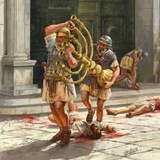
Revelation 9:10 says that these 'locusts' were allowed to attack and torment the city relentlessly for five months. As the besieged people of Jerusalem slowly starved from famine, many of them made graves for themselves, and crawling in, laid there day and night, awaiting death's relief.
"And in those days shall men seek death, and shall not find it; and shall desire to die, and death shall flee from them." Revelation 9:6
Jewish historian Josephus, as well as several Roman historians, recorded that the Roman siege of Jerusalem in 70 AD lasted for five months. Even more significantly, this siege began in mid-April of that year and lasted until late August/ early September, the very same period when locusts would normally appear in Judea.
"And in those days shall men seek death, and shall not find it; and shall desire to die, and death shall flee from them." Revelation 9:6
Jewish historian Josephus, as well as several Roman historians, recorded that the Roman siege of Jerusalem in 70 AD lasted for five months. Even more significantly, this siege began in mid-April of that year and lasted until late August/ early September, the very same period when locusts would normally appear in Judea.
👍5
70 A.D.
Photo
REVELATION 9:13-21
This is the same army as the army of 'locusts', the Roman army (note the nearly identical physical description). In the last judgement, they are given power to *torment* the jews for five months. In this judgement, they are given the power to kill a third of them by fire and other plagues.
"And loosed were the four messengers, who have been made ready for the hour, and day, and month, and year, that they may kill the third of men; and the number of the forces of the horsemen was twice ten thousand ten thousands, and I heard the number of them. by these three were the third of men killed, from the fire, and from the smoke, and from the brimstone, that is proceeding out of their mouth. Revelation 9:15-16, 18
The Greek word for “twice ten thousand” or twenty thousand of v. 16 is “dismyriades.” Each of the three major units of Titus’ army consisted of a dismyriades or 20,000 soldiers. Aside from the Roman army, Titus had a foreign army of 80,000 men including: Macedonians, Britains, Aramites, Africans, Burgundians, Redarans, Persians, and Chaldeans.
It is interesting to note that Josephus states that there were more than 3 million jews in Jerusalem at the time of the siege. Of those 3+ million, 1.1 million died.
Exactly one third.
This is the same army as the army of 'locusts', the Roman army (note the nearly identical physical description). In the last judgement, they are given power to *torment* the jews for five months. In this judgement, they are given the power to kill a third of them by fire and other plagues.
"And loosed were the four messengers, who have been made ready for the hour, and day, and month, and year, that they may kill the third of men; and the number of the forces of the horsemen was twice ten thousand ten thousands, and I heard the number of them. by these three were the third of men killed, from the fire, and from the smoke, and from the brimstone, that is proceeding out of their mouth. Revelation 9:15-16, 18
The Greek word for “twice ten thousand” or twenty thousand of v. 16 is “dismyriades.” Each of the three major units of Titus’ army consisted of a dismyriades or 20,000 soldiers. Aside from the Roman army, Titus had a foreign army of 80,000 men including: Macedonians, Britains, Aramites, Africans, Burgundians, Redarans, Persians, and Chaldeans.
It is interesting to note that Josephus states that there were more than 3 million jews in Jerusalem at the time of the siege. Of those 3+ million, 1.1 million died.
Exactly one third.
👍1