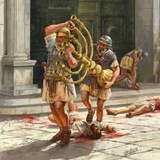
"All this occurred in this manner, in the second year of the reign of Vespasian, according to the predictions of our Lord and Saviour Jesus Christ, who by his divine power foresaw all these things as if already present at the time, who wept and mourned indeed, at the prospect, as the holy evangelists show in their writings. These give us the very words that he uttered, when he said to this same Jerusalem, "If thou didst know, even thou, in this thy day the things that belong to thy peace, but now they are hidden from thy eyes, for the days will come upon thee, and thy enemies shall cast a trench around thee, and shall encompass thee around, and shall everywhere shut thee in, and they shall level thee and thy children with the ground." Afterwards he speaks as if of the people—"For there shall be great distress upon earth, and wrath upon this people, and they shall fall by the edge of the sword, and they shall be carried away captive to all nations, and Jerusalem shall be trodden down by the nations, until the times of the nations shall be fulfilled." And again, "When ye shall see Jerusalem surrounded by armies, then know that her desolation has drawn near."
On comparing the declarations of our Saviour with the other parts of the historian's [Josephus] work, where he describes the whole war, how can one fail to acknowledge and wonder at the truly divine and extraordinary foreknowledge and prediction of our Saviour'?"
- Eusebius, Ecclesiastical History, Book III, Ch. VII
On comparing the declarations of our Saviour with the other parts of the historian's [Josephus] work, where he describes the whole war, how can one fail to acknowledge and wonder at the truly divine and extraordinary foreknowledge and prediction of our Saviour'?"
- Eusebius, Ecclesiastical History, Book III, Ch. VII
👍1
In the Bible “earth” signifies the specific land addressed (Israel), while the “sea” symbolizes foreign nations (Rome).
"Then I stood on the sand of the sea. And I saw a beast rising up out of the sea, having seven heads and ten horns, and on his horns ten crowns, and on his heads a blasphemous name." Rev 13:1
“Who is like the beast?” Rev 13:14
"Thou didst divide the sea by thy strength: thou brakest the heads of the dragons in the waters. Thou brakest the heads of Leviathan in pieces."
Psalm 74:13-14
“Nothing on earth is like him." Job 41:33
"The waters which you saw where the harlot sits, are peoples and multitudes and nations and tongues." Rev 17:15
Then I saw another beast coming up out of the earth, and he had two horns like a lamb and spoke like a dragon. Rev 13:11
Lo, I pray thee, Behemoth, that I made with thee.. He is a beginning of the ways of God, His Maker bringeth nigh his sword. (Job 40:15 , 19)
Behemoth is said to dwell east of Eden “where the chosen and righteous dwell” (1 Enoch 60:8)
"Then I stood on the sand of the sea. And I saw a beast rising up out of the sea, having seven heads and ten horns, and on his horns ten crowns, and on his heads a blasphemous name." Rev 13:1
“Who is like the beast?” Rev 13:14
"Thou didst divide the sea by thy strength: thou brakest the heads of the dragons in the waters. Thou brakest the heads of Leviathan in pieces."
Psalm 74:13-14
“Nothing on earth is like him." Job 41:33
"The waters which you saw where the harlot sits, are peoples and multitudes and nations and tongues." Rev 17:15
Then I saw another beast coming up out of the earth, and he had two horns like a lamb and spoke like a dragon. Rev 13:11
Lo, I pray thee, Behemoth, that I made with thee.. He is a beginning of the ways of God, His Maker bringeth nigh his sword. (Job 40:15 , 19)
Behemoth is said to dwell east of Eden “where the chosen and righteous dwell” (1 Enoch 60:8)
❤3
70 A.D.
In the Bible “earth” signifies the specific land addressed (Israel), while the “sea” symbolizes foreign nations (Rome). "Then I stood on the sand of the sea. And I saw a beast rising up out of the sea, having seven heads and ten horns, and on his horns ten…
“[A] thunderbolt presently struck the Temple of the Caesars, decapitating all the statues at a stroke and dashed Augustus’s sceptre from his hands.”
- Suetonius, Lives of the Twelve Caesars, 7.1
- Suetonius, Lives of the Twelve Caesars, 7.1
🔥1
Crawford-Transcript-With-Glaser-Translation.pdf
1.6 MB
Crawford Codex of the Book of Revelation, Syriac-English Interlinear
Chronology of the War: The Siege and Destruction of Jerusalem, March 70 - September 70
Forwarded from 70 A.D.
First century Laodicea was a renowned centre of banking, finance, fashion, and pharmaceuticals. However, in spite of its great wealth, the city had one major problem. It had no ready source of water.
As such, water had to be piped in through aqueducts from two different sources.
One came from the hot springs in Hierapolis six miles to the north. The other came from a cooler source in Colossae, which was located 10 miles to the east. But, regardless of whether the original water source was hot or cold, it was lukewarm by the time it reached the city of Laodicea.
"So then because thou art lukewarm, and neither cold nor hot, I will spew thee out of my mouth. Because thou sayest, I am rich, and increased with goods, and have need of nothing." Revelation 3:16-17
Laodicea was destroyed by a disastrous earthquake in 62 AD (Tacitus, Annals, 14.27), under the reign of Nero. The only other cities to sustain significant damage, were Colossae and Hierapolis. (Eusebius, Chron. Olymp. 210.4).
As such, water had to be piped in through aqueducts from two different sources.
One came from the hot springs in Hierapolis six miles to the north. The other came from a cooler source in Colossae, which was located 10 miles to the east. But, regardless of whether the original water source was hot or cold, it was lukewarm by the time it reached the city of Laodicea.
"So then because thou art lukewarm, and neither cold nor hot, I will spew thee out of my mouth. Because thou sayest, I am rich, and increased with goods, and have need of nothing." Revelation 3:16-17
Laodicea was destroyed by a disastrous earthquake in 62 AD (Tacitus, Annals, 14.27), under the reign of Nero. The only other cities to sustain significant damage, were Colossae and Hierapolis. (Eusebius, Chron. Olymp. 210.4).