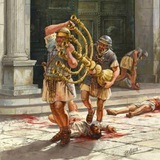
And I saw the dead, small and great, stand before God; and the books were opened: and another book was opened, which is the book of life: and the dead were judged out of those things which were written in the books, according to their works. And the sea gave up the dead which were in it; and death and hell [sheol] delivered up the dead which were in them: and they were judged every man according to their works. And death and hell [sheol] were cast into the lake of fire. This is the second death. (Revelation 20:12 - 14)
At last! The redeemer had come.
O death, where is thy sting? O grave, where is thy victory? The sting of death is sin; and the strength of sin is the law. But thanks be to God, which giveth us the victory through our Lord Jesus Christ. (1 Corinthians 15:55 - 57)
At last! The redeemer had come.
O death, where is thy sting? O grave, where is thy victory? The sting of death is sin; and the strength of sin is the law. But thanks be to God, which giveth us the victory through our Lord Jesus Christ. (1 Corinthians 15:55 - 57)
WARS AND RUMORS OF WARS
And ye shall hear of wars and rumors of wars: see that ye be not troubled: for all these things must come to pass, but the end is not yet. (v 6)
“I am entering on the history of a period rich in disasters, frightful in its wars, torn by civil strife, and even in peace full of horrors. Four emperors perished by the sword. There were three civil wars; there were more with foreign enemies; there were often wars that had both characters at once. There was success in the East, and disaster in the West..” (Tacitus, Histories, I.2)
For nation shall rise against nation, and kingdom against kingdom. (v 7)
During Nero’s reign, Rome went to war with the Parthians, there was a war in Britain and various other rebellious disturbances across the empire. All of these uprisings and wars immediately preceded the Judean War.
At the same time, Judea revolted against Rome, civil war broke out amongst the Judeans, and they began to turn their weapons on one another.
And ye shall hear of wars and rumors of wars: see that ye be not troubled: for all these things must come to pass, but the end is not yet. (v 6)
“I am entering on the history of a period rich in disasters, frightful in its wars, torn by civil strife, and even in peace full of horrors. Four emperors perished by the sword. There were three civil wars; there were more with foreign enemies; there were often wars that had both characters at once. There was success in the East, and disaster in the West..” (Tacitus, Histories, I.2)
For nation shall rise against nation, and kingdom against kingdom. (v 7)
During Nero’s reign, Rome went to war with the Parthians, there was a war in Britain and various other rebellious disturbances across the empire. All of these uprisings and wars immediately preceded the Judean War.
At the same time, Judea revolted against Rome, civil war broke out amongst the Judeans, and they began to turn their weapons on one another.
👍1
FAMINES
"and there shall be famines, and pestilences, and earthquakes, in divers places." (v. 7)
"Then came Tiberius Alexander as successor to Fadus … Under these procurators that great famine happened in Judea, in which queen Helena brought corn in Egypt at a great expense, and distributed it to those that were in want." (Josephus, Antiquities, 20:5:2)
Fadus was governor of Judea from AD 44 - 46, and was replaced by Tiberius Julius Alexander who was governor from AD 46 - 48. This dates the famine to the year AD 46.
"And there stood up one of them named Ag´abus, and signified by the Spirit that there should be great dearth [famine] throughout all the world: which came to pass in the days of Claudius Caesar." Acts 11:28
"Scanty crops too, and consequent famine were regarded as a token of calamity. Nor were there merely whispered complaints; while Claudius was administering justice, the populace crowded round him with a boisterous clamour and drove him to a corner of the forum," (Tacitus. Annals 12:43)
"and there shall be famines, and pestilences, and earthquakes, in divers places." (v. 7)
"Then came Tiberius Alexander as successor to Fadus … Under these procurators that great famine happened in Judea, in which queen Helena brought corn in Egypt at a great expense, and distributed it to those that were in want." (Josephus, Antiquities, 20:5:2)
Fadus was governor of Judea from AD 44 - 46, and was replaced by Tiberius Julius Alexander who was governor from AD 46 - 48. This dates the famine to the year AD 46.
"And there stood up one of them named Ag´abus, and signified by the Spirit that there should be great dearth [famine] throughout all the world: which came to pass in the days of Claudius Caesar." Acts 11:28
"Scanty crops too, and consequent famine were regarded as a token of calamity. Nor were there merely whispered complaints; while Claudius was administering justice, the populace crowded round him with a boisterous clamour and drove him to a corner of the forum," (Tacitus. Annals 12:43)
PESTILENCE
"and there shall be famines, and pestilences, and earthquakes, in divers places." (v. 7)
"A year of shame and of so many evil deeds heaven also marked by storms and pestilence. Campania was devastated by a hurricane, which destroyed everywhere country-houses, plantations and crops, and carried its fury to the neighbourhood of Rome, where a terrible plague was sweeping away all classes of human beings.." (Tacitus, Annals, 16.13)
"To these terrible and shameful calamities brought upon the people by their prince, were added some proceeding from misfortune. Such were a pestilence, by which, within the space of one autumn, there died no less than thirty thousand persons." (Suetonius, Nero, 39)
"In his attempt to root out their very name, he [Nero] put to death Peter and Paul. . . Soon wretched Rome was engulfed by disasters pressing in upon her from every side. The following autumn so great a plague visited the City that thirty thousand funerals were entered in the register.." (Orosius 7.7.1011)
"and there shall be famines, and pestilences, and earthquakes, in divers places." (v. 7)
"A year of shame and of so many evil deeds heaven also marked by storms and pestilence. Campania was devastated by a hurricane, which destroyed everywhere country-houses, plantations and crops, and carried its fury to the neighbourhood of Rome, where a terrible plague was sweeping away all classes of human beings.." (Tacitus, Annals, 16.13)
"To these terrible and shameful calamities brought upon the people by their prince, were added some proceeding from misfortune. Such were a pestilence, by which, within the space of one autumn, there died no less than thirty thousand persons." (Suetonius, Nero, 39)
"In his attempt to root out their very name, he [Nero] put to death Peter and Paul. . . Soon wretched Rome was engulfed by disasters pressing in upon her from every side. The following autumn so great a plague visited the City that thirty thousand funerals were entered in the register.." (Orosius 7.7.1011)
EARTHQUAKES
"and there shall be famines, and pestilences, and earthquakes, in divers places." (v. 7)
"The earth did quake and the rocks split." (Matthew 27:51)
"There was a violent earthquake" (Matthew 28:2)
"There was such a violent earthquake that the foundations of the prison were shaken." (Acts 16:25)
62-64 AD: Pergamum, Laodicea, Hierapolis, and Colossae destroyed by earthquakes. (Tacitus, Annals, 14.27)
Pompeii nearly engulfed by an earthquake. (Tacitus, Annals, 15.22; Josephus, Ant. 20.7.2)
Prior to 70 AD, there were also earthquakes in Crete, Smyrna, Miletus, Chios, Samos, Campania, Rome and Judea.
"and there shall be famines, and pestilences, and earthquakes, in divers places." (v. 7)
"The earth did quake and the rocks split." (Matthew 27:51)
"There was a violent earthquake" (Matthew 28:2)
"There was such a violent earthquake that the foundations of the prison were shaken." (Acts 16:25)
62-64 AD: Pergamum, Laodicea, Hierapolis, and Colossae destroyed by earthquakes. (Tacitus, Annals, 14.27)
Pompeii nearly engulfed by an earthquake. (Tacitus, Annals, 15.22; Josephus, Ant. 20.7.2)
Prior to 70 AD, there were also earthquakes in Crete, Smyrna, Miletus, Chios, Samos, Campania, Rome and Judea.
🔥2
“But woe to you, scribes and Pharisees, hypocrites! For you shut up the kingdom of heaven against men; for you neither go in yourselves, nor do you allow those who are entering to go in." Matthew 23:13
"For there are many unruly and vain talkers and deceivers, specially they of the circumcision: whose mouths must be stopped, who subvert whole houses, teaching things which they ought not, for filthy lucre's sake." Titus 1:10 - 11
Then Jesus said to them, “Take heed and beware of the leaven of the Pharisees and the Sadducees.” Matthew 16:6
A little leaven leavens the whole lump. Galatians 5:9
"For there are many unruly and vain talkers and deceivers, specially they of the circumcision: whose mouths must be stopped, who subvert whole houses, teaching things which they ought not, for filthy lucre's sake." Titus 1:10 - 11
Then Jesus said to them, “Take heed and beware of the leaven of the Pharisees and the Sadducees.” Matthew 16:6
A little leaven leavens the whole lump. Galatians 5:9
🔥2❤1👍1
The scriptures are silent about a millennial reign of the Messiah. Not once does the concept appear anywhere in the Bible. Not a single verse can be produced that mentions or even alludes to such a concept. Virtually every passage of scripture, Old or New, which describes Christ’s reign, places its beginning at his ascension, whence it continues without interruption…forever.
Isa. 9:7 - “Of the increase of his government and peace there shall be no end, upon the throne of David, and upon his kingdom, to order it, and to establish it with judgment and justice from henceforth even forever.”
Dan. 7:13 - "I saw in the night visions, and, behold, one like the Son of man came with the clouds of heaven, and came to the Ancient of days, and they brought him near before him. And there was given him dominion, and glory, and a kingdom, that all people, nations, and languages, should serve him: his dominion is an everlasting dominion, which shall not pass away, and his kingdom that which shall not be destroyed."
Isa. 9:7 - “Of the increase of his government and peace there shall be no end, upon the throne of David, and upon his kingdom, to order it, and to establish it with judgment and justice from henceforth even forever.”
Dan. 7:13 - "I saw in the night visions, and, behold, one like the Son of man came with the clouds of heaven, and came to the Ancient of days, and they brought him near before him. And there was given him dominion, and glory, and a kingdom, that all people, nations, and languages, should serve him: his dominion is an everlasting dominion, which shall not pass away, and his kingdom that which shall not be destroyed."
SATAN - ADVERSARY/APOSTATE
The terminology designating an evil personage in the early writings of the Christian tradition is widely varied, but there are two dominant terms which pervade all the selected literature. The term "Satan," predominantly used in the New Testament more than in any other early Christian writing, is an Aramaic name derived from the root satan which means "to oppose" or "to act as an adversary." The term "Devil," which comes from the Greek word diabolos used in the Septuagint to translate the Aramaic satan, is a more frequently used term in the writings of the Apostolic and early Greek Fathers. Both terms Satan and Devil, however, are to be found in the New Testament as well as in the later writings. The New Testament writers Mark and Paul show a preference for the term Satanas, whereas Matthew more frequently uses the other designation diabolos, but all three authors use both terms. And whereas Justin Martyr, Irenaeus and Origen most frequently speak of the Devil (diabolos), each writer provides us with his own version of the etymological derivation and meaning of the word Satan (adversary or apostate). In short, the two terms are treated as synonyms throughout the early tradition.
So, if this adversary/apostate (Satan) was defeated in 70 AD, and no longer exists, why is there still sin in the world?
Let no man say when he is tempted, I am tempted of God: for God cannot be tempted with evil, neither tempteth he any man: but every man is tempted, when he is drawn away of his own lust, and enticed. Then when lust hath conceived, it bringeth forth sin; and sin, when it is finished, bringeth forth death. (James 1:13 - 15)
Blessed are they whose iniquities are forgiven, and whose sins are covered. Blessed is the man to whom the Lord will not impute sin. (Romans 4:7 - 8)
There is no condemnation for those who are in Christ.
The terminology designating an evil personage in the early writings of the Christian tradition is widely varied, but there are two dominant terms which pervade all the selected literature. The term "Satan," predominantly used in the New Testament more than in any other early Christian writing, is an Aramaic name derived from the root satan which means "to oppose" or "to act as an adversary." The term "Devil," which comes from the Greek word diabolos used in the Septuagint to translate the Aramaic satan, is a more frequently used term in the writings of the Apostolic and early Greek Fathers. Both terms Satan and Devil, however, are to be found in the New Testament as well as in the later writings. The New Testament writers Mark and Paul show a preference for the term Satanas, whereas Matthew more frequently uses the other designation diabolos, but all three authors use both terms. And whereas Justin Martyr, Irenaeus and Origen most frequently speak of the Devil (diabolos), each writer provides us with his own version of the etymological derivation and meaning of the word Satan (adversary or apostate). In short, the two terms are treated as synonyms throughout the early tradition.
So, if this adversary/apostate (Satan) was defeated in 70 AD, and no longer exists, why is there still sin in the world?
Let no man say when he is tempted, I am tempted of God: for God cannot be tempted with evil, neither tempteth he any man: but every man is tempted, when he is drawn away of his own lust, and enticed. Then when lust hath conceived, it bringeth forth sin; and sin, when it is finished, bringeth forth death. (James 1:13 - 15)
Blessed are they whose iniquities are forgiven, and whose sins are covered. Blessed is the man to whom the Lord will not impute sin. (Romans 4:7 - 8)
There is no condemnation for those who are in Christ.
❤2
DEATH SWALLOWED UP IN VICTORY
“Now is the time for judgment on this world; now the prince of this world [death] will be cast out.” (John 12:31)
The last enemy is done away — death. (1 Corinthians 15:26)
Jesus’ resurrection was a true and total defeat of death. As the only begotten Son of God, Jesus overcame death once and for all, as Peter explained: “It was impossible for death to keep its hold on him.” (Acts 2:24)
Christ conquered death because He was sinless. “The wages of sin is death.” But Jesus Christ had no sin (1 Peter 2:22); therefore, death had no power over Him.
At his second coming [70 AD] Jesus said, "I am he that liveth, and was dead; and, behold, I am alive for evermore, Amen; and have the keys of hell and of death." (Revelation 1:18)
And I saw the dead [old covenant, both the righteous and unrighteous who died before Christ], small and great, stand before God; and the books were opened: and another book was opened, which is the book of life: and the dead were judged out of those things which were written in the books, according to their works. And the sea gave up the dead which were in it; and death and hell delivered up the dead which were in them: and they were judged every man according to their works. (This is the resurrection of Daniel 12)
And death and hell were cast into the lake of fire. (Revelation 20:12 - 14)
When Christ conquered death for us, He removed the “sting of death,” sin (1 Corinthians 15:56)— that is, we will no longer be judged by God according to our works; rather, we will stand before God robed in Christ’s own perfect righteousness.
Sin and Death [the accuser, satan] have been swallowed up in victory!
It is finished!
“Now is the time for judgment on this world; now the prince of this world [death] will be cast out.” (John 12:31)
The last enemy is done away — death. (1 Corinthians 15:26)
Jesus’ resurrection was a true and total defeat of death. As the only begotten Son of God, Jesus overcame death once and for all, as Peter explained: “It was impossible for death to keep its hold on him.” (Acts 2:24)
Christ conquered death because He was sinless. “The wages of sin is death.” But Jesus Christ had no sin (1 Peter 2:22); therefore, death had no power over Him.
At his second coming [70 AD] Jesus said, "I am he that liveth, and was dead; and, behold, I am alive for evermore, Amen; and have the keys of hell and of death." (Revelation 1:18)
And I saw the dead [old covenant, both the righteous and unrighteous who died before Christ], small and great, stand before God; and the books were opened: and another book was opened, which is the book of life: and the dead were judged out of those things which were written in the books, according to their works. And the sea gave up the dead which were in it; and death and hell delivered up the dead which were in them: and they were judged every man according to their works. (This is the resurrection of Daniel 12)
And death and hell were cast into the lake of fire. (Revelation 20:12 - 14)
When Christ conquered death for us, He removed the “sting of death,” sin (1 Corinthians 15:56)— that is, we will no longer be judged by God according to our works; rather, we will stand before God robed in Christ’s own perfect righteousness.
Sin and Death [the accuser, satan] have been swallowed up in victory!
It is finished!
👍7
"... Josephus a writer of histories saying, that there was in that time a wise man, if it is proper however, he said, to call a man the creator of marvelous works, who appeared living to his disciples after three days of his death in accordance with the writings of the prophets, who prophesied both this and innumerable other things full of miracles about him; from which began the community of Christians and penetrated into every tribe of men, nor has any nation of the Roman world remained which was left without worship of him."
- Pseudo-Hegesippus, XII, pg. 164
- Pseudo-Hegesippus, XII, pg. 164
"There broke out a prodigious storm in the night, with the utmost violence, and very strong winds, with the largest showers of rain, with continued lightnings, terrible thunderings, and amazing concussions and bellowings of the earth, that was in an earthquake. These things were a manifest indication that some destruction was coming upon men, when the system of the world was put into this disorder; and any one would guess that these wonders foreshowed some grand calamities that were coming." (War, 4.4.5)
"While they were thus talking together, there arose up a great cloud, and lightnings were seen, with fire and darkness, with mighty thunder-claps and showers of hail, that all that saw it were wonderfully afraid, wherefore the people fled wholly, left not only the walls, but Anani also, for they could not abide to tarry any longer: but Anani took heart unto him, and abode it, to mark those horrible signs of heaven which did appear, that he might judge what they betokened." (Joseph Ben Gorion's Yosippon)
"While they were thus talking together, there arose up a great cloud, and lightnings were seen, with fire and darkness, with mighty thunder-claps and showers of hail, that all that saw it were wonderfully afraid, wherefore the people fled wholly, left not only the walls, but Anani also, for they could not abide to tarry any longer: but Anani took heart unto him, and abode it, to mark those horrible signs of heaven which did appear, that he might judge what they betokened." (Joseph Ben Gorion's Yosippon)
🔥1
70 A.D.
"There broke out a prodigious storm in the night, with the utmost violence, and very strong winds, with the largest showers of rain, with continued lightnings, terrible thunderings, and amazing concussions and bellowings of the earth, that was in an earthquake.…
"And he [Anani] gave this judgment indeed (but not according to the truth) that the thunder and hail, with darkness, signified God's help by the hope whereof they should defend the sanctuary of the Lord, so likewise judged all the elders that were with him, without perceiving that all these signs betokened the evils that should come upon Jerusalem and all Israel."
This earthquake/storm was so violent, Mystery Babylon (Jerusalem) was plunged into utter darkness. So much so that people couldn't see each other's faces due to the thickness thereof, and so hid themselves out of fear. God used this particular judgement to give the Edomites a way into the city.
"When they that were shut in the temple perceived that they that kept the watch before the gate of the temple were fled also for fear of the tempest, they went and opened the doors of the temple, and in that darkness, which although it was so great that one could not see another for the thickness thereof, neither durst any of the town once look out of his doors (they were so afraid of those terrible signs of the element) yet came those desperate fellows, the seditious, out of the temple, drew towards the walls without all fear with saws and other instruments, to cut asunder the bars of the gates, and when the crashing of the thunder and hail was greatest, then laboured they hardest, in wresting the locks and bolts off the gates, lest they should be perceived. And ever when the thunder-clap was past, then stayed they and left off till it came again. Thus played they till they had broken and opened the gates, and let the Edomites into the city; who being once come in, wandered here and there for that night, devising how they might set upon the citizens of the town, and utterly deftroy them." (Joseph Ben Gorion's Yosippon)
This earthquake/storm was so violent, Mystery Babylon (Jerusalem) was plunged into utter darkness. So much so that people couldn't see each other's faces due to the thickness thereof, and so hid themselves out of fear. God used this particular judgement to give the Edomites a way into the city.
"When they that were shut in the temple perceived that they that kept the watch before the gate of the temple were fled also for fear of the tempest, they went and opened the doors of the temple, and in that darkness, which although it was so great that one could not see another for the thickness thereof, neither durst any of the town once look out of his doors (they were so afraid of those terrible signs of the element) yet came those desperate fellows, the seditious, out of the temple, drew towards the walls without all fear with saws and other instruments, to cut asunder the bars of the gates, and when the crashing of the thunder and hail was greatest, then laboured they hardest, in wresting the locks and bolts off the gates, lest they should be perceived. And ever when the thunder-clap was past, then stayed they and left off till it came again. Thus played they till they had broken and opened the gates, and let the Edomites into the city; who being once come in, wandered here and there for that night, devising how they might set upon the citizens of the town, and utterly deftroy them." (Joseph Ben Gorion's Yosippon)
SPARTA AND THE TRIBE OF DAN
“Jonathan the high priest, and the elders of the nation, and the priests, and the other of the Judeans, unto the Lacedemonians [Spartans] their brethren send greeting.” (1 Maccabees 12:6)
"The most distinguished of the expelled foreigners [from Egypt] followed Danaus and Cadmus into Greece; but the greater number were led by Moses into Judæa." (Hecateus of Abdera, c. 300 BC)
"They say also that those who set forth with Danaus, likewise from Egypt, settled what is practically the oldest city of Greece, Argos, and that the nations of the Colchi in Pontus and that of the Judean, which lies between Arabia and Syria, were founded as colonies by certain emigrants from their country; and this is the reason why it is a long-established institution among these peoples to circumcise their male children . . . the custom having been brought over from Egypt. Even the Athenians, they say, are colonists from Sais in [the Nile Delta of] Egypt" (Diodorus of Sicily, Book 1, sec. 28, 1-5).
The Greek historian Herodotus reveals that some of the ancient Greeks actually came from Egypt, and that the ancestor of the Dorian princes in southern Greece was a certain "Danae, the daughter of Acrisus" (Herodotus, VI, 1, iii). The term "Dorian" comes from the name of a city of Manasseh, in northern Israel, called "Dor," near the Mediterranean coast. The Dorians were Danites, of the tribe of Dan, perhaps mixed with some of the descendants of Manasseh.
“Danaus, the father of fifty daughters on coming to Argos took up his abode in the city of Inarchos and throughout Hellas (i.e., Greece). He laid down the law that all people hitherto named Pelasgians were to be named Danaans.” (Strabo 5.2.40 quoting Euripides).
"Now, the question remains, how do we know the Spartans were the offspring of the tribe of Dan? . . . Aside from the fact that the Spartans wore long hair as a symbol of their power (like Samson) there is a legend written about the son of Belus, king of the Spartans -- in which is given the story of one named ’Danaus,’ who arrived in Greece with his daughters by ship. According to the legend, his daughters called themselves Danades. They introduced the cult of the mother goddess, which became the established religion of the Arcadians and developed over the years into the worship of Diana. . .The Spartans so loved their king that they called themselves Danaans -- long before they adopted the name of Spartans. Also in the legend is a record of the arrival of ’colonists from Palestine.’ The man who headed the expedition was named Danaus. (Church, p. 120-21)
"In Greek myth. . .[is] the legend of King Belaus, one Danaus, who arrives in Greece with his daughters, by ship. His daughters are said to have introduced the cult of the mother goddess, which became the established cult of the Arcadians. According to Robert Graves the Danaus myth records the arrival in the Peleponnesus of ’colonists from Palestine.’ Graves states that King Belaus is in fact Baal, or Bel -- or perhaps Belial from the Old Testament." (Baigent, Holy Blood, p. 275)
"At that particular time Arcadia was ruled by Spartans. . . The Spartans placed a special magical significance on their long hair . . .associated with their great strength. There appears to have been a relationship between the Spartans and the Judeans. In the Apocryphal we read: ’It has been found in writing concerning the Spartans and the Judeans that they are brethren and are of the family of Abraham.’ (Maccabees I 12:21)"
[Van Buren, p. 45]
"The Judeans said to one another, 'Where does this man intend to go that we cannot find him? Will he go where our people live SCATTERED AMONG THE GREEKS and teach the Greeks?'" (John 7:35).
On an interesting note: The Greek god Hercules shares many affinities with Biblical Samson, who just so happened to be a Danite.
“Jonathan the high priest, and the elders of the nation, and the priests, and the other of the Judeans, unto the Lacedemonians [Spartans] their brethren send greeting.” (1 Maccabees 12:6)
"The most distinguished of the expelled foreigners [from Egypt] followed Danaus and Cadmus into Greece; but the greater number were led by Moses into Judæa." (Hecateus of Abdera, c. 300 BC)
"They say also that those who set forth with Danaus, likewise from Egypt, settled what is practically the oldest city of Greece, Argos, and that the nations of the Colchi in Pontus and that of the Judean, which lies between Arabia and Syria, were founded as colonies by certain emigrants from their country; and this is the reason why it is a long-established institution among these peoples to circumcise their male children . . . the custom having been brought over from Egypt. Even the Athenians, they say, are colonists from Sais in [the Nile Delta of] Egypt" (Diodorus of Sicily, Book 1, sec. 28, 1-5).
The Greek historian Herodotus reveals that some of the ancient Greeks actually came from Egypt, and that the ancestor of the Dorian princes in southern Greece was a certain "Danae, the daughter of Acrisus" (Herodotus, VI, 1, iii). The term "Dorian" comes from the name of a city of Manasseh, in northern Israel, called "Dor," near the Mediterranean coast. The Dorians were Danites, of the tribe of Dan, perhaps mixed with some of the descendants of Manasseh.
“Danaus, the father of fifty daughters on coming to Argos took up his abode in the city of Inarchos and throughout Hellas (i.e., Greece). He laid down the law that all people hitherto named Pelasgians were to be named Danaans.” (Strabo 5.2.40 quoting Euripides).
"Now, the question remains, how do we know the Spartans were the offspring of the tribe of Dan? . . . Aside from the fact that the Spartans wore long hair as a symbol of their power (like Samson) there is a legend written about the son of Belus, king of the Spartans -- in which is given the story of one named ’Danaus,’ who arrived in Greece with his daughters by ship. According to the legend, his daughters called themselves Danades. They introduced the cult of the mother goddess, which became the established religion of the Arcadians and developed over the years into the worship of Diana. . .The Spartans so loved their king that they called themselves Danaans -- long before they adopted the name of Spartans. Also in the legend is a record of the arrival of ’colonists from Palestine.’ The man who headed the expedition was named Danaus. (Church, p. 120-21)
"In Greek myth. . .[is] the legend of King Belaus, one Danaus, who arrives in Greece with his daughters, by ship. His daughters are said to have introduced the cult of the mother goddess, which became the established cult of the Arcadians. According to Robert Graves the Danaus myth records the arrival in the Peleponnesus of ’colonists from Palestine.’ Graves states that King Belaus is in fact Baal, or Bel -- or perhaps Belial from the Old Testament." (Baigent, Holy Blood, p. 275)
"At that particular time Arcadia was ruled by Spartans. . . The Spartans placed a special magical significance on their long hair . . .associated with their great strength. There appears to have been a relationship between the Spartans and the Judeans. In the Apocryphal we read: ’It has been found in writing concerning the Spartans and the Judeans that they are brethren and are of the family of Abraham.’ (Maccabees I 12:21)"
[Van Buren, p. 45]
"The Judeans said to one another, 'Where does this man intend to go that we cannot find him? Will he go where our people live SCATTERED AMONG THE GREEKS and teach the Greeks?'" (John 7:35).
On an interesting note: The Greek god Hercules shares many affinities with Biblical Samson, who just so happened to be a Danite.
❤1🔥1
70 A.D.
SPARTA AND THE TRIBE OF DAN “Jonathan the high priest, and the elders of the nation, and the priests, and the other of the Judeans, unto the Lacedemonians [Spartans] their brethren send greeting.” (1 Maccabees 12:6) "The most distinguished of the expelled…
TUATHA DE DANAAN: ANCIENT IRISH HISTORY AND THE TRIBE OF DAN
Early Irish history reveals that the first permanent settlers in Ireland were called "Nemedians," after their leader, and were "of the patriarch, Jacob" and were "said to have come from the shores of the Euxine [Black] Sea" (Moore, The History of Ireland, Vo.1, p. 63).
The Nemedians dwelt in Ireland from 1709-1492 B.C., during the time most of the descendants of Israel were in Egypt. Before the time of the Exodus, the Nemedians were conquered by sea-rovers called Fomorians, and a colony of them fled to Greece, where other Israelites and Danites had settled, after leaving Egypt. They later returned to Ireland, now known as the Firbolgs. They were the first people to establish royal authority over Ireland, dividing the land into five provinces.
After ruling about 30-40 years, a new tribe conquered the Firbolgs -- called the "Tuatha de Danaan." This tribe also dwelt in Greece, and then migrated to Denmark and Norway, and then to Ireland (Moore, p. 60). The Tuatha de Danaan became the sole masters of the country. In time, they were dispossessed of the country by another group of Israelites -- the Milesian Scots.
Says Moore in The History of Ireland:
"In process of time, the Tuatha-de-Danaan were themselves dispossessed of their sway; a successive invasion from the coast of SPAIN having put and end to the Danaanian dynasty, and transferred the sceptre into the hands of that Milesian or SCOTIC race, which through so long a series of succeeding ages, supplied Ireland with her kings. This celebrated colony, though coming directly from Spain, was originally, we are told, of Scythic race" (p. 60).
The Milesian Scots, under Heremon the son of Gathelus, arrived in Ireland shortly after the Exodus -- bringing with them the celebrated Lia Fail or Pillar-Stone of Jacob. They ruled Ireland for many hundreds of years and eventually settled the northern part of England, calling it Scotland.
These Milesian Scots came from Scythia and said they were originally from Egypt, and connected themselves with the children of Israel. Says Moore:
"Tracing this chosen race in their migrations to different countries, and connecting them, by marriage or friendship, during their long sojourn in Egypt, with most of the heroes of Scripture history, our Bards conduct them at length, by a route not very intelligible, to Spain" (ibid.).
These Scots spoke of a "long sojourn" in Egypt, no doubt the same as that of Israel, from the time of Jacob till Moses, over two hundred years. Says Moore:
"A scheme of descent which traces the ancestors of the Irish through a direct series of generations not merely to the first founders of Phoenician arts and enterprise, but even to chieftains connected by friendship with the prophet Moses himself" (p. 71).
This authority concludes that the Milesian Scots were of the same race as the three colonies in Ireland before them -- that is, the Nemedians, the Firbolgs, and the Tuatha de Danaan. Notice!
"The Bardic historians themselves, who represent the Scoti to have been of Scythic descent and to have from thence derived their distinctive appellation...and to confirm still further the origin of the Scots from that quarter. It is added by the Bards that they were OF THE SAME RACE WITH THE THREE COLONIES that had preceded them; namely, the Nemedians, the Tuatha-de-Danaans, and the firbolgs or Belgae" (p. 74).
Early Irish history reveals that the first permanent settlers in Ireland were called "Nemedians," after their leader, and were "of the patriarch, Jacob" and were "said to have come from the shores of the Euxine [Black] Sea" (Moore, The History of Ireland, Vo.1, p. 63).
The Nemedians dwelt in Ireland from 1709-1492 B.C., during the time most of the descendants of Israel were in Egypt. Before the time of the Exodus, the Nemedians were conquered by sea-rovers called Fomorians, and a colony of them fled to Greece, where other Israelites and Danites had settled, after leaving Egypt. They later returned to Ireland, now known as the Firbolgs. They were the first people to establish royal authority over Ireland, dividing the land into five provinces.
After ruling about 30-40 years, a new tribe conquered the Firbolgs -- called the "Tuatha de Danaan." This tribe also dwelt in Greece, and then migrated to Denmark and Norway, and then to Ireland (Moore, p. 60). The Tuatha de Danaan became the sole masters of the country. In time, they were dispossessed of the country by another group of Israelites -- the Milesian Scots.
Says Moore in The History of Ireland:
"In process of time, the Tuatha-de-Danaan were themselves dispossessed of their sway; a successive invasion from the coast of SPAIN having put and end to the Danaanian dynasty, and transferred the sceptre into the hands of that Milesian or SCOTIC race, which through so long a series of succeeding ages, supplied Ireland with her kings. This celebrated colony, though coming directly from Spain, was originally, we are told, of Scythic race" (p. 60).
The Milesian Scots, under Heremon the son of Gathelus, arrived in Ireland shortly after the Exodus -- bringing with them the celebrated Lia Fail or Pillar-Stone of Jacob. They ruled Ireland for many hundreds of years and eventually settled the northern part of England, calling it Scotland.
These Milesian Scots came from Scythia and said they were originally from Egypt, and connected themselves with the children of Israel. Says Moore:
"Tracing this chosen race in their migrations to different countries, and connecting them, by marriage or friendship, during their long sojourn in Egypt, with most of the heroes of Scripture history, our Bards conduct them at length, by a route not very intelligible, to Spain" (ibid.).
These Scots spoke of a "long sojourn" in Egypt, no doubt the same as that of Israel, from the time of Jacob till Moses, over two hundred years. Says Moore:
"A scheme of descent which traces the ancestors of the Irish through a direct series of generations not merely to the first founders of Phoenician arts and enterprise, but even to chieftains connected by friendship with the prophet Moses himself" (p. 71).
This authority concludes that the Milesian Scots were of the same race as the three colonies in Ireland before them -- that is, the Nemedians, the Firbolgs, and the Tuatha de Danaan. Notice!
"The Bardic historians themselves, who represent the Scoti to have been of Scythic descent and to have from thence derived their distinctive appellation...and to confirm still further the origin of the Scots from that quarter. It is added by the Bards that they were OF THE SAME RACE WITH THE THREE COLONIES that had preceded them; namely, the Nemedians, the Tuatha-de-Danaans, and the firbolgs or Belgae" (p. 74).
🤔1
THE SCOTTISH DECLARATION OF ARBROATH AND THE STONE OF DESTINY
In Arbroath Abbey, following the removal of the "Stone of Destiny" to Westminster, king Robert "the Bruce" of Scotland was visited by two emissaries of pope John 22 to whom Edward 2 of England had appealed for help to compel Scotland to acknowledge England's lordship. These emissaries bore a message from the pope advising Bruce to submit to Edward's claims, but Bruce and his nobles drafted a letter which they addressed to pope John 22 and which can still be seen in Register House in Edinburgh. It had attached to it coloured ribbons and seals with the signatures of Robert the Bruce and twenty-five of his nobles. The letter which is drafted:- April 6, 1320, read in part:-
"We know Most Holy Father and Lord, and from the chronicles and books of the ancients gather, that among other illustrious nations, our's, to wit, the nation of the Scots, has been distinguished by many honours; which passing from the greater Scythia through the Mediterranean Sea and Pillars of Hercules (Gibraltar) and sojourning in Spain (Iberia - Heberia - the Hebrew's land) among most savage tribes through a long course of time, could nowhere be subjugated by any people however barbarous; and coming thence one thousand two hundred years after the outgoing of the People of Israel (the Exodus), they by many victories and infinite toil, acquired for themselves the possessions in the West which they now hold........In their kingdom one hundred and thirteen kings of their own royal stock, no stranger intervening, have reigned... For so long as a hundred of us are left alive we will yield in no least way to English domination. We fight not for glory, nor for wealth nor honour, but only and alone for freedom, which no man surrenders but with his life."
This letter thus asserts that the Scots who had the "Stone of Destiny" ("Lia Fail") were connected with the ancient people of Israel; whom archaeology has established became the Scythians and the Cimmerians of history.
In Arbroath Abbey, following the removal of the "Stone of Destiny" to Westminster, king Robert "the Bruce" of Scotland was visited by two emissaries of pope John 22 to whom Edward 2 of England had appealed for help to compel Scotland to acknowledge England's lordship. These emissaries bore a message from the pope advising Bruce to submit to Edward's claims, but Bruce and his nobles drafted a letter which they addressed to pope John 22 and which can still be seen in Register House in Edinburgh. It had attached to it coloured ribbons and seals with the signatures of Robert the Bruce and twenty-five of his nobles. The letter which is drafted:- April 6, 1320, read in part:-
"We know Most Holy Father and Lord, and from the chronicles and books of the ancients gather, that among other illustrious nations, our's, to wit, the nation of the Scots, has been distinguished by many honours; which passing from the greater Scythia through the Mediterranean Sea and Pillars of Hercules (Gibraltar) and sojourning in Spain (Iberia - Heberia - the Hebrew's land) among most savage tribes through a long course of time, could nowhere be subjugated by any people however barbarous; and coming thence one thousand two hundred years after the outgoing of the People of Israel (the Exodus), they by many victories and infinite toil, acquired for themselves the possessions in the West which they now hold........In their kingdom one hundred and thirteen kings of their own royal stock, no stranger intervening, have reigned... For so long as a hundred of us are left alive we will yield in no least way to English domination. We fight not for glory, nor for wealth nor honour, but only and alone for freedom, which no man surrenders but with his life."
This letter thus asserts that the Scots who had the "Stone of Destiny" ("Lia Fail") were connected with the ancient people of Israel; whom archaeology has established became the Scythians and the Cimmerians of history.
🤔2🔥1