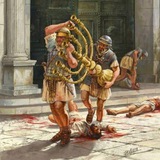
Eusebius, Book III, Chapter V.—The Last Siege of the jews after Christ.
1. After Nero had held the power thirteen years, and Galba and Otho had ruled a year and six months, Vespasian, who had become distinguished in the campaigns against the jews, was proclaimed sovereign in Judea and received the title of Emperor from the armies there. Setting out immediately, therefore, for Rome, he entrusted the conduct of the war against the jews to his son Titus.
2. For the jews after the ascension of our Saviour, in addition to their crime against him, had been devising as many plots as they could against his apostles. First Stephen was stoned to death by them, and after him James, the son of Zebedee and the brother of John, was beheaded, and finally James, the first that had obtained the episcopal seat in Jerusalem after the ascension of our Saviour, died in the manner already described. But the rest of the apostles, who had been incessantly plotted against with a view to their destruction, and had been driven out of the land of Judea, went unto all nations to preach the Gospel, relying upon the power of Christ, who had said to them, “Go ye and make disciples of all the nations in my name.”
3. But the people of the church in Jerusalem had been commanded by a revelation, vouchsafed to approved men there before the war, to leave the city and to dwell in a certain town of Perea called Pella. And when those that believed in Christ had come thither from Jerusalem, then, as if the royal city of the jews and the whole land of Judea were entirely destitute of holy men, the judgment of God at length overtook those who had committed such outrages against Christ and his apostles, and totally destroyed that generation of impious men.
4. But the number of calamities which everywhere fell upon the nation at that time; the extreme misfortunes to which the inhabitants of Judea were especially subjected, the thousands of men, as well as women and children, that perished by the sword, by famine, and by other forms of death innumerable,—all these things, as well as the many great sieges which were carried on against the cities of Judea, and the excessive. sufferings endured by those that fled to Jerusalem itself, as to a city of perfect safety, and finally the general course of the whole war, as well as its particular occurrences in detail, and how at last the abomination of desolation, proclaimed by the prophets, stood in the very temple of God, so celebrated of old, the temple which was now awaiting its total and final destruction by fire,—all these things any one that wishes may find accurately described in the history written by Josephus.
5. But it is necessary to state that this writer records that the multitude of those who were assembled from all Judea at the time of the Passover, to the number of three million souls, were shut up in Jerusalem “as in a prison,” to use his own words.
6. For it was right that in the very days in which they had inflicted suffering upon the Saviour and the Benefactor of all, the Christ of God, that in those days, shut up “as in a prison,” they should meet with destruction at the hands of divine justice.
7. But passing by the particular calamities which they suffered from the attempts made upon them by the sword and by other means, I think it necessary to relate only the misfortunes which the famine caused, that those who read this work may have some means of knowing that God was not long in executing vengeance upon them for their wickedness against the Christ of God.
1. After Nero had held the power thirteen years, and Galba and Otho had ruled a year and six months, Vespasian, who had become distinguished in the campaigns against the jews, was proclaimed sovereign in Judea and received the title of Emperor from the armies there. Setting out immediately, therefore, for Rome, he entrusted the conduct of the war against the jews to his son Titus.
2. For the jews after the ascension of our Saviour, in addition to their crime against him, had been devising as many plots as they could against his apostles. First Stephen was stoned to death by them, and after him James, the son of Zebedee and the brother of John, was beheaded, and finally James, the first that had obtained the episcopal seat in Jerusalem after the ascension of our Saviour, died in the manner already described. But the rest of the apostles, who had been incessantly plotted against with a view to their destruction, and had been driven out of the land of Judea, went unto all nations to preach the Gospel, relying upon the power of Christ, who had said to them, “Go ye and make disciples of all the nations in my name.”
3. But the people of the church in Jerusalem had been commanded by a revelation, vouchsafed to approved men there before the war, to leave the city and to dwell in a certain town of Perea called Pella. And when those that believed in Christ had come thither from Jerusalem, then, as if the royal city of the jews and the whole land of Judea were entirely destitute of holy men, the judgment of God at length overtook those who had committed such outrages against Christ and his apostles, and totally destroyed that generation of impious men.
4. But the number of calamities which everywhere fell upon the nation at that time; the extreme misfortunes to which the inhabitants of Judea were especially subjected, the thousands of men, as well as women and children, that perished by the sword, by famine, and by other forms of death innumerable,—all these things, as well as the many great sieges which were carried on against the cities of Judea, and the excessive. sufferings endured by those that fled to Jerusalem itself, as to a city of perfect safety, and finally the general course of the whole war, as well as its particular occurrences in detail, and how at last the abomination of desolation, proclaimed by the prophets, stood in the very temple of God, so celebrated of old, the temple which was now awaiting its total and final destruction by fire,—all these things any one that wishes may find accurately described in the history written by Josephus.
5. But it is necessary to state that this writer records that the multitude of those who were assembled from all Judea at the time of the Passover, to the number of three million souls, were shut up in Jerusalem “as in a prison,” to use his own words.
6. For it was right that in the very days in which they had inflicted suffering upon the Saviour and the Benefactor of all, the Christ of God, that in those days, shut up “as in a prison,” they should meet with destruction at the hands of divine justice.
7. But passing by the particular calamities which they suffered from the attempts made upon them by the sword and by other means, I think it necessary to relate only the misfortunes which the famine caused, that those who read this work may have some means of knowing that God was not long in executing vengeance upon them for their wickedness against the Christ of God.
❤1👍1🔥1
“Then was fulfilled that which was spoken by the prophet: “I will take away from them the voice of joy and the voice of gladness, the voice of the bridegroom and the voice of the bride, the scent of myrrh, and the light of a lamp, and the whole land shall be destroyed” [Jer. 25:10]. For the whole service of the law has been abolished from them, and henceforth and forever they remain without a feast.” (St. Athanasius, Letters [vi])
Not only were the temple and city destroyed in 70 AD, but the genealogical records of the Levitical priesthood were burned to ashes right along with it. Legitimate sacrifices can never be reestablished, because there is no longer a way to identify the descendants of Levi.
If therefore perfection were by the Levitical priesthood, (for under it the people received the law,) what further need was there that another priest should rise after the order of Melchiz´edek, and not be called after the order of Aaron? For the priesthood being changed, there is made of necessity a change also of the law. And inasmuch as not without an oath he was made priest: (for those priests were made without an oath; but this with an oath by him that said unto him, The Lord sware and will not repent, Thou art a priest for ever after the order of Melchiz´edek:) by so much was Jesus made a surety of a better testament.
Hebrews 7:11 - 12 , 20 - 22
But Christ being come a high priest of good things to come, by a greater and more perfect tabernacle, not made with hands, that is to say, not of this building; neither by the blood of goats and calves, but by his own blood he entered in once into the holy place, having obtained eternal redemption for us.
Hebrews 9:11 - 12
God is true to His word.
Not only were the temple and city destroyed in 70 AD, but the genealogical records of the Levitical priesthood were burned to ashes right along with it. Legitimate sacrifices can never be reestablished, because there is no longer a way to identify the descendants of Levi.
If therefore perfection were by the Levitical priesthood, (for under it the people received the law,) what further need was there that another priest should rise after the order of Melchiz´edek, and not be called after the order of Aaron? For the priesthood being changed, there is made of necessity a change also of the law. And inasmuch as not without an oath he was made priest: (for those priests were made without an oath; but this with an oath by him that said unto him, The Lord sware and will not repent, Thou art a priest for ever after the order of Melchiz´edek:) by so much was Jesus made a surety of a better testament.
Hebrews 7:11 - 12 , 20 - 22
But Christ being come a high priest of good things to come, by a greater and more perfect tabernacle, not made with hands, that is to say, not of this building; neither by the blood of goats and calves, but by his own blood he entered in once into the holy place, having obtained eternal redemption for us.
Hebrews 9:11 - 12
God is true to His word.
Julian the Apostate and the Rebuilding of the Third Temple - in Three Parts
When Flavius Claudius Julianus, Emperor Julian, the Apostate, died in Persia, his supporters failed to maintain support for Hellenism (paganism) as the official state religion, and Christianity re-emerged as dominant.
Julian (born A.D. 332), the nephew of the first Christian emperor, Constantine, was trained as a Christian, yet he is known as the apostate because when he became emperor (A.D. 360) he opposed Christianity.
In his attempt to revive Hellenism, he promised the jews to help rebuild the temple. They hoped by this means to falsify the prophecies of Christ (since Jesus in the New Testament had prophesied the destruction of the Temple, its rebuilding would make of him a false prophet and a liar, thus, proving Christianity to be false).
When Flavius Claudius Julianus, Emperor Julian, the Apostate, died in Persia, his supporters failed to maintain support for Hellenism (paganism) as the official state religion, and Christianity re-emerged as dominant.
Julian (born A.D. 332), the nephew of the first Christian emperor, Constantine, was trained as a Christian, yet he is known as the apostate because when he became emperor (A.D. 360) he opposed Christianity.
In his attempt to revive Hellenism, he promised the jews to help rebuild the temple. They hoped by this means to falsify the prophecies of Christ (since Jesus in the New Testament had prophesied the destruction of the Temple, its rebuilding would make of him a false prophet and a liar, thus, proving Christianity to be false).
70 A.D.
Julian the Apostate and the Rebuilding of the Third Temple - in Three Parts When Flavius Claudius Julianus, Emperor Julian, the Apostate, died in Persia, his supporters failed to maintain support for Hellenism (paganism) as the official state religion, and…
Though the emperor hated and oppressed the Christians, he manifested benevolence and humanity towards the jews. He wrote to the jewish patriarchs and leaders, as well as to the people, requesting them to pray for him,
and for the prosperity of the empire. In taking this step he was not actuated, I am convinced, by any respect for their religion; for he was aware that it is, so to speak, the mother of the Christian religion, and he knew that both religions rest upon the authority of the [biblical] patriarchs and the prophets; but he thought to grieve the Christians by favoring the jews, who are their most inveterate enemies. But perhaps he also calculated upon persuading the jews to embrace paganism and sacrifices; for they were only acquainted with the mere letter of Scripture, and could not, like the Christians and a few of the wisest among the Hebrews, discern the hidden meaning [the allegorical meaning, through which the Christians could prove the validity of Christianity from the OT].
Events proved that this was his real motive; for he sent for some of the chiefs of the race and exhorted them to return to the observance of the laws of Moses and the customs of their fathers. On their replying that because the Temple in Jerusalem was overturned, it was neither lawful nor ancestral to do this in another place than the metropolis out of which they had been cast, he gave them public money, commanded them to rebuild the Temple, and to practice the cult similar to that of their ancestors, by sacrificing after the ancient way.
The jews entered upon the undertaking, without reflecting that, according to the prediction of the holy prophets, it could not be accomplished. They sought for the most skillful artisans, collected materials, cleared the ground, and entered so earnestly upon the task, that even the women carried heaps of earth, and brought their necklaces and other female ornaments towards defraying the expense.
The emperor, the other pagans, and all the jews, regarded every other undertaking as secondary in importance to this.
Although the pagans were not well-disposed towards the jews, yet they assisted them in this enterprise, because they reckoned upon its ultimate success, and hoped by this means to falsify the prophecies of Christ.
Besides this motive, the jews themselves [relying on the sympathy of Julian] were impelled by the consideration that the time had arrived for rebuilding their Temple.
When they had removed the ruins of the former building, they dug up the ground and cleared away its foundation; it is said that on the following day when they were about to lay the first foundation, a great earthquake occurred, and by the violent agitation of the earth, stones were thrown up from the depths, by which those of the jews who were engaged in the work were wounded, as likewise those who were merely looking on. The houses and public porticos, near the site of the Temple, in which they had diverted themselves, were suddenly thrown down; many were caught thereby, some perished immediately, others were found half dead and mutilated of hands or legs, others were injured in other parts of the body. When God caused the earthquake to cease, the workmen who survived again returned to their task, partly because such was the edict of the emperor, and partly because they were themselves interested in the undertaking. Men often, in endeavoring to gratify their own passions, seek what is injurious to them, reject what would be truly advantageous, and are deluded by the idea that nothing is really useful except what is agreeable to them.
When once led astray by this error, they are no longer able to act in a manner conducive to their own interests, or to take warning by the calamities which are visited upon them.
The jews, I believe, were just in this state; for, instead of regarding this unexpected earthquake as a manifest indication that God was opposed to the re-erection of their Temple, they proceeded to recommence the work.
and for the prosperity of the empire. In taking this step he was not actuated, I am convinced, by any respect for their religion; for he was aware that it is, so to speak, the mother of the Christian religion, and he knew that both religions rest upon the authority of the [biblical] patriarchs and the prophets; but he thought to grieve the Christians by favoring the jews, who are their most inveterate enemies. But perhaps he also calculated upon persuading the jews to embrace paganism and sacrifices; for they were only acquainted with the mere letter of Scripture, and could not, like the Christians and a few of the wisest among the Hebrews, discern the hidden meaning [the allegorical meaning, through which the Christians could prove the validity of Christianity from the OT].
Events proved that this was his real motive; for he sent for some of the chiefs of the race and exhorted them to return to the observance of the laws of Moses and the customs of their fathers. On their replying that because the Temple in Jerusalem was overturned, it was neither lawful nor ancestral to do this in another place than the metropolis out of which they had been cast, he gave them public money, commanded them to rebuild the Temple, and to practice the cult similar to that of their ancestors, by sacrificing after the ancient way.
The jews entered upon the undertaking, without reflecting that, according to the prediction of the holy prophets, it could not be accomplished. They sought for the most skillful artisans, collected materials, cleared the ground, and entered so earnestly upon the task, that even the women carried heaps of earth, and brought their necklaces and other female ornaments towards defraying the expense.
The emperor, the other pagans, and all the jews, regarded every other undertaking as secondary in importance to this.
Although the pagans were not well-disposed towards the jews, yet they assisted them in this enterprise, because they reckoned upon its ultimate success, and hoped by this means to falsify the prophecies of Christ.
Besides this motive, the jews themselves [relying on the sympathy of Julian] were impelled by the consideration that the time had arrived for rebuilding their Temple.
When they had removed the ruins of the former building, they dug up the ground and cleared away its foundation; it is said that on the following day when they were about to lay the first foundation, a great earthquake occurred, and by the violent agitation of the earth, stones were thrown up from the depths, by which those of the jews who were engaged in the work were wounded, as likewise those who were merely looking on. The houses and public porticos, near the site of the Temple, in which they had diverted themselves, were suddenly thrown down; many were caught thereby, some perished immediately, others were found half dead and mutilated of hands or legs, others were injured in other parts of the body. When God caused the earthquake to cease, the workmen who survived again returned to their task, partly because such was the edict of the emperor, and partly because they were themselves interested in the undertaking. Men often, in endeavoring to gratify their own passions, seek what is injurious to them, reject what would be truly advantageous, and are deluded by the idea that nothing is really useful except what is agreeable to them.
When once led astray by this error, they are no longer able to act in a manner conducive to their own interests, or to take warning by the calamities which are visited upon them.
The jews, I believe, were just in this state; for, instead of regarding this unexpected earthquake as a manifest indication that God was opposed to the re-erection of their Temple, they proceeded to recommence the work.
70 A.D.
Julian the Apostate and the Rebuilding of the Third Temple - in Three Parts When Flavius Claudius Julianus, Emperor Julian, the Apostate, died in Persia, his supporters failed to maintain support for Hellenism (paganism) as the official state religion, and…
But all parties relate that they had scarcely returned to the undertaking, when fire burst suddenly from the foundations of the Temple, and consumed several of the workmen.
This fact is fearlessly stated, & believed by all; the only discrepancy in the narrative is that some maintain that flame burst from the interior of the Temple, as the workmen were striving to force an entrance, while others say that the fire proceeded - directly from the earth.
In whichever way the phenomenon might have occurred, it is equally wonderful. A more tangible and still more extraordinary miracle ensued; suddenly the sign of the cross appeared spontaneously on the garments of the persons engaged in the undertaking.
These crosses looked like stars, and appeared the work of art. Many were hence led to confess that Christ is God, and that the rebuilding of the Temple was not pleasing to Him; others presented themselves in the church, were initiated, and besought Christ, with hymns and supplications, to pardon their transgression. If any one does not feel disposed to believe my narrative, let him go and be convinced by those who heard the facts I have related from the eyewitnesses of them, for they are still alive.
Let him inquire, also, of the jews and pagans who left the work in an incomplete state, or who, to speak more accurately, were unable to commence it.
The story of this attempted rebuilding of the Temple is found in the Ecclesiastical History written in Greek by Salamanius Hermias Sozomenus about 443-450. Sozomen was a native Palestinian and claimed to have his knowledge from eye-witnesses.
He was a conservative Christian without sympathy for the jews or for Julian.
The End
This fact is fearlessly stated, & believed by all; the only discrepancy in the narrative is that some maintain that flame burst from the interior of the Temple, as the workmen were striving to force an entrance, while others say that the fire proceeded - directly from the earth.
In whichever way the phenomenon might have occurred, it is equally wonderful. A more tangible and still more extraordinary miracle ensued; suddenly the sign of the cross appeared spontaneously on the garments of the persons engaged in the undertaking.
These crosses looked like stars, and appeared the work of art. Many were hence led to confess that Christ is God, and that the rebuilding of the Temple was not pleasing to Him; others presented themselves in the church, were initiated, and besought Christ, with hymns and supplications, to pardon their transgression. If any one does not feel disposed to believe my narrative, let him go and be convinced by those who heard the facts I have related from the eyewitnesses of them, for they are still alive.
Let him inquire, also, of the jews and pagans who left the work in an incomplete state, or who, to speak more accurately, were unable to commence it.
The story of this attempted rebuilding of the Temple is found in the Ecclesiastical History written in Greek by Salamanius Hermias Sozomenus about 443-450. Sozomen was a native Palestinian and claimed to have his knowledge from eye-witnesses.
He was a conservative Christian without sympathy for the jews or for Julian.
The End
70 A.D.
But all parties relate that they had scarcely returned to the undertaking, when fire burst suddenly from the foundations of the Temple, and consumed several of the workmen. This fact is fearlessly stated, & believed by all; the only discrepancy in the narrative…
For more information on Julian the Apostate and the jews, see this link https://web.archive.org/web/20181231000454/http://www.preteristarchive.com/Rome/Monarchs/julian-the-apostate.html
web.archive.org
Julian the Apostate Study Archive
Preterist Study Archive
The Martyr of James the Just.
(Eusebius, Clement, Hegesippus)
"Why do ye ask me concerning Jesus, the Son of Man? He himself sitteth in heaven at the right hand of the great Power, and is ABOUT TO come upon the clouds of heaven." - James the Just
(Eusebius, Clement, Hegesippus)
"Why do ye ask me concerning Jesus, the Son of Man? He himself sitteth in heaven at the right hand of the great Power, and is ABOUT TO come upon the clouds of heaven." - James the Just
🤔1
70 A.D.
One thing today's Christians struggle to understand, is that the Bible is a spiritual (not physical) book from beginning to end. It is about the transition from the old covenant (old heaven and earth), to the new covenant (new heaven and earth). "For if that…
Moreover, thou son of man, take thee one stick, and write upon it, For Judah, and for the children of Israel his companions: then take another stick, and write upon it, For Joseph, the stick of E´phra-im, and for all the house of Israel his companions: and join them one to another into one stick; and they shall become one in thine hand. And say unto them, Thus saith the Lord God; Behold, I will take the children of Israel from among the heathen, whither they be gone, and will gather them on every side, and bring them into their own land: and I will make them one nation in the land upon the mountains of Israel; and one king shall be king to them all: and they shall be no more two nations, neither shall they be divided into two kingdoms any more at all: Moreover I will make a covenant of peace with them; it shall be an everlasting covenant with them: and I will place them, and multiply them, and will set my sanctuary in the midst of them for evermore. My tabernacle also shall be with them: yea, I will be their God, and they shall be my people. And the heathen shall know that I the Lord do sanctify Israel, when my sanctuary shall be in the midst of them for evermore.
Ezekiel 37:16 - 17 , 21 - 22 , 26 - 28
Behold, the tabernacle of God is with men, and he will dwell with them, and they shall be his people, and God himself shall be with them, and be their God. (Revelation 21:3)
Israel is the Church.
Ezekiel 37:16 - 17 , 21 - 22 , 26 - 28
Behold, the tabernacle of God is with men, and he will dwell with them, and they shall be his people, and God himself shall be with them, and be their God. (Revelation 21:3)
Israel is the Church.
70 A.D.
"On the eighth day of the month Xanthicus, and at the ninth hour of the night, so great a light shone round the altar and the holy house, that it appeared to be bright day time; which lasted for half an hour. This light seemed to be a good sign to the unskillful…
In 66 AD, starting at Passover and ending with the feast of Pentecost, God gave three miraculous signs to signify the wrath that would soon befall that wicked generation, and to show them that the old age had come to an end, and the new age (the kingdom of God) would soon begin.
Aside from the great light that shone around the altar for half an hour during Passover (see attached post), there are multiple historians who record the Glory of God leaving the temple at Pentecost and hovering over the Mount of Olives for 3.5 years.
"At that feast which we call Pentecost, as the priests were going by night into the inner temple…they felt a quaking and heard a great noise, and after that they heard a sound as of a great multitude, saying, ‘Let us remove hence'." (Josephus, Wars, 5.6.3)
“A sudden lightening flash from the clouds lit up the Temple. The doors of the holy place abruptly opened, a superhuman voice was heard to declare that the gods were leaving it, and in the same instant came the rushing tumult of their departure”. (Tacitus, Histories, 5.13)
"Which it [Ezekiel 11:22-23] is possible for us to see literally fulfilled in another way even today, since believers in Christ all congregate from all parts of the world, not as of old time because of the glory of Jerusalem, nor that they may worship in the ancient Temple at Jerusalem, but they rest there that they may learn both about the city being taken and devastated as the prophets foretold, and that they may worship at the Mount of Olives opposite to the city, whither the glory of the Lord migrated when it left the former city." (Eusebius of Caesarea: Demonstratio Evangelica, Book 6, chapter 18)
Ezekiel 11:22-23 "Then the cherubim, with the wheels beside them, spread their wings, and the glory of the God of Israel was above them. The glory of the Lord went up from within the city and stopped above the mountain east of it."
"Three and a half years the Shekinah abode upon the Mount of Olives hoping that Israel would repent, but they did not." (Rabbi Jonathan in Midrash Rabbah, Lamentations proem 25)
The third miraculous sign of God's impending wrath, was the opening of the eastern gate of its own accord, as if to welcome the encroaching armies.
“At that same feast, the eastern gate of the inner court at the sixth hour of the night [at midnight] opened of its own accord. This gate was of brass and very large and heavy, seeing that when it was closed each evening it took twenty men to shut it. It had bolts sunk to a great depth into a threshold made of a solid block of stone. . . This again to the uninitiated seemed like the best of signs, as they thought that God had opened to them the gate of blessings; but the wise understood that the security of the Temple was leaving of its own accord and that the opening of the gate showed it was a gift to the enemy” (Josephus, Wars,VI.293-295)
"Moreover there was discerned on the Sanctum Sanctorum, a whole night long, the face of a Man, wonderful terrible." (Joseph Ben Gorion's Yosippon)
*Note the lightnings, earthquake, rumblings (Revelation 8:1, 5)
Aside from the great light that shone around the altar for half an hour during Passover (see attached post), there are multiple historians who record the Glory of God leaving the temple at Pentecost and hovering over the Mount of Olives for 3.5 years.
"At that feast which we call Pentecost, as the priests were going by night into the inner temple…they felt a quaking and heard a great noise, and after that they heard a sound as of a great multitude, saying, ‘Let us remove hence'." (Josephus, Wars, 5.6.3)
“A sudden lightening flash from the clouds lit up the Temple. The doors of the holy place abruptly opened, a superhuman voice was heard to declare that the gods were leaving it, and in the same instant came the rushing tumult of their departure”. (Tacitus, Histories, 5.13)
"Which it [Ezekiel 11:22-23] is possible for us to see literally fulfilled in another way even today, since believers in Christ all congregate from all parts of the world, not as of old time because of the glory of Jerusalem, nor that they may worship in the ancient Temple at Jerusalem, but they rest there that they may learn both about the city being taken and devastated as the prophets foretold, and that they may worship at the Mount of Olives opposite to the city, whither the glory of the Lord migrated when it left the former city." (Eusebius of Caesarea: Demonstratio Evangelica, Book 6, chapter 18)
Ezekiel 11:22-23 "Then the cherubim, with the wheels beside them, spread their wings, and the glory of the God of Israel was above them. The glory of the Lord went up from within the city and stopped above the mountain east of it."
"Three and a half years the Shekinah abode upon the Mount of Olives hoping that Israel would repent, but they did not." (Rabbi Jonathan in Midrash Rabbah, Lamentations proem 25)
The third miraculous sign of God's impending wrath, was the opening of the eastern gate of its own accord, as if to welcome the encroaching armies.
“At that same feast, the eastern gate of the inner court at the sixth hour of the night [at midnight] opened of its own accord. This gate was of brass and very large and heavy, seeing that when it was closed each evening it took twenty men to shut it. It had bolts sunk to a great depth into a threshold made of a solid block of stone. . . This again to the uninitiated seemed like the best of signs, as they thought that God had opened to them the gate of blessings; but the wise understood that the security of the Temple was leaving of its own accord and that the opening of the gate showed it was a gift to the enemy” (Josephus, Wars,VI.293-295)
"Moreover there was discerned on the Sanctum Sanctorum, a whole night long, the face of a Man, wonderful terrible." (Joseph Ben Gorion's Yosippon)
*Note the lightnings, earthquake, rumblings (Revelation 8:1, 5)
🔥2
Peter warned the church that in the last days, there would be scoffers, walking after their own lusts.
knowing this first, that there shall come in the last days scoffers, walking after their own lusts and saying "where is the promise of his coming?". (2 Peter 3:3-4)
When these scoffers/antichrists showed up, John reminded the church that "this is how we know it is the last time."
Little children, it is the last time: and as ye have heard that antichrist shall come, even now are there many antichrists; whereby we know that it is the last time. (1 John 2:18)
Once these scoffers had crept in and started turning believers away from Christ, Jude felt it necessary to send out a reminder letter, telling the church to hold fast to the faith. These were the last-day scoffers the apostles had warned about.
Beloved, when I gave all diligence to write unto you of the common salvation, it was needful for me to write unto you, and exhort you that ye should earnestly contend for the faith which was once delivered unto the saints. For there are certain men crept in unawares, who were before of old ordained to this condemnation, ungodly men, turning the grace of our God into lasciviousness, and denying the only Lord God, and our Lord Jesus Christ. But, beloved, remember ye the words which were spoken before of the apostles of our Lord Jesus Christ; how that they told you there should be mockers in the last time, who should walk after their own ungodly lusts. (Jude 1:3-4 , 17-18)
knowing this first, that there shall come in the last days scoffers, walking after their own lusts and saying "where is the promise of his coming?". (2 Peter 3:3-4)
When these scoffers/antichrists showed up, John reminded the church that "this is how we know it is the last time."
Little children, it is the last time: and as ye have heard that antichrist shall come, even now are there many antichrists; whereby we know that it is the last time. (1 John 2:18)
Once these scoffers had crept in and started turning believers away from Christ, Jude felt it necessary to send out a reminder letter, telling the church to hold fast to the faith. These were the last-day scoffers the apostles had warned about.
Beloved, when I gave all diligence to write unto you of the common salvation, it was needful for me to write unto you, and exhort you that ye should earnestly contend for the faith which was once delivered unto the saints. For there are certain men crept in unawares, who were before of old ordained to this condemnation, ungodly men, turning the grace of our God into lasciviousness, and denying the only Lord God, and our Lord Jesus Christ. But, beloved, remember ye the words which were spoken before of the apostles of our Lord Jesus Christ; how that they told you there should be mockers in the last time, who should walk after their own ungodly lusts. (Jude 1:3-4 , 17-18)
This media is not supported in your browser
VIEW IN TELEGRAM
The Binding of Satan - Satan Cast Out
When Satan Was Bound:
How can Satan cast out Satan? No man can enter into a strong man's house, and spoil his goods, except he will first bind the strong man; and then he will spoil his house. (Mark 3:22-23, 27)
When Satan Was Cast Out:
..but for this cause came I unto this hour. NOW is the judgment of this world: NOW shall the prince of this world be cast out.
(John 12:27, 31)
And the great dragon was cast out, that old serpent, called the Devil, and Satan, which deceiveth the whole world: he was cast out into the earth, and his angels were cast out with him. And I heard a loud voice saying in heaven, NOW is come salvation, and strength, and the kingdom of our God, and the power of his Christ: for the accuser of our brethren is cast down, which accused them before our God day and night.
Woe to the inhabiters of the earth and of the sea! for the devil is come down unto you, having great wrath, because he knoweth that he hath but a short time. (Rev 12:9-10, 12)
When Satan Was Bound:
How can Satan cast out Satan? No man can enter into a strong man's house, and spoil his goods, except he will first bind the strong man; and then he will spoil his house. (Mark 3:22-23, 27)
When Satan Was Cast Out:
..but for this cause came I unto this hour. NOW is the judgment of this world: NOW shall the prince of this world be cast out.
(John 12:27, 31)
And the great dragon was cast out, that old serpent, called the Devil, and Satan, which deceiveth the whole world: he was cast out into the earth, and his angels were cast out with him. And I heard a loud voice saying in heaven, NOW is come salvation, and strength, and the kingdom of our God, and the power of his Christ: for the accuser of our brethren is cast down, which accused them before our God day and night.
Woe to the inhabiters of the earth and of the sea! for the devil is come down unto you, having great wrath, because he knoweth that he hath but a short time. (Rev 12:9-10, 12)
👍2