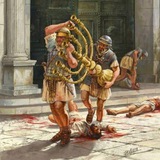
70 A.D.
SIMON MAGUS But there was a certain man, called Simon, which beforetime in the same city used sorcery, and bewitched the people of Samaria, giving out that himself was some great one: to whom they all gave heed, from the least to the greatest, saying, This…
The Egyptian False Prophet
Art not thou that Egyptian, which before these days madest an uproar, and leddest out into the wilderness four thousand men that were murderers?
Acts 21:38
Art not thou that Egyptian, which before these days madest an uproar, and leddest out into the wilderness four thousand men that were murderers?
Acts 21:38
70 A.D.
The Egyptian False Prophet Art not thou that Egyptian, which before these days madest an uproar, and leddest out into the wilderness four thousand men that were murderers? Acts 21:38
The False Prophet at the Burning of the Temple (Josephus, Wars, Book VI, Chapter 5.2)
"And now the Romans, judging that it was in vain to spare what was round about the holy house, burnt all those places; as also the remains of the cloisters, and the gates: two excepted: the one on the east side, and the other on the south. Both which however they burnt afterward. They also burnt down the treasury chambers; in which was an immense quantity of money, and an immense number of garments, and other precious goods there reposited. And, to speak all in a few words, there it was that the intire riches of the Jews were heaped up together: while the rich people had there built themselves chambers. The soldiers also came to the rest of the cloisters that were in the outer temple: whither the women, and children, and a great mixed multitude of the people fled in number about six thousand. But before Cæsar had determined any thing about these people, or given the commanders any orders relating to them, the soldiers were in such a rage, that they set that cloister on fire. By which means it came to pass that some of these were destroyed by throwing themselves down headlong; and some were burnt in the cloisters themselves. Nor did any one of them escape with his life.
A false prophet was the occasion of these peoples destruction: who had made a publick proclamation in the city, that very day, that “God commanded them to get up upon the temple, and that there they should receive miraculous signs of their deliverance.” Now there was then a great number of false prophets, suborned by the tyrants, to impose on the people: who denounced this to them, that they should wait for deliverance from God; and this was in order to keep them from deserting; and that they might be buoyed up above fear and care by such hopes. Now a man that is in adversity does easily comply with such promises. For when such a seducer makes him believe that he shall be delivered from those miseries which oppress him, then it is that the patient is full of hopes of such his deliverance.
Thus were the miserable people persuaded by these deceivers, and such as belied God himself. While they did not attend, nor give credit to the signs that were so evident, and did so plainly foretel their future desolation."
"And now the Romans, judging that it was in vain to spare what was round about the holy house, burnt all those places; as also the remains of the cloisters, and the gates: two excepted: the one on the east side, and the other on the south. Both which however they burnt afterward. They also burnt down the treasury chambers; in which was an immense quantity of money, and an immense number of garments, and other precious goods there reposited. And, to speak all in a few words, there it was that the intire riches of the Jews were heaped up together: while the rich people had there built themselves chambers. The soldiers also came to the rest of the cloisters that were in the outer temple: whither the women, and children, and a great mixed multitude of the people fled in number about six thousand. But before Cæsar had determined any thing about these people, or given the commanders any orders relating to them, the soldiers were in such a rage, that they set that cloister on fire. By which means it came to pass that some of these were destroyed by throwing themselves down headlong; and some were burnt in the cloisters themselves. Nor did any one of them escape with his life.
A false prophet was the occasion of these peoples destruction: who had made a publick proclamation in the city, that very day, that “God commanded them to get up upon the temple, and that there they should receive miraculous signs of their deliverance.” Now there was then a great number of false prophets, suborned by the tyrants, to impose on the people: who denounced this to them, that they should wait for deliverance from God; and this was in order to keep them from deserting; and that they might be buoyed up above fear and care by such hopes. Now a man that is in adversity does easily comply with such promises. For when such a seducer makes him believe that he shall be delivered from those miseries which oppress him, then it is that the patient is full of hopes of such his deliverance.
Thus were the miserable people persuaded by these deceivers, and such as belied God himself. While they did not attend, nor give credit to the signs that were so evident, and did so plainly foretel their future desolation."
Historians Tacitus, Suetonius, and Josephus claimed Vespasian was the messiah, fulfilling an ancient Judean prophecy.
"At that time also there was a writing found graven in an old stone "What time the building of the Temple shall be brought to a foursquare then it shall be destroyed." Now when the Antochia was taken and razed by the Romans and the walls of the temple were all bruised, the jews making speed to repair the ruines and dilapidations, without remembrance of the old writing, they made the temple foursquare. Besides these words were found in the walls of the Sanctum Sanctorum 'When the whole building of the temple shall be foursquare, then shall a King reign over Israel, and that King and Ruler shall reign over all the Land of Israel.'" - Joseph Ben Gorion's Yosippon
“About that time one, from their country, should become governor of the habitable earth. . . The jews took this prediction to belong to themselves in particular: and many of the wise men were thereby deceived in their determination. Now this oracle certainly denoted the government of Vespasian: who was appointed emperor in Judea." - Flavius Josephus, Jewish War 6.312-313
"There had spread over all the Orient an old and established belief, that it was fated for men coming from Judaea to rule the world. This prediction, referring to the emperor of Rome - as afterwards appeared from the event - the people of Judaea took to themselves." - Suetonius, Life of Vespasian 4.5.
"The majority [of the jews] were convinced that the ancient scriptures of their priests alluded to the present as the very time when the Orient would triumph and from Judaea would go forth men destined to rule the world. This mysterious prophecy really referred to Vespasian and Titus, but the common people, true to the selfish ambitions of mankind, thought that this exalted destiny was reserved for them, and not even their calamities opened their eyes to the truth." - Tacitus, Histories 5.13.
"At that time also there was a writing found graven in an old stone "What time the building of the Temple shall be brought to a foursquare then it shall be destroyed." Now when the Antochia was taken and razed by the Romans and the walls of the temple were all bruised, the jews making speed to repair the ruines and dilapidations, without remembrance of the old writing, they made the temple foursquare. Besides these words were found in the walls of the Sanctum Sanctorum 'When the whole building of the temple shall be foursquare, then shall a King reign over Israel, and that King and Ruler shall reign over all the Land of Israel.'" - Joseph Ben Gorion's Yosippon
“About that time one, from their country, should become governor of the habitable earth. . . The jews took this prediction to belong to themselves in particular: and many of the wise men were thereby deceived in their determination. Now this oracle certainly denoted the government of Vespasian: who was appointed emperor in Judea." - Flavius Josephus, Jewish War 6.312-313
"There had spread over all the Orient an old and established belief, that it was fated for men coming from Judaea to rule the world. This prediction, referring to the emperor of Rome - as afterwards appeared from the event - the people of Judaea took to themselves." - Suetonius, Life of Vespasian 4.5.
"The majority [of the jews] were convinced that the ancient scriptures of their priests alluded to the present as the very time when the Orient would triumph and from Judaea would go forth men destined to rule the world. This mysterious prophecy really referred to Vespasian and Titus, but the common people, true to the selfish ambitions of mankind, thought that this exalted destiny was reserved for them, and not even their calamities opened their eyes to the truth." - Tacitus, Histories 5.13.
According to numerous ancient Roman historians, Emperor Vespasian was widely believed to be able to perform holy miracles. Three ancient scholars—Tacitus, Suetonius and Cassius Dio (the first two lived during the reign of Vespasian)—specifically mentioned two instances of miracle healings that Vespasian performed. The healings were both said to have occurred in Alexandria around June or July of the year 70.
*see attached histories*
*see attached histories*
And the great city was divided into three parts, and the cities of the nations fell: and great Babylon came in remembrance before God, to give unto her the cup of the wine of the fierceness of his wrath. (Revelation 16:19)
"it so happened, that the sedition at Jerusalem was revived, and parted into three factions: and that one faction fought against the other. Which partition in such evil cases may be said to be a good thing; and the effect of divine justice. Now as to the attack the zealots made upon the people, and which I esteem the beginning of the cities destruction."
“And now there were three treacherous factions in the city, the one parted from the other. Eleazar [ben Simon] and his party, that kept the sacred first-fruits, came against John [Levi of Gischala] in their cups. Those that were with John plundered the populace and went out with zeal against Simon [Bar Giora].”
Josephus, Wars, 5.1
"it so happened, that the sedition at Jerusalem was revived, and parted into three factions: and that one faction fought against the other. Which partition in such evil cases may be said to be a good thing; and the effect of divine justice. Now as to the attack the zealots made upon the people, and which I esteem the beginning of the cities destruction."
“And now there were three treacherous factions in the city, the one parted from the other. Eleazar [ben Simon] and his party, that kept the sacred first-fruits, came against John [Levi of Gischala] in their cups. Those that were with John plundered the populace and went out with zeal against Simon [Bar Giora].”
Josephus, Wars, 5.1
Moreover I will take from them the voice of mirth, and the voice of gladness, the voice of the bridegroom, and the voice of the bride, the sound of the millstones, and the light of the candle. Jeremiah 25:10
I will cause to cease out of the cites of Judah, and from without Jerusalem, the voice of mirth, and the voice of joy, the voice of the bridegroom, and the voice of the bride: and the whole land shall be desolate of inhabitants. Baruch 2:23
Moreover I will take from them the voice of mirth, and the voice of gladness, the voice of the bridegroom, and the voice of the bride, the sound of the millstones, and the light of the candle. Jeremiah 25:10
and the light of a candle shall shine no more at all in thee; and the voice of the bridegroom and of the bride shall be heard no more at all in thee: for thy merchants were the great men of the earth; for by thy sorceries were all nations deceived. Revelation 18:23
I will cause to cease out of the cites of Judah, and from without Jerusalem, the voice of mirth, and the voice of joy, the voice of the bridegroom, and the voice of the bride: and the whole land shall be desolate of inhabitants. Baruch 2:23
Moreover I will take from them the voice of mirth, and the voice of gladness, the voice of the bridegroom, and the voice of the bride, the sound of the millstones, and the light of the candle. Jeremiah 25:10
and the light of a candle shall shine no more at all in thee; and the voice of the bridegroom and of the bride shall be heard no more at all in thee: for thy merchants were the great men of the earth; for by thy sorceries were all nations deceived. Revelation 18:23
❤1
First century Laodicea was a renowned centre of banking, finance, fashion, and pharmaceuticals. However, in spite of its great wealth, the city had one major problem. It had no ready source of water.
As such, water had to be piped in through aqueducts from two different sources.
One came from the hot springs in Hierapolis six miles to the north. The other came from a cooler source in Colossae, which was located 10 miles to the east. But, regardless of whether the original water source was hot or cold, it was lukewarm by the time it reached the city of Laodicea.
"So then because thou art lukewarm, and neither cold nor hot, I will spew thee out of my mouth. Because thou sayest, I am rich, and increased with goods, and have need of nothing." Revelation 3:16-17
Laodicea was destroyed by a disastrous earthquake in 62 AD (Tacitus, Annals, 14.27), under the reign of Nero. The only other cities to sustain significant damage, were Colossae and Hierapolis. (Eusebius, Chron. Olymp. 210.4).
As such, water had to be piped in through aqueducts from two different sources.
One came from the hot springs in Hierapolis six miles to the north. The other came from a cooler source in Colossae, which was located 10 miles to the east. But, regardless of whether the original water source was hot or cold, it was lukewarm by the time it reached the city of Laodicea.
"So then because thou art lukewarm, and neither cold nor hot, I will spew thee out of my mouth. Because thou sayest, I am rich, and increased with goods, and have need of nothing." Revelation 3:16-17
Laodicea was destroyed by a disastrous earthquake in 62 AD (Tacitus, Annals, 14.27), under the reign of Nero. The only other cities to sustain significant damage, were Colossae and Hierapolis. (Eusebius, Chron. Olymp. 210.4).
Did you know: Giants (as giants are depicted to be) were seen on the hills of Rome during the reigns of both Vitellius and Vespasian.
Dio Cassius, Roman Histories, Book 65
Dio Cassius, Roman Histories, Book 65
👍2🤔2💩1
WAR: And another horse came forth, a red horse: and to him that sat thereon it was given to take peace from the earth, and that they should slay one another: and there was given unto him a great sword.
FAMINE: And I saw, and behold, a black horse; and he that sat thereon had a balance in his hand. And I heard as it were a voice in the midst of the four living creatures saying, A measure of wheat for a shilling, and three measures of barley for a shilling; and the oil and the wine hurt thou not.
PLAGUE/DEATH: And I saw, and behold, a pale horse: and he that sat upon him, his name was Death; and Hades followed with him. And there was given unto them authority over the fourth part of the earth, to kill with sword, and with famine, and with death, and by the wild beasts of the earth. Revelation 6:2 , 4 - 6 , 8
"So thus you see at that time the Lord visited the citizens of Jerusalem with four kind of Plagues: Sword, Pestilence, Hunger and Fire." - Joseph Ben Gorion's, Yossipon, pg. 186
(see attached pic)
FAMINE: And I saw, and behold, a black horse; and he that sat thereon had a balance in his hand. And I heard as it were a voice in the midst of the four living creatures saying, A measure of wheat for a shilling, and three measures of barley for a shilling; and the oil and the wine hurt thou not.
PLAGUE/DEATH: And I saw, and behold, a pale horse: and he that sat upon him, his name was Death; and Hades followed with him. And there was given unto them authority over the fourth part of the earth, to kill with sword, and with famine, and with death, and by the wild beasts of the earth. Revelation 6:2 , 4 - 6 , 8
"So thus you see at that time the Lord visited the citizens of Jerusalem with four kind of Plagues: Sword, Pestilence, Hunger and Fire." - Joseph Ben Gorion's, Yossipon, pg. 186
(see attached pic)
🔥1
Emperor Vespasian sent Joseph Ben Gorion to his son Titus with these instructions:
1. Besiege Jerusalem.
2. If anyone defames Joseph, he is to be executed immediately.
3. If the jews submit to Rome, repair their cities and free them from tribute for two years, on the condition that they set Roman flags upon their walls three times a year, on their most holy feast days.
4. The jews will offer a sacrifice to Rome upon the alter of the holy of holies, every feast day.
5. If they refuse, raze their city to the ground. Kill them with the sword. Take anyone who survives captive.
1. Besiege Jerusalem.
2. If anyone defames Joseph, he is to be executed immediately.
3. If the jews submit to Rome, repair their cities and free them from tribute for two years, on the condition that they set Roman flags upon their walls three times a year, on their most holy feast days.
4. The jews will offer a sacrifice to Rome upon the alter of the holy of holies, every feast day.
5. If they refuse, raze their city to the ground. Kill them with the sword. Take anyone who survives captive.
The destruction of Jerusalem by Titus Vespasian in two parts : as it is acted at the Theatre Royal / written by Mr. Crowne.
Crown, Mr. (John), 1640?-1712
https://archive.org/details/1677-crowne-destruction-of-jerusalem-1873
Crown, Mr. (John), 1640?-1712
https://archive.org/details/1677-crowne-destruction-of-jerusalem-1873
🔥2
"..and the Lord said unto him, Go through the midst of the city, through the midst of Jerusalem, and set a mark upon the foreheads of the men that sigh and that cry for all the abominations that be done in the midst thereof. And to the others he said in mine hearing, Go ye after him through the city, and smite: let not your eye spare, neither have ye pity: slay utterly old and young, both maids, and little children, and women: but come not near any man upon whom is the mark; and begin at my sanctuary. Then they began at the ancient men which were before the house. Then said he unto me, The iniquity of the house of Israel and Judah is exceeding great, and the land is full of blood, and the city full of perverseness: for they say, The Lord hath forsaken the earth, and the Lord seeth not. And as for me also, mine eye shall not spare, neither will I have pity, but I will recompense their way upon their head."
Ezekiel 9:4 - 6 , 9 - 10
Ezekiel 9:4 - 6 , 9 - 10