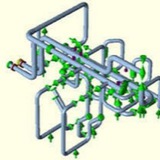
A failure analysis based on ASME Sec-VIII div-2 was done to evaluate ‘Plastic-Collapse’ & ‘Buckling analysis’ using the elastic & elastic-plastic stress methods, by considering the static loads & dynamic loads in combination that act on the 60” pipe header of the flare system. The results were analyzed for the location of buckling failure that occurred during the 1st Failure recorded. The expansion stresses in the pipe header were twice as much higher than that those due to the normal operating temperature loads and were greatest at the time of the failure, when compared to normal operating temperatures. It was found that the failure in the pipe header characterized as the inward plastic collapse could be attribute to 'Buckling' failure mechanism and that may have been caused by multiple static loads creating the pre-stressed state combined with the dynamic load that triggers the actual failure.
The overall vibration characteristics of the 60in flare header piping system, based on the first 15 modes, suggested concerns regarding the presence of maxima / minima and ‘Point of Inflections’ on the 60” section of the main header in the vicinity of Node-3383, which is location of actual failure that occurred during the failure incident. The current configuration of the sulfur lateral branch was also found to provide restraint to the 60" header, such that it is believed to impose unfavorable modes characteristics at the location of actual failure that occurred during the failure incident.
The mode characteristics thus acting on the old (0.375" thickness) header when combined with the high D/t ratio would result in header bending. Under bending, when the cylinder is very long, the flattening of the cross-section leads to large reduction of the effective section modulus of the 60" header, and the instability occurs as a single transverse wave (Buckle) on the compression side of the shell. This phenomenon was attributed to the failure of the 60” sections of flare header piping system. Decreasing the D/t ratio is the most effective way to counter this failure mechanism.
The theoretical solution for the one & two dimensional model of the 60” header cylinder, estimated the critical buckling load under compressive torsional & bending stress to be much higher than what existed in the 60” flare header. However, the modal analysis suggested that given the situation that the flare header piping system would vibrate under a given dynamic condition, it would be much likely that it would do so with a maximum situated at the N-3383, the region of failure incident that occurred. This would be a pre-requisite for a 60” pipe header to buckle at this specific location.
Finite Element Analysis for Piping & Vessel
Engineers using CAESAR II
Engineers using CAESAR II
Experienced stress engineers know that beam element programs like CAESAR II have limitations
that, for certain types of problems, may indicate a stress or loading problem that doesn't exist,
or fail to indicate one that does. The typical scenario is one where larger diameter pipes and their
intersections are inadequately modeled by beam theory.
that, for certain types of problems, may indicate a stress or loading problem that doesn't exist,
or fail to indicate one that does. The typical scenario is one where larger diameter pipes and their
intersections are inadequately modeled by beam theory.
There are also errors and limitations in our existing piping codes that engineers sometimes need to address. Stress intensification factors given by the code are limited and sometimes wrong.
This is not news.
This is not news.
When we attach a pipe or structural support to a bend, what's the SIF supposed to be?
— Piping codes don't address these and many other geometries that we build in practice every day.
— Piping codes don't address these and many other geometries that we build in practice every day.
For these and other problems, finite element analysis (FEA) is the answer, but the ability to
build FEA models, generate good results and relate the results to meaningful piping code stresses
and allowables requires expertise or time that most stress engineers don't have.
build FEA models, generate good results and relate the results to meaningful piping code stresses
and allowables requires expertise or time that most stress engineers don't have.