maximum deflection of 1.6 mm in the direction of load, for combining loads in the
abnormal operation service.
abnormal operation service.
High temperature, high pressure steam piping can fail for many
reasons. This can include some combination of metallurgical,
operational, fabrication, erection and design short comings.
This has proven that high-energy piping systems are not
maintenance free and have a finite service life.\
reasons. This can include some combination of metallurgical,
operational, fabrication, erection and design short comings.
This has proven that high-energy piping systems are not
maintenance free and have a finite service life.\
The ASME B31.1 Code states that piping is “subjected to strain
concentrations due to elastic follow-up of the stiffer or lower
stressed portions."
concentrations due to elastic follow-up of the stiffer or lower
stressed portions."
Advanced creep stress analysis is one
method to do this. However, it is still important to recognize
the conditions that can reduce pipe life and addressing them
method to do this. However, it is still important to recognize
the conditions that can reduce pipe life and addressing them
The Code describes several piping system geometries that can
be the catalyst for elastic follow-up. They Include:
1. Smaller pipe that operates in a higher stress range than
the larger or stiffer pipe to which it is connected.
2. The introduction of reducers or other configurations in
which the pipe section modulus becomes smaller.
3. Pipe material that is, or becomes, locally weaker.
4. The use of insufficient offset to absorb the expansion
strain of the major portion of the piping system.
be the catalyst for elastic follow-up. They Include:
1. Smaller pipe that operates in a higher stress range than
the larger or stiffer pipe to which it is connected.
2. The introduction of reducers or other configurations in
which the pipe section modulus becomes smaller.
3. Pipe material that is, or becomes, locally weaker.
4. The use of insufficient offset to absorb the expansion
strain of the major portion of the piping system.
The Code acknowledges that piping systems self-stress relieve.
This phenomenon occurs when the thermal expansion stresses
in a piping system tend to "relax in the hot condition." The
expansion stresses then appear in the cold condition. Because
they are not consistently applied, these stresses are treated as
secondary stresses. Expansion stresses are compared to an
allowable stress range, which is equivalent to the weighted sum
of the Code's cold (Sc) and hot (Sh) stress allowables.
This phenomenon occurs when the thermal expansion stresses
in a piping system tend to "relax in the hot condition." The
expansion stresses then appear in the cold condition. Because
they are not consistently applied, these stresses are treated as
secondary stresses. Expansion stresses are compared to an
allowable stress range, which is equivalent to the weighted sum
of the Code's cold (Sc) and hot (Sh) stress allowables.
However, the pipe routing and restraint configurations listed
above may not allow high temperature piping to self-stress
relieve. This is a form of elastic follow-up.
above may not allow high temperature piping to self-stress
relieve. This is a form of elastic follow-up.
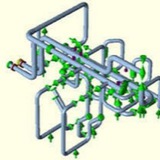
One of the problems with the subject piping system that caused
the elastic follow-up condition is that it was “close coupled”.
Close coupling occurs when a system is inflexible by virtue of
its routing and restraint scheme. The two closely spaced 24” O.
D. turbine leads rise only twelve feet and lack sufficient
flexibility to adequately absorb the expansion developed from
the other one hundred five feet of station piping (Fig. No. 4).
In addition, the situation is further aggravated by the limit stop
installed at the turbine centerline (Fig. No. 5). By virtue of its
design and location, it tended to restrict the piping’s axial
displacement and rotation as well as isolate the north lead,
thereby causing considerable bending, especially in the vicinity
of the failure.
the elastic follow-up condition is that it was “close coupled”.
Close coupling occurs when a system is inflexible by virtue of
its routing and restraint scheme. The two closely spaced 24” O.
D. turbine leads rise only twelve feet and lack sufficient
flexibility to adequately absorb the expansion developed from
the other one hundred five feet of station piping (Fig. No. 4).
In addition, the situation is further aggravated by the limit stop
installed at the turbine centerline (Fig. No. 5). By virtue of its
design and location, it tended to restrict the piping’s axial
displacement and rotation as well as isolate the north lead,
thereby causing considerable bending, especially in the vicinity
of the failure.
One method of verifying if the piping was close coupled is to
test its sensitivity to small changes in the boundary conditions.
The boundary conditions selected were the thermal
displacements of the turbine connections and the free
movement gap of the restraint. Close coupling occurs if the
calculated restraint loads and piping stresses vary greatly with
only minor boundary changes that are well within installation
and operating tolerances.
Using the "as-exists” elastic stress analysis as the basis,
variations were first made to the free movement gap of the
restraint. When the gap was changed by only 1/32", the
combined bending and axial stress at the failure varied by
nearly 1,000 psi from the base values.
Then, the turbine reheat connections’ displacements were
varied. When the thermal displacements of the connections
were changed by only ¼”, the load on the restraint increased
and the stresses at the failure increased significantly.
This high sensitivity of the piping to small changes suggests a
strong susceptibility to inelastic strain resulting in elastic
follow-up. This is especially true since the boundary condition
variations are not unreasonable. That is, restraint tolerancesand equipment displacement tolerances of fractions of an inch
are difficult to maintain. With systems such as this, the
boundary conditions cannot be modeled precisely enough to provide assurance that the elastic analysis accurately calculates
the stresses.
test its sensitivity to small changes in the boundary conditions.
The boundary conditions selected were the thermal
displacements of the turbine connections and the free
movement gap of the restraint. Close coupling occurs if the
calculated restraint loads and piping stresses vary greatly with
only minor boundary changes that are well within installation
and operating tolerances.
Using the "as-exists” elastic stress analysis as the basis,
variations were first made to the free movement gap of the
restraint. When the gap was changed by only 1/32", the
combined bending and axial stress at the failure varied by
nearly 1,000 psi from the base values.
Then, the turbine reheat connections’ displacements were
varied. When the thermal displacements of the connections
were changed by only ¼”, the load on the restraint increased
and the stresses at the failure increased significantly.
This high sensitivity of the piping to small changes suggests a
strong susceptibility to inelastic strain resulting in elastic
follow-up. This is especially true since the boundary condition
variations are not unreasonable. That is, restraint tolerancesand equipment displacement tolerances of fractions of an inch
are difficult to maintain. With systems such as this, the
boundary conditions cannot be modeled precisely enough to provide assurance that the elastic analysis accurately calculates
the stresses.
In contrast, a similar variation of the boiler connection
movements had little effect on the local stresses and restraint
loads. This indicated that the remainder of the hot reheat
piping was not close coupled and hence only the piping near
the turbine was prone to elastic follow-up.
The combination of the inflexible close coupling of the turbinepiping
risers, the influence of the axial restraint and the lateral's
geometry prevented the system from self-stress relieving
locally. The piping became highly sensitive to small changes in
displacements. This favors the potential for accelerated creep
damage. The more highly stressed piping near the turbine is
then subject to excessive plastic deformation and strain
concentrations due to elastic follow-up from the lower stressed
stiffer portions of the piping (i. e. the header).
To recognize the possibility of elastic follow-up conditions
requires an understanding of the phenomenon and experience
in analysis, design and evaluations. As detailed above, the
standard elastic stress analysis did not indicate a problem.
However, an experienced piping engineer should recognize
when the piping is close coupled around the turbine.
Sensitivity analyses involving variations of the turbine
movements, cold spring and limit stopgaps would provide
sufficient data to show that the pipe could be susceptible to
elastic follow-up. Therefore the secondary stresses convert to
the primary level. Hence, it is probable that the actual primary
stresses, especially the bending stresses, at the least stiff
regions of the subject area, far exceed those calculated by the
elastic analysis. As a result the pipe should be rerouted.
movements had little effect on the local stresses and restraint
loads. This indicated that the remainder of the hot reheat
piping was not close coupled and hence only the piping near
the turbine was prone to elastic follow-up.
The combination of the inflexible close coupling of the turbinepiping
risers, the influence of the axial restraint and the lateral's
geometry prevented the system from self-stress relieving
locally. The piping became highly sensitive to small changes in
displacements. This favors the potential for accelerated creep
damage. The more highly stressed piping near the turbine is
then subject to excessive plastic deformation and strain
concentrations due to elastic follow-up from the lower stressed
stiffer portions of the piping (i. e. the header).
To recognize the possibility of elastic follow-up conditions
requires an understanding of the phenomenon and experience
in analysis, design and evaluations. As detailed above, the
standard elastic stress analysis did not indicate a problem.
However, an experienced piping engineer should recognize
when the piping is close coupled around the turbine.
Sensitivity analyses involving variations of the turbine
movements, cold spring and limit stopgaps would provide
sufficient data to show that the pipe could be susceptible to
elastic follow-up. Therefore the secondary stresses convert to
the primary level. Hence, it is probable that the actual primary
stresses, especially the bending stresses, at the least stiff
regions of the subject area, far exceed those calculated by the
elastic analysis. As a result the pipe should be rerouted.