Determine_the_optimal_span_between.pdf
353.7 KB
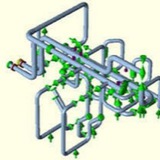
"Determine the optimal span between pipe supports for thin walled piping systems" International Conference on researches in Science and Engineering
28 July 2016, Istanbul University, Turkey
28 July 2016, Istanbul University, Turkey
FE Analysis Report - Saddle:
Design Data:
Design Pressure 3.9 kg/cm² g
Design Temperature 65 °C
Corrosion Allowance 3.0 mm (Shell)
Design Data:
Design Pressure 3.9 kg/cm² g
Design Temperature 65 °C
Corrosion Allowance 3.0 mm (Shell)
For 2100mm Sadddle
Maximum Equivalent Stress (Von Mises) (400.26 MPa Fig 6) occurs in the web plate near web plate to wear pate junction, this is less than the allowable stress 413.67 MPa. Hence provided design is safe.
Maximum Equivalent Stress (Von Mises) (400.26 MPa Fig 6) occurs in the web plate near web plate to wear pate junction, this is less than the allowable stress 413.67 MPa. Hence provided design is safe.
ASME B 31J & B 31J Essentials: Why these are useful in Piping Stress Analysis?
Intergraph has announced an extension of Caesar II 2017 in May 2017. B31J Essentials provides a set of calculations for revised SIFs and flexibility factors, as defined in the code ASME B31J-2017, Stress Intensification Factors (i-Factors), Flexibility Factors (k-Factors) and their Determination for Metallic Piping Components.
By using these revised SIFs and flexibilities, your stress analyses produce more accurate results. B31J Essentials provides the “more applicable data” referenced in recent editions of the piping codes. If someone is current on CAESAR II maintenance and have installed CAESAR II 2017 (v.9.00), He can download the B31J Essentials installer from Intergraph Smart Support (http://smartsupport.intergraph.com) for free and install in their system. This article will try to inform what ASME B31J covers in brief.
For a long time, there was a need for a standard method to develop stress intensification factors (SIFs or i-factors) for ASME piping components and joints. At the time, the B31 Code books provided SIFs for various standard fittings and joints but did not provide guidance on how to conduct further research on existing SIFs or how to establish SIFs for nonstandard and other standard fittings or joints.
ASME B 31J is the outcome of a recent research by MDC on current manufacturing practices in the SIF and k-factor test procedures, to provide a consistent and up-to-date table of SIFs and k-factors for metallic piping components.
ASME B 31J provides a standard approach for the development of SIFs, k-factors, and sustained stress multipliers for piping components and joints of all types, including standard, nonstandard, and proprietary fittings. However, this code still does not cover fittings which have D/T ration greater than 100 for which you have to be dependent on FEA analysis.
Sustained stress multipliers are used to multiply the nominal bending stress due to sustained loading and reflect the collapse capacity of the metallic piping component or joint. Where more accurate sustained stresses are needed but an equation for the sustained stress is not given in the B31 Code book, nominal stresses due to sustained moments computed using the section modulus of the matching pipe should be multiplied by the appropriate sustained stress multiplier. Where the sustained stress is needed and an equation for the sustained stress is given in the Code book as a function of the SIF and provided in lieu of more applicable data, the sustained stress multipliers developed using the method in this Standard may be substituted as more applicable data and used with the nominal stress computed using the section modulus of the matching pipe.