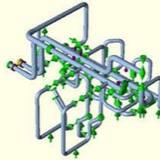
Boundary condition:
For this study, assumed infinite length for buried pipeline. It is acceptable to consider roller
as the boundary of the ends of pipeline because the buried pipeline may be moved with soil
relatively.
Additionally, the bottom surface of 3D-FE soil model is proposed to be completely fixed This
is because the bottom boundary is selected at the known location of a bedrock surface.
For this study, assumed infinite length for buried pipeline. It is acceptable to consider roller
as the boundary of the ends of pipeline because the buried pipeline may be moved with soil
relatively.
Additionally, the bottom surface of 3D-FE soil model is proposed to be completely fixed This
is because the bottom boundary is selected at the known location of a bedrock surface.
There are two type stresses on pipe: inner stress and outer stress. Inner stress is more than
outer stress because of water pressure, so for this study maximum von misses’ stress has
considered.
outer stress because of water pressure, so for this study maximum von misses’ stress has
considered.
For compression von misses stress in pipe line, defined four paths in up, down, right and left
corner of pipeline like pervious section.
Von misses stress of these paths compared in below figures for defined paths.
corner of pipeline like pervious section.
Von misses stress of these paths compared in below figures for defined paths.
It’s obvious from these figures von misses stress in the bottom of pipeline more than upper of pipeline. Von misses’ stress for bottom path of pipelines in depth of 2 m from ground surface is 34 MPa and for the upper path is 20 MPa also for bottom path of pipelines in depth of 4 m from ground surface is 74 MPa and for the upper path is 35 Mpa.
All plots in upper figures have showed stress on pipeline is less than yield stress of gray cast (230 MPa), so there is no plastic strain and plastic deformation.
Water hammer (or, more generally, fluid hammer) is a pressure surge or wave caused when a fluid (usually a liquid but sometimes also a gas) in motion is forced to stop or change direction suddenly (momentum change). A water hammer commonly occurs when a valve closes suddenly at an end of a pipeline system, and a pressure wave propagates in the pipe. It is also called hydraulic shock. This pressure wave can cause major problems, from noise and vibration to pipe collapse. It is possible to reduce the effects of the water hammer pulses with accumulators, expansion tanks and other features.