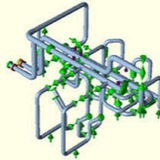
• Refer Fig. 4 and prepare the highlighted load cases additionally for wind analysis. Load cases for L17 to L20 are for code compliance checking and load cases from L5 to L8 for support and Nozzle load checking.
• Refer Fig. 5 and make the combination method as scalar or absolute for the shown load cases.
• In the final stage run the analysis and check results. If failing make suitable adjustments to qualify the same.
Forwarded from Piping Stress Analysis (PSA Group)
Gimbal "Metal Expansion Joints"
Forwarded from Piping Stress Analysis (PSA Group)
Description:
Gimbal Expansion Joints are designed to allow angular movement in any plane by the use of two pairs of hinges affixed to a common floating gimbal ring. The gimbal ring, hinged and pins are designed to restrain the pressure thrust due to internal pressure and shear forces.
A gimbal ring is either round or square. For round gimbals the torsional moment shall be considered and for square gimbals the instability due to the bending shall be considered.
Gimbal Expansion Joints are designed to allow angular movement in any plane by the use of two pairs of hinges affixed to a common floating gimbal ring. The gimbal ring, hinged and pins are designed to restrain the pressure thrust due to internal pressure and shear forces.
A gimbal ring is either round or square. For round gimbals the torsional moment shall be considered and for square gimbals the instability due to the bending shall be considered.
Forwarded from Piping Stress Analysis (PSA Group)
Features:
1-Absorbs angular movements in all planes
2-Restrains pressure thrust forces
3-Transmits shear and wind loads
4-Supports dead weight
5-Avoid twisting the bellows
6-No main anchors required
1-Absorbs angular movements in all planes
2-Restrains pressure thrust forces
3-Transmits shear and wind loads
4-Supports dead weight
5-Avoid twisting the bellows
6-No main anchors required
Forwarded from Piping Stress Analysis (PSA Group)
The capacit y of the Gimbal Expansion Joints to absorb angular movements in any plane is usually applied by using two Gimbal Expansion Joints as shown in the diagram. Only two intermediate fixed points are requiered owing to the fact that the Gimbal system absorbs the thrust produced by the internal pressure. This system of two Gimbal Expansion Joints means that any vertical expansion of the pipes is absorbed by the bend in the horizontal sections of piping and it may therefore be necessary to install spring hangers in both sections.
Forwarded from Piping Stress Analysis (PSA Group)
When it is either impossible or undesirable for the horizontal sections of piping to absorb the expansion of the vertical section, a system composed of two Gimbal Expansion Joints plus one Hinged Expansion Joint must be used as shown in the diagram. The use of a Hinged Expansion Joint is justified by the fact that movement in the vertical section only occurs in one plane.
Forwarded from Piping Stress Analysis (PSA Group)
Hinged " Metal Expansion Joints"
Forwarded from Piping Stress Analysis (PSA Group)
Description:
These expansion joints are made of one single bellows element fitted with welding ends or flanges plus a system of articulated supports which allow for angular movement in one plane only. The hinge mechanism is designed to accept full pressure thrust.
These units do not allow axial movement however, some types of hinge systems can be provided with holes for the hinge pin that are slotted to allow limited axial displacement. These “slotted hinge” types can not resist the pressure thrust forces and therefore proper anchorage must be provided.
These expansion joints are made of one single bellows element fitted with welding ends or flanges plus a system of articulated supports which allow for angular movement in one plane only. The hinge mechanism is designed to accept full pressure thrust.
These units do not allow axial movement however, some types of hinge systems can be provided with holes for the hinge pin that are slotted to allow limited axial displacement. These “slotted hinge” types can not resist the pressure thrust forces and therefore proper anchorage must be provided.
Forwarded from Piping Stress Analysis (PSA Group)
Features:
1-Absorbs angular movements in a single plane
2-Restrains pressure thrust forces
3-Transmits shear and wind loads
4-Supports dead weight
5-Avoid twisting the bellows
6-No main anchors required
1-Absorbs angular movements in a single plane
2-Restrains pressure thrust forces
3-Transmits shear and wind loads
4-Supports dead weight
5-Avoid twisting the bellows
6-No main anchors required