Forwarded from Piping Stress Analysis (PSA Group)
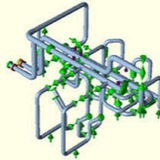
Mechanical vibration analysis is part of a Design Approach 3 of API 618, 5th edition. The scope includes calculating Mechanical Natural Frequencies (MNFs) throughout the system and a Forced Response Analysis to predict vibration and stress amplitudes, if necessary.
Forwarded from Piping Stress Analysis (PSA Group)
Accurate FE modeling, including
“super‐element” compressor frame
“super‐element” compressor frame
PVP2017-65744.pdf
457.3 KB
"STRESS OF LARGE DIAMETER PIPING SYSTEM SHOE SUPPORT"
Proceedings of the ASME 2017 Pressure Vessels & Piping Division Conference, PVP2017, July 16-20, 2017, Waikoloa, Hawaii, United States.
Proceedings of the ASME 2017 Pressure Vessels & Piping Division Conference, PVP2017, July 16-20, 2017, Waikoloa, Hawaii, United States.
ASME_B31J_2008_Test_Method_for_Determining.pdf
438.4 KB
ASME-B31J-2008-Test Method for Determining Stress Intensification Factor
Stress_Intensification_Factor_for.pdf
589.4 KB
PVP2015-45378"Stress Intensification Factor for Large Diameter Welding Tee Connections"
Proceedings of the ASME 2015 Pressure Vessels and Piping Conference, July 19-23, 2015, Boston, Massachusetts
Proceedings of the ASME 2015 Pressure Vessels and Piping Conference, July 19-23, 2015, Boston, Massachusetts
Static Method of Wind Analysis of Piping systems in Caesar II using Pressure Vs elevation Method
Wind load is an occasional load which normally occurs less than 20% of plant operating time. There are two methods for wind analysis-Static and Dynamic.
Criteria for selection of lines for Wind Analysis:
Criteria should be mentioned in ITB document. As a guideline the following can be followed after verification from client:
• Lines with outside diameter 16” and larger (including insulation) running on 10 m and above.
• Steam / Flare header on the pipe rack.
• Other lines considered important as per stress engineer’s decision.
However if lines are covered by some shelter or other structures then wind analysis can be ignored for those lines.
Criteria should be mentioned in ITB document. As a guideline the following can be followed after verification from client:
• Lines with outside diameter 16” and larger (including insulation) running on 10 m and above.
• Steam / Flare header on the pipe rack.
• Other lines considered important as per stress engineer’s decision.
However if lines are covered by some shelter or other structures then wind analysis can be ignored for those lines.
Data Required for Wind Analysis:
For wind analysis you must have following data from the client.
• Wind shape factor: Normally for pipe elements the data varies from 0.6-0.8. Check in ITB what value it says to use.
• Pressure Vs Elevation Profile: Sometimes client provides this profile directly and sometimes provides equation and data to calculate the profile. A typical wind profile will be shown in diagram while explaining the steps required while analyzing using Caesar II.
• Elevation of the line under analysis. If HPP elevation is other than 0 you have to reduce HPP from line global elevation to get actual elevation.
For wind analysis you must have following data from the client.
• Wind shape factor: Normally for pipe elements the data varies from 0.6-0.8. Check in ITB what value it says to use.
• Pressure Vs Elevation Profile: Sometimes client provides this profile directly and sometimes provides equation and data to calculate the profile. A typical wind profile will be shown in diagram while explaining the steps required while analyzing using Caesar II.
• Elevation of the line under analysis. If HPP elevation is other than 0 you have to reduce HPP from line global elevation to get actual elevation.
What to check:
As per code B 31.3 we have to check code compliance of the calculated stress (Sustained +Wind). The allowable stress for wind analysis is 1.33 times Sh values. However sometimes client requires to check the nozzle loading in Operating+ Wind cases (W+T+P+Win) for static equipment. Normally client does not require wind load checking for rotating equipment.
As per code B 31.3 we have to check code compliance of the calculated stress (Sustained +Wind). The allowable stress for wind analysis is 1.33 times Sh values. However sometimes client requires to check the nozzle loading in Operating+ Wind cases (W+T+P+Win) for static equipment. Normally client does not require wind load checking for rotating equipment.