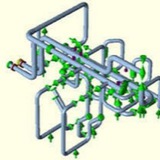
For these and other problems, finite element analysis (FEA) is the answer, but the ability to
build FEA models, generate good results and relate the results to meaningful piping code stresses
and allowables requires expertise or time that most stress engineers don't have.
build FEA models, generate good results and relate the results to meaningful piping code stresses
and allowables requires expertise or time that most stress engineers don't have.
FEATools is a unique collection of FEA software applications specifically developed to solve
piping & vessel problems that beam element and current code limitations prevent you
from solving accurately.
piping & vessel problems that beam element and current code limitations prevent you
from solving accurately.
Why is this important?
Take the large diameter pipe issue - in many cases, stresses and loads are calculated and reported to be much higher in beam analysis programs when compared to reality.
With larger pipe, the solutions to problems that don't exist cost a lot more than solutions to smaller-bore piping problems (where beam theory provides more accurate answers).
The result is that many engineers re-route pipe or otherwise spend a lot of money solving problems that don't really exist.
Take the large diameter pipe issue - in many cases, stresses and loads are calculated and reported to be much higher in beam analysis programs when compared to reality.
With larger pipe, the solutions to problems that don't exist cost a lot more than solutions to smaller-bore piping problems (where beam theory provides more accurate answers).
The result is that many engineers re-route pipe or otherwise spend a lot of money solving problems that don't really exist.
Wouldn't it be nice to click a button & get a better answer?
That's exactly what one of the utilities in the FEATools library does. You point to a CAESAR file,
and FEATools reads the file, identifies the Tees, performs FE analysis, calculates flexibilities and
SIFs, then create a new CAESAR model with these new properties in the model.
That's exactly what one of the utilities in the FEATools library does. You point to a CAESAR file,
and FEATools reads the file, identifies the Tees, performs FE analysis, calculates flexibilities and
SIFs, then create a new CAESAR model with these new properties in the model.
The results can be alarming, and it's so easy to do. To accomplish the same task in the past would
require running FEA software separately, generate the new SIFs and flexibilities, then make
elaborate modifications to the pipe stress model to reflect these changes; very time consuming.
require running FEA software separately, generate the new SIFs and flexibilities, then make
elaborate modifications to the pipe stress model to reflect these changes; very time consuming.
Modules included:
FE107 - FEA on fabricated branch connections: Unreinforced Tees, Pad-reinforced Tees and Laterals
Stresses per ASME Section VIII, Division 2 with comparison to WRC 107 & WRC 297.
FE-107 Screens
FESIF - FEA on fabricated branch connections: Designed to calculate SIFs and stiffness values for
use in CAESAR II.
FEBend - FEA on bends with our without attachments, including piping and structural attachments.
Generate SIFs stiffness and perform full stress evaluations. FEBend Screens
FETee - FEA on contoured Tees. Extruded and B16.9 Tees included. Useful for
evaluating non-compliant Tees.
CAESAR II Enhanced Branch Connection Modeler - Use FEA or ST-LLC-07-02 to apply more
applicable data to a CAESAR II input file than beam-theory and code defaults.
Automatically models FEA-evaluated SIFs and k's and creates a new CAESAR II model with the
modifications. This feature alone is worth the price of admission.
New Branch Connection SIFs and Ks - Display & compare SIF and stiffness factors from a
wide variety of notable sources. Also calculates stresses for various combinations of loads.
New Branch Connection SIF and Ks Screen.
FE107 - FEA on fabricated branch connections: Unreinforced Tees, Pad-reinforced Tees and Laterals
Stresses per ASME Section VIII, Division 2 with comparison to WRC 107 & WRC 297.
FE-107 Screens
FESIF - FEA on fabricated branch connections: Designed to calculate SIFs and stiffness values for
use in CAESAR II.
FEBend - FEA on bends with our without attachments, including piping and structural attachments.
Generate SIFs stiffness and perform full stress evaluations. FEBend Screens
FETee - FEA on contoured Tees. Extruded and B16.9 Tees included. Useful for
evaluating non-compliant Tees.
CAESAR II Enhanced Branch Connection Modeler - Use FEA or ST-LLC-07-02 to apply more
applicable data to a CAESAR II input file than beam-theory and code defaults.
Automatically models FEA-evaluated SIFs and k's and creates a new CAESAR II model with the
modifications. This feature alone is worth the price of admission.
New Branch Connection SIFs and Ks - Display & compare SIF and stiffness factors from a
wide variety of notable sources. Also calculates stresses for various combinations of loads.
New Branch Connection SIF and Ks Screen.
Dynamics of Pipelines with a Finite Element Method.pdf
6.7 MB
Dynamics of Pipelines with a Finite Element Method
Forwarded from Deleted Account
کاتالوگ نفتا صنعت ناظران- 960425.pdf
19.6 MB
Mechanical Vibration Analysis (Design Approach 3, API 618, 5th Edition)
While pulsation forces can be reduced through the pulsation solution (as outlined in Section 2), the remaining
forces such as gas forces, crosshead forces, mass unbalance and couples, cannot be reduced – they must be
controlled through a mechanical vibration analysis. This analysis provides recommendations on piping supports,
package design, piping, clamps, skid, and other components.
forces such as gas forces, crosshead forces, mass unbalance and couples, cannot be reduced – they must be
controlled through a mechanical vibration analysis. This analysis provides recommendations on piping supports,
package design, piping, clamps, skid, and other components.