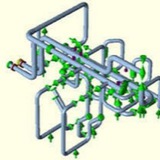
The mode characteristics thus acting on the old (0.375" thickness) header when combined with the high D/t ratio would result in header bending. Under bending, when the cylinder is very long, the flattening of the cross-section leads to large reduction of the effective section modulus of the 60" header, and the instability occurs as a single transverse wave (Buckle) on the compression side of the shell. This phenomenon was attributed to the failure of the 60” sections of flare header piping system. Decreasing the D/t ratio is the most effective way to counter this failure mechanism.
The theoretical solution for the one & two dimensional model of the 60” header cylinder, estimated the critical buckling load under compressive torsional & bending stress to be much higher than what existed in the 60” flare header. However, the modal analysis suggested that given the situation that the flare header piping system would vibrate under a given dynamic condition, it would be much likely that it would do so with a maximum situated at the N-3383, the region of failure incident that occurred. This would be a pre-requisite for a 60” pipe header to buckle at this specific location.
Finite Element Analysis for Piping & Vessel
Engineers using CAESAR II
Engineers using CAESAR II
Experienced stress engineers know that beam element programs like CAESAR II have limitations
that, for certain types of problems, may indicate a stress or loading problem that doesn't exist,
or fail to indicate one that does. The typical scenario is one where larger diameter pipes and their
intersections are inadequately modeled by beam theory.
that, for certain types of problems, may indicate a stress or loading problem that doesn't exist,
or fail to indicate one that does. The typical scenario is one where larger diameter pipes and their
intersections are inadequately modeled by beam theory.
There are also errors and limitations in our existing piping codes that engineers sometimes need to address. Stress intensification factors given by the code are limited and sometimes wrong.
This is not news.
This is not news.
When we attach a pipe or structural support to a bend, what's the SIF supposed to be?
— Piping codes don't address these and many other geometries that we build in practice every day.
— Piping codes don't address these and many other geometries that we build in practice every day.
For these and other problems, finite element analysis (FEA) is the answer, but the ability to
build FEA models, generate good results and relate the results to meaningful piping code stresses
and allowables requires expertise or time that most stress engineers don't have.
build FEA models, generate good results and relate the results to meaningful piping code stresses
and allowables requires expertise or time that most stress engineers don't have.
FEATools is a unique collection of FEA software applications specifically developed to solve
piping & vessel problems that beam element and current code limitations prevent you
from solving accurately.
piping & vessel problems that beam element and current code limitations prevent you
from solving accurately.
Why is this important?
Take the large diameter pipe issue - in many cases, stresses and loads are calculated and reported to be much higher in beam analysis programs when compared to reality.
With larger pipe, the solutions to problems that don't exist cost a lot more than solutions to smaller-bore piping problems (where beam theory provides more accurate answers).
The result is that many engineers re-route pipe or otherwise spend a lot of money solving problems that don't really exist.
Take the large diameter pipe issue - in many cases, stresses and loads are calculated and reported to be much higher in beam analysis programs when compared to reality.
With larger pipe, the solutions to problems that don't exist cost a lot more than solutions to smaller-bore piping problems (where beam theory provides more accurate answers).
The result is that many engineers re-route pipe or otherwise spend a lot of money solving problems that don't really exist.
Wouldn't it be nice to click a button & get a better answer?
That's exactly what one of the utilities in the FEATools library does. You point to a CAESAR file,
and FEATools reads the file, identifies the Tees, performs FE analysis, calculates flexibilities and
SIFs, then create a new CAESAR model with these new properties in the model.
That's exactly what one of the utilities in the FEATools library does. You point to a CAESAR file,
and FEATools reads the file, identifies the Tees, performs FE analysis, calculates flexibilities and
SIFs, then create a new CAESAR model with these new properties in the model.
The results can be alarming, and it's so easy to do. To accomplish the same task in the past would
require running FEA software separately, generate the new SIFs and flexibilities, then make
elaborate modifications to the pipe stress model to reflect these changes; very time consuming.
require running FEA software separately, generate the new SIFs and flexibilities, then make
elaborate modifications to the pipe stress model to reflect these changes; very time consuming.