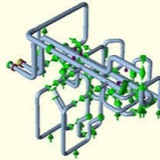
As such, it’s able to analyze how the material responds to pressure, temperatures, fluid and supports, thus helping engineers:
⤵️Observe the pipe’s flexibility and stiffness.
⤵️Determine values such as maximum stresses, forces, displacements and restraints.
⤵️Monitor the limits of stress in piping components and their correspondence to applicable standards.
⤵️Decide on the right support systems to ensure their loads and movements are correct and safe avoiding unsuitable materials that do not support the necessary loads and pressures.
⤵️Notice potential disengagements from support structures and pipes.
⤵️Foresee how mechanical vibrations, seismic loads or acoustic vibrations might influence pipe operations.
⤵️Guarantee pipes are leak-proof to prevent leakage.
⤵️Select appropriate materials that meet strength and durability requirements.
⤵️Determine values such as maximum stresses, forces, displacements and restraints.
⤵️Monitor the limits of stress in piping components and their correspondence to applicable standards.
⤵️Decide on the right support systems to ensure their loads and movements are correct and safe avoiding unsuitable materials that do not support the necessary loads and pressures.
⤵️Notice potential disengagements from support structures and pipes.
⤵️Foresee how mechanical vibrations, seismic loads or acoustic vibrations might influence pipe operations.
⤵️Guarantee pipes are leak-proof to prevent leakage.
⤵️Select appropriate materials that meet strength and durability requirements.
❗️❗️All in all, the main reason to perform pipe stress analysis is to guarantee maximum safety wherever pipe systems are installed, so that pipe failures can be minimized. The right pipe analysis can also extend the pipe’s life cycle and ensure the quality and integrity of the transported product.
Main types of piping stresses
Certain pressure, temperature and vibration conditions, as well as occasional loads, all have an impact on pipe systems. As such, the main piping stresses can be divided in 5 categories:
Certain pressure, temperature and vibration conditions, as well as occasional loads, all have an impact on pipe systems. As such, the main piping stresses can be divided in 5 categories:
Hoop stress:
a type of uniform pressure applied internally or externally, it can have an impact on the pipe’s diameter and wall thickness.
a type of uniform pressure applied internally or externally, it can have an impact on the pipe’s diameter and wall thickness.
Axial stress:
caused by factors such as thermal or pressure expansions, as well as applied forces that result in the pipe’s restrained axial growth. As different materials react differently to this type of stress, pipe stress analysis remains crucial to detect this issue.
caused by factors such as thermal or pressure expansions, as well as applied forces that result in the pipe’s restrained axial growth. As different materials react differently to this type of stress, pipe stress analysis remains crucial to detect this issue.
Bending stress:
it originates by certain body forces that can be concentrated (such as those related to valves) or occasional (such as the ones created by atmospheric forces, including seismic movements or extreme wind events). Bending stress can also be detected as forced displacements that are generated by the growth of other equipment and piping that ultimately impacts the analyzed pipe.
it originates by certain body forces that can be concentrated (such as those related to valves) or occasional (such as the ones created by atmospheric forces, including seismic movements or extreme wind events). Bending stress can also be detected as forced displacements that are generated by the growth of other equipment and piping that ultimately impacts the analyzed pipe.
Torsional stress:
caused by body forces that bring about rotational moments around the pipe axis.
caused by body forces that bring about rotational moments around the pipe axis.
Fatigue stress:
this is created by the combination of continuous stresses that may impact certain pipe systems.
this is created by the combination of continuous stresses that may impact certain pipe systems.
🔔❗️Additionally, it’s also important to understand the three categories of loads that influence pipe stress:
⏩ Primary or sustained stresses, which account for 55% of the standard allowable stress following ASME standards.
⏩Displacement stresses, which should be kept between 80% to 90% of allowed ASME requirements and can be reduced by adding flexibility to the piping system
⏩Occasional stresses, originated by one-time events (typically related to seismic movements, extreme wind events or relief-thrust loads). ASME codes allow for certain increases in the event of these stresses, including allowing a 15% increase if the event lasts less than 8 hours and less than 800 hours per year (wind-related) and a 20% increase if the event lasts less than 1 hour and less than 80 hours per year (seismic movements and relief thrust).
A pneumatic conveying system is a method of transporting materials, typically bulk solids like powders and granules, through a network of pipes using compressed air or another gas. These systems offer a versatile and efficient way to move materials over both short and long distances, finding applications in various industries.
⬇️ There are 3 types of pneumatic conveyors
# Dense phase pneumatic conveyor
⏩ In dense phase conveying, the material is conveyed in a more concentrated, slower-moving plug or slug within the pipeline. This method is suitable for lighter or more fragile materials, and it reduces the risk of material degradation when tablets or other small parts are transferred which are prone to chipping in the transferring process. Dense phase conveying is often used for short distances. It is important when gentle handling of the material is needed.
⏩ In dense phase conveying, the material is conveyed in a more concentrated, slower-moving plug or slug within the pipeline. This method is suitable for lighter or more fragile materials, and it reduces the risk of material degradation when tablets or other small parts are transferred which are prone to chipping in the transferring process. Dense phase conveying is often used for short distances. It is important when gentle handling of the material is needed.
#Medium phase pneumatic conveyor
⏩Medium phase conveying falls between lean phase and dense phase conveying in terms of material concentration. The velocity is higher than that of dense phase conveying but lower than dilute phase conveying. Medium-phase conveying is a balance between dilute and dense phase. It provides a flexible solution for materials that fall in between these two types.
⏩Medium phase conveying falls between lean phase and dense phase conveying in terms of material concentration. The velocity is higher than that of dense phase conveying but lower than dilute phase conveying. Medium-phase conveying is a balance between dilute and dense phase. It provides a flexible solution for materials that fall in between these two types.
#Dilute (lean) phase pneumatic conveyor
⏩ In dilute phase conveying, the material is transported in suspension within a stream of air or gas. The terms "dilute phase" and “lean phase” are thereby often used interchangeably. The material is usually moved at high speeds. The amount of material in the air is low inside the conveying line. Dilute phase or lean phase conveying is suitable for heavier materials and is often used for longer-distance transport.
⏩ In dilute phase conveying, the material is transported in suspension within a stream of air or gas. The terms "dilute phase" and “lean phase” are thereby often used interchangeably. The material is usually moved at high speeds. The amount of material in the air is low inside the conveying line. Dilute phase or lean phase conveying is suitable for heavier materials and is often used for longer-distance transport.
Forwarded from Pdms & piping
❤️ آری به اتفاق جهان میتوان گرفت
🌺 به همت و نیکی شما خوبان از امروز 24 مهر، 6مین طرح مهر قلم را برای سیستان و بلوچستان آغاز می کنیم
❤️سمینار گلریزان
✅اصول طراحی پایپینگ با نرم افزار PDMS با تدریس مهندس رحمانپور برای دریافت فایل های آموزشی به ID:@Roham1234567890 پیام بدهید.
💢هزینه آموزش ۳۵۰ هزارتومان
❤️برای سیستان بلوچستان
🌷هدف مهربانی : 800 میلیون تومان برای 400 دانش آموز وطن
⚡️حضور برای توزیع قاصدک های مهربانی : هفته اول آبان 1404
❤️نحوه واریز:
✅شماره کارت بانک توسعه تعاون
5029081031797406
بنام ابراهیم خیِّر
شماره شبا
IR190220142302013719535001
پس از واریز مهربانی به آیدی زیر پیام ارسال فرمایید
@Roham1234567890
مهندس رحمانپور
✅پکیچ آموزشی بصورت آفلاین میباشد ولی پشتیبانی انلاین بصورت کامل دارد.
https://t.me/joinchat/AAAAAFXXehmMZsI0YNDwfQ
🌺 به همت و نیکی شما خوبان از امروز 24 مهر، 6مین طرح مهر قلم را برای سیستان و بلوچستان آغاز می کنیم
❤️سمینار گلریزان
✅اصول طراحی پایپینگ با نرم افزار PDMS با تدریس مهندس رحمانپور برای دریافت فایل های آموزشی به ID:@Roham1234567890 پیام بدهید.
💢هزینه آموزش ۳۵۰ هزارتومان
❤️برای سیستان بلوچستان
🌷هدف مهربانی : 800 میلیون تومان برای 400 دانش آموز وطن
⚡️حضور برای توزیع قاصدک های مهربانی : هفته اول آبان 1404
❤️نحوه واریز:
✅شماره کارت بانک توسعه تعاون
5029081031797406
بنام ابراهیم خیِّر
شماره شبا
IR190220142302013719535001
پس از واریز مهربانی به آیدی زیر پیام ارسال فرمایید
@Roham1234567890
مهندس رحمانپور
✅پکیچ آموزشی بصورت آفلاین میباشد ولی پشتیبانی انلاین بصورت کامل دارد.
https://t.me/joinchat/AAAAAFXXehmMZsI0YNDwfQ
Telegram
طرحمهر قلم ۱۴۰۵
❤️ هفتمین طرح مهر قلم ۱۴۰۵ برای سیستان و بلوچستان
💥نحوه واریز
شماره کارت بانک توسعه تعاون
5029081031797406
بنام ابراهیم خیِّر
💟اطلاع رسانی پویش
https://t.me/+Vdd6GYxmwjRg0P
💥نحوه واریز
شماره کارت بانک توسعه تعاون
5029081031797406
بنام ابراهیم خیِّر
💟اطلاع رسانی پویش
https://t.me/+Vdd6GYxmwjRg0P
Dear All,
As 2025 draws to a close, I would like to extend my warmest wishes to all group member. May this festive season bring joy and peace, and may the New Year be filled with success and exciting opportunities.
I wish everyone a prosperous 2026. We look forward to achieving great things together.
Warm Regards,
Akbar Daneshvar
PSA Group
As 2025 draws to a close, I would like to extend my warmest wishes to all group member. May this festive season bring joy and peace, and may the New Year be filled with success and exciting opportunities.
I wish everyone a prosperous 2026. We look forward to achieving great things together.
Warm Regards,
Akbar Daneshvar
PSA Group