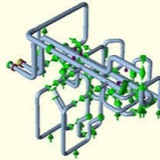
Variable spring hanger supports are used at locations that are subjected to vertical thermal displacements. The size and type of variable spring hangers to be used depends on the load requirements and the method of installation. The actual load for which the spring is to support (hot condition), and the amount and direction of the pipe line movement from the cold to the hot position is required to properly determine sizes.
training-Support(1).pdf
4 MB
training-Support(1).pdf
❗️What is pipe stress analysis and how to perform it?
Pipe stress analysis is a crucial operation in both pipe design and maintenance operations.
As pipe failures might lead to critical situations, the performance of correct pipe stress calculations becomes essential to ensure maximum safety and efficiency while verifying pipe design has been correct in order to extend the product’s life cycle.
As pipe failures might lead to critical situations, the performance of correct pipe stress calculations becomes essential to ensure maximum safety and efficiency while verifying pipe design has been correct in order to extend the product’s life cycle.
What is pipe stress analysis?
Pipe stress analysis is a testing method that examines a piping system’s behavior under different loading situations.
Pipe stress analysis is a testing method that examines a piping system’s behavior under different loading situations.
As such, it’s able to analyze how the material responds to pressure, temperatures, fluid and supports, thus helping engineers:
⤵️Observe the pipe’s flexibility and stiffness.
⤵️Determine values such as maximum stresses, forces, displacements and restraints.
⤵️Monitor the limits of stress in piping components and their correspondence to applicable standards.
⤵️Decide on the right support systems to ensure their loads and movements are correct and safe avoiding unsuitable materials that do not support the necessary loads and pressures.
⤵️Notice potential disengagements from support structures and pipes.
⤵️Foresee how mechanical vibrations, seismic loads or acoustic vibrations might influence pipe operations.
⤵️Guarantee pipes are leak-proof to prevent leakage.
⤵️Select appropriate materials that meet strength and durability requirements.
⤵️Determine values such as maximum stresses, forces, displacements and restraints.
⤵️Monitor the limits of stress in piping components and their correspondence to applicable standards.
⤵️Decide on the right support systems to ensure their loads and movements are correct and safe avoiding unsuitable materials that do not support the necessary loads and pressures.
⤵️Notice potential disengagements from support structures and pipes.
⤵️Foresee how mechanical vibrations, seismic loads or acoustic vibrations might influence pipe operations.
⤵️Guarantee pipes are leak-proof to prevent leakage.
⤵️Select appropriate materials that meet strength and durability requirements.
❗️❗️All in all, the main reason to perform pipe stress analysis is to guarantee maximum safety wherever pipe systems are installed, so that pipe failures can be minimized. The right pipe analysis can also extend the pipe’s life cycle and ensure the quality and integrity of the transported product.
Main types of piping stresses
Certain pressure, temperature and vibration conditions, as well as occasional loads, all have an impact on pipe systems. As such, the main piping stresses can be divided in 5 categories:
Certain pressure, temperature and vibration conditions, as well as occasional loads, all have an impact on pipe systems. As such, the main piping stresses can be divided in 5 categories: