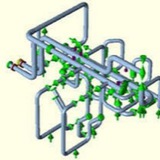
Determining support locations
Support places are dependent on many factors, such as pipe size, piping configuration, the location of heavy attachments such as valves and fittings, etc. The movement anticipated at support points dictates the type of support required. The selected type of pipe support must be capable of accommodating movements.
It is suggested to select first the simpler or basic rigid pipe support type and add complexity as conditions warrant. It is better to use more simpler and economical types that satisfy the design requirements than more complex ones.
Support places are dependent on many factors, such as pipe size, piping configuration, the location of heavy attachments such as valves and fittings, etc. The movement anticipated at support points dictates the type of support required. The selected type of pipe support must be capable of accommodating movements.
It is suggested to select first the simpler or basic rigid pipe support type and add complexity as conditions warrant. It is better to use more simpler and economical types that satisfy the design requirements than more complex ones.
Types of Pipe Supports
ANCHORS
Rigid pipe supports that restricts movement in orthogonal directions and rotational directions. This usually is a part that is welded or bolted to steel or concrete.
There are two types of anchors: fixed anchors and directional anchors.
Fixed anchors used in those cases where movement in a line must be prevented. This is called as a ‘fixing point’. The most basic way to anchor a pipe is to weld it directly to support or structural part. For insulated pipes, a pipe shoe is welded and then the pipe shoe is welded to the structure.
Directional anchors allow movement to occur in one direction while restricting it from in the opposite direction. Directional anchors lead a pipe’s movement away from structures, buildings, , equipment etc.
ANCHORS
Rigid pipe supports that restricts movement in orthogonal directions and rotational directions. This usually is a part that is welded or bolted to steel or concrete.
There are two types of anchors: fixed anchors and directional anchors.
Fixed anchors used in those cases where movement in a line must be prevented. This is called as a ‘fixing point’. The most basic way to anchor a pipe is to weld it directly to support or structural part. For insulated pipes, a pipe shoe is welded and then the pipe shoe is welded to the structure.
Directional anchors allow movement to occur in one direction while restricting it from in the opposite direction. Directional anchors lead a pipe’s movement away from structures, buildings, , equipment etc.
DUMMY LEG SUPPORTS
Dummy legs are extension parts welded to elbows to support a pipeline and rests or anchors on steel components.
Size of pipe, length, and wall thickness of the pipe-extension depends on various aspects.
Dummy legs are extension parts welded to elbows to support a pipeline and rests or anchors on steel components.
Size of pipe, length, and wall thickness of the pipe-extension depends on various aspects.
HANGER RODS
Vertical support that incorporates a rod. It may be a rigid, variable spring or constant support hanger.
Rod hangers or pipe hangers fixed to the pipe by a clevis, U bolt, a pipe clamp, etc.
The rod hanger gives support in the vertical direction and permits limited movement in the horizontal direction.
Vertical support that incorporates a rod. It may be a rigid, variable spring or constant support hanger.
Rod hangers or pipe hangers fixed to the pipe by a clevis, U bolt, a pipe clamp, etc.
The rod hanger gives support in the vertical direction and permits limited movement in the horizontal direction.
GUIDES
If restriction of pipe movement isn’t required, guides are used.
Pipe guides constrict movement along the pipe’s linear axis. This is called as a ‘sliding point’. Guides mainly used to maintain appropriate line spacing in a pipe rack and they restrict lateral or sideway movement.
Different than the pipe anchor, the guide permits pipe to slide.
If restriction of pipe movement isn’t required, guides are used.
Pipe guides constrict movement along the pipe’s linear axis. This is called as a ‘sliding point’. Guides mainly used to maintain appropriate line spacing in a pipe rack and they restrict lateral or sideway movement.
Different than the pipe anchor, the guide permits pipe to slide.
CONSTANT LOAD HANGER
A particularly engineered hanger that is designed to move through many inches of vertical movement with a minimal change in support load. There are different designs and types depending on the producers.
Constant hangers and constant supports are used when higher levels of vertical travel occur. Their function is to transfer the working load over the whole travel area while maintaining constancy, i.e., without any considerable deviations.
A particularly engineered hanger that is designed to move through many inches of vertical movement with a minimal change in support load. There are different designs and types depending on the producers.
Constant hangers and constant supports are used when higher levels of vertical travel occur. Their function is to transfer the working load over the whole travel area while maintaining constancy, i.e., without any considerable deviations.
VARIABLE SPRING HANGERS AND SUPPORTS
Helical coils that are used to support a dead weight load and allow movement. Spring supports use helical coil compression springs Helical Coil Compression is the critical component in both the type of spring supports
Helical coils that are used to support a dead weight load and allow movement. Spring supports use helical coil compression springs Helical Coil Compression is the critical component in both the type of spring supports
HYDRAULIC SHOCK ABSORBERS
Shock absorbers mostly preferred in piping systems that are thermally operating. In a dynamic event, the shock absorber forms a rigid restraint between the protected part and the structure. This way dynamic energy can be absorbed and harmlessly transferred.
Shock absorbers mostly preferred in piping systems that are thermally operating. In a dynamic event, the shock absorber forms a rigid restraint between the protected part and the structure. This way dynamic energy can be absorbed and harmlessly transferred.
Piping Stress Analysis (PSA Group)
Photo
What Is MSS SP-58?
MSS SP-58 is the set of guidelines and fabrication criteria for pipe hanger components to ensure pipes maintain the combined weight of the pipe system and the material that passes through it.
MSS SP-58 is the set of guidelines and fabrication criteria for pipe hanger components to ensure pipes maintain the combined weight of the pipe system and the material that passes through it.
ساپورت گذاری سیستم پایپینگ.pdf
16.9 MB
Share ساپورت گذاری سیستم پایپینگ.pdf
Fabrication of pipe supports requires attention. How the pipe supports are prefabricated and how they are installed is important. Wrong prefabrication/installation of pipe supports could cause unwanted effects (high repair costs, failure of the pipe support etc.). Pipe supports often contain a mix of metallic materials together with non-metallic components. The fabrication of such items requires good workmanship. It starts with a good design and fabrication friendly solutions/philosophies, but also the fabrication process has its challenges. It is very important to follow up both vendors of pipe support standard details and the main fabricator contractor to ensure good workmanship in all phases of the pipe support fabrication.
Installation weld Guide/Stop – Welding guides adjacent to e.g a pipe support shoe is a challenge. Because the guide-weld towards the shoe needs to be from one side, the type of weld to be used is a challenge. A full pen. weld is not possible if we want the intended function between the guide and the shoe base plate. A type of K-weld could be evaluated.
PIPE SUPPORT FRAMEWORK
The prefabrication of the pipe support frames usually follows the standard and procedures for structural steel. However pipe supports may have a different material philosophy (using stainless steel like 316L or Lean Duplex). In those cases we may use hollow sections with thin wall (due to higher strength). such sections, attention should be made to the places where partly penetration welds are used (ref. highlighted weld in fig.). When we have a section wall thickness less than 6mm we might come in conflict with minimum weld size requirements. This needs to be clarified before design/fabrication starts.
The prefabrication of the pipe support frames usually follows the standard and procedures for structural steel. However pipe supports may have a different material philosophy (using stainless steel like 316L or Lean Duplex). In those cases we may use hollow sections with thin wall (due to higher strength). such sections, attention should be made to the places where partly penetration welds are used (ref. highlighted weld in fig.). When we have a section wall thickness less than 6mm we might come in conflict with minimum weld size requirements. This needs to be clarified before design/fabrication starts.