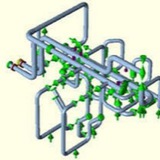
Pipe stress analysis expertise
We are highly experienced in working on the entire lifecycle of many piping installations, and therefore have a great understanding of all aspects involved from initial concept to completion.
This makes us well-positioned to offer detailed pipe stress analysis services to our clients. We have the ability to identify potential piping challenges and determine the root cause of the problem, before proposing a fully engineered solution.
Our pipe stress analysis services include:
1-Static & dynamic thermal stress analysis for given load cases
2-Analysis of occasional conditions such as wind loads & pressure relief valve loads
3-Nozzle assessments including nozzle loads, stiffnesses and local stress analysis
4-Assessment of design modifications including expansions joints, spring supports, ...
5-Pipeline lifting assessments
6-Structural support Analysis and detailed design of piping supports
7-Seismic analysis
.
.
.
We are highly experienced in working on the entire lifecycle of many piping installations, and therefore have a great understanding of all aspects involved from initial concept to completion.
This makes us well-positioned to offer detailed pipe stress analysis services to our clients. We have the ability to identify potential piping challenges and determine the root cause of the problem, before proposing a fully engineered solution.
Our pipe stress analysis services include:
1-Static & dynamic thermal stress analysis for given load cases
2-Analysis of occasional conditions such as wind loads & pressure relief valve loads
3-Nozzle assessments including nozzle loads, stiffnesses and local stress analysis
4-Assessment of design modifications including expansions joints, spring supports, ...
5-Pipeline lifting assessments
6-Structural support Analysis and detailed design of piping supports
7-Seismic analysis
.
.
.
Piping آشنایی با دانش.pdf
747.4 KB
آشنایی با دانش پایپینگ
مبدل حرارتی.pdf
2.6 MB
آشنایی با مبدلهای حرارتی
VID-20231123-WA0012.mp4
9.6 MB
Shell and Tube Heat Exchanger
Pipe hangers and supports, which support piping from above (hangers) or below (props), alleviate stress on pipes as they transport fluids from one location to another. An improper supporting system spaced too far apart adds stress to piping and may cause damage to the entire system, leading to fractures, sagging pipes, and leaks.
INSPECTION CHECKLIST EXPANSION JOINTS:
# check for signs of leakage or a loss of pressure
# inspect for any distortion or yielding of anchors, hardware, bellows, and piping connection points
# observe for any unanticipated movement of piping due to pressure
# inspect for evidence of instability (squirm), distortion or damage in the bellows convolutions
# check the expansion joint, the guides, and other moveable parts of the system for evidence of binding
# check for misalignment of the expansion joint unit
# check for vibration damage
# check for signs of leakage or a loss of pressure
# inspect for any distortion or yielding of anchors, hardware, bellows, and piping connection points
# observe for any unanticipated movement of piping due to pressure
# inspect for evidence of instability (squirm), distortion or damage in the bellows convolutions
# check the expansion joint, the guides, and other moveable parts of the system for evidence of binding
# check for misalignment of the expansion joint unit
# check for vibration damage
Overview of Pipe Supports
Pipe supports are supporting parts of the pipes in facilities that include piping systems. They are the essential elements for the stabilization and the carrying of the pipes. Let’s examine pipe support briefly in the following.
Pipe supports are supporting parts of the pipes in facilities that include piping systems. They are the essential elements for the stabilization and the carrying of the pipes. Let’s examine pipe support briefly in the following.
What is a pipe support? What are they used for?
Pipe supports are the components that transfer the weight from a pipe or the structural attachment to the supporting structures. The weight includes the weight of the pipe, the content that the pipe carries, the pipe fittings fixed to the pipe, and the pipe wraps. The fundamental functions of pipe supports are to anchor, guide, absorb shock, and support a particular load.
Pipe supports are the components that transfer the weight from a pipe or the structural attachment to the supporting structures. The weight includes the weight of the pipe, the content that the pipe carries, the pipe fittings fixed to the pipe, and the pipe wraps. The fundamental functions of pipe supports are to anchor, guide, absorb shock, and support a particular load.
How pipe supports are used?
A pipe is rested on a supporting part often of a standard structural shape. The pipe may be fastened to this part with a pipe support. A pipe is either held from above by hangers or supports of various types on which it rests. Hangers are also considered as supports.
There are various types of pipe supports which can be installed to support dead weight loads, and constrain the pipe for thermal and dynamic loads.
Pipe supports include brackets, rod hangers, sway braces, anchors, spring hangers, turnbuckles, struts, saddles, rollers, and sliding supports. Structural attachments are components that are bolted, welded, or clamped to the pipe, such as lugs ,clips, clamps, clevises, and stops.Pipe supports that are used in temperature sensitive applications may also consist of insulation materials.
A pipe is rested on a supporting part often of a standard structural shape. The pipe may be fastened to this part with a pipe support. A pipe is either held from above by hangers or supports of various types on which it rests. Hangers are also considered as supports.
There are various types of pipe supports which can be installed to support dead weight loads, and constrain the pipe for thermal and dynamic loads.
Pipe supports include brackets, rod hangers, sway braces, anchors, spring hangers, turnbuckles, struts, saddles, rollers, and sliding supports. Structural attachments are components that are bolted, welded, or clamped to the pipe, such as lugs ,clips, clamps, clevises, and stops.Pipe supports that are used in temperature sensitive applications may also consist of insulation materials.
Design and selection of the pipe supports
The design configuration of a pipe support assembly is reliant on the loading conditions and pipe support location and is only limited by the imagination of the engineer and designer, as thousands of different designs have been used for specific purposes. The correct and cost-effective selection of pipe supports for different piping systems usually presents obstacles of different degrees. Proper pipe support selection must be the objective of the designing and construction phases.
The design configuration of a pipe support assembly is reliant on the loading conditions and pipe support location and is only limited by the imagination of the engineer and designer, as thousands of different designs have been used for specific purposes. The correct and cost-effective selection of pipe supports for different piping systems usually presents obstacles of different degrees. Proper pipe support selection must be the objective of the designing and construction phases.
What kind of loads do pipe supports carry?
# Dead Weight
It is the weight of pipe including the fluid it carries, weight of pipe fittings & other components (flanges, valves, insulation, etc.). This type of load may cause bending. In horizontal pipes, the dead-weight load is taken care of by placing pipe support on a regular span to avoid sagging of pipe, and in vertical pipes, this load is taken care of by placing proper load taking support in the horizontal portion just before/after the vertical portion or lug support in the vertical portion.
#Internal / External Pressure
A pipe used for carrying fluid would be under pressure load internally and externally. A pipe transporting high-pressure fluid is under net internal pressure while pipe with vacuum conditions may be under net external pressure.
#Occasional Loads
Pipe supports also carry the loads that occur occasionally like wind loads, seismic load, water hammer loads, steam hammer loads, etc.
#Secondary Loads
The causes of secondary loads are the displacement of some kind. For example, the pipe connected to a vessel may be under load if the storage tank nozzle to which it is connected moves down due to tank settlement.
# Dead Weight
It is the weight of pipe including the fluid it carries, weight of pipe fittings & other components (flanges, valves, insulation, etc.). This type of load may cause bending. In horizontal pipes, the dead-weight load is taken care of by placing pipe support on a regular span to avoid sagging of pipe, and in vertical pipes, this load is taken care of by placing proper load taking support in the horizontal portion just before/after the vertical portion or lug support in the vertical portion.
#Internal / External Pressure
A pipe used for carrying fluid would be under pressure load internally and externally. A pipe transporting high-pressure fluid is under net internal pressure while pipe with vacuum conditions may be under net external pressure.
#Occasional Loads
Pipe supports also carry the loads that occur occasionally like wind loads, seismic load, water hammer loads, steam hammer loads, etc.
#Secondary Loads
The causes of secondary loads are the displacement of some kind. For example, the pipe connected to a vessel may be under load if the storage tank nozzle to which it is connected moves down due to tank settlement.
Determining support locations
Support places are dependent on many factors, such as pipe size, piping configuration, the location of heavy attachments such as valves and fittings, etc. The movement anticipated at support points dictates the type of support required. The selected type of pipe support must be capable of accommodating movements.
It is suggested to select first the simpler or basic rigid pipe support type and add complexity as conditions warrant. It is better to use more simpler and economical types that satisfy the design requirements than more complex ones.
Support places are dependent on many factors, such as pipe size, piping configuration, the location of heavy attachments such as valves and fittings, etc. The movement anticipated at support points dictates the type of support required. The selected type of pipe support must be capable of accommodating movements.
It is suggested to select first the simpler or basic rigid pipe support type and add complexity as conditions warrant. It is better to use more simpler and economical types that satisfy the design requirements than more complex ones.
Types of Pipe Supports
ANCHORS
Rigid pipe supports that restricts movement in orthogonal directions and rotational directions. This usually is a part that is welded or bolted to steel or concrete.
There are two types of anchors: fixed anchors and directional anchors.
Fixed anchors used in those cases where movement in a line must be prevented. This is called as a ‘fixing point’. The most basic way to anchor a pipe is to weld it directly to support or structural part. For insulated pipes, a pipe shoe is welded and then the pipe shoe is welded to the structure.
Directional anchors allow movement to occur in one direction while restricting it from in the opposite direction. Directional anchors lead a pipe’s movement away from structures, buildings, , equipment etc.
ANCHORS
Rigid pipe supports that restricts movement in orthogonal directions and rotational directions. This usually is a part that is welded or bolted to steel or concrete.
There are two types of anchors: fixed anchors and directional anchors.
Fixed anchors used in those cases where movement in a line must be prevented. This is called as a ‘fixing point’. The most basic way to anchor a pipe is to weld it directly to support or structural part. For insulated pipes, a pipe shoe is welded and then the pipe shoe is welded to the structure.
Directional anchors allow movement to occur in one direction while restricting it from in the opposite direction. Directional anchors lead a pipe’s movement away from structures, buildings, , equipment etc.