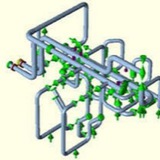
Step 1 – Qualitative assessment & prioritisation
Using a rigorous methodology, we carry out a qualitative assessment of all the main lines in a process system to identify the potential excitation mechanisms. We then produce a report prioritising and identifying the potential excitation mechanisms that need to be quantitatively analysed.
Using a rigorous methodology, we carry out a qualitative assessment of all the main lines in a process system to identify the potential excitation mechanisms. We then produce a report prioritising and identifying the potential excitation mechanisms that need to be quantitatively analysed.
Step 2 – Quantitative assessment & Solutions
Main lines: For each excitation mechanism that has been identified as potentially at risk, a quantitative assessment is carried out to determine the likelihood of vibration-induced pipe failure.
The potential excitation mechanisms that can be addressed are:
Flow induced turbulence
Mechanical excitation
Pulsation:
– Reciprocating/Positive displacement pumps and compressors
– Rotating stall
– Flow induced excitation
High frequency acoustic excitation
Surge/Momentum change due to valve operation Cavitation and Flashing
Main lines: For each excitation mechanism that has been identified as potentially at risk, a quantitative assessment is carried out to determine the likelihood of vibration-induced pipe failure.
The potential excitation mechanisms that can be addressed are:
Flow induced turbulence
Mechanical excitation
Pulsation:
– Reciprocating/Positive displacement pumps and compressors
– Rotating stall
– Flow induced excitation
High frequency acoustic excitation
Surge/Momentum change due to valve operation Cavitation and Flashing
Small Bore Connection (SBC): For each piping line that has been identified as a potential excitation source for SBC, a quantitative assessment is carried out to determine the likelihood of vibration-induced pipe failure.
Intrusive elements: The risk of coincidence between thermowell (or, intrusive elements) vortex shedding excitation frequency and the structural natural frequency is assessed.
For each of the above investigated excitation mechanism, when a situation is identified as potentially critical, a corrective action is suggested or an appropriate vibration analysis recommended.
Note: The AIV & FIV assessment methodology is based on the “Guideline for the Avoidance of Vibration Induced Fatigue Failure in Process Pipework” published by Energy Institute.
For each of the above investigated excitation mechanism, when a situation is identified as potentially critical, a corrective action is suggested or an appropriate vibration analysis recommended.
Note: The AIV & FIV assessment methodology is based on the “Guideline for the Avoidance of Vibration Induced Fatigue Failure in Process Pipework” published by Energy Institute.
Centrifugal compressors coincidence Analysis (AIV & FIV)
We offer a preventive approach to identify and mitigate the risk of Acoustical and Flow induced vibration in centrifugal compressors :
Support arrangement is assessed and design optimized against flow induced turbulence and when process condition cannot avoid pulsation generated by rotating stall.
A coincidence analysis is carried out for each no-flow side branch that can be subject to flow induced pulsation caused by periodic vortex shedding in T-joint.
The fatigue generated by high frequency acoustic phenomena is assessed by calculating the sound power level in each pressure reducing devices (e.g. Valve or high capacity & press. drop devices) and discontinuity.
Small bore connection (SBC) design is assessed against potential vibration excitation sources.
Coincidence analysis of intrusive elements (or thermowell) structural natural frequency with vortex shedding excitation frequency is carried out.
We offer a preventive approach to identify and mitigate the risk of Acoustical and Flow induced vibration in centrifugal compressors :
Support arrangement is assessed and design optimized against flow induced turbulence and when process condition cannot avoid pulsation generated by rotating stall.
A coincidence analysis is carried out for each no-flow side branch that can be subject to flow induced pulsation caused by periodic vortex shedding in T-joint.
The fatigue generated by high frequency acoustic phenomena is assessed by calculating the sound power level in each pressure reducing devices (e.g. Valve or high capacity & press. drop devices) and discontinuity.
Small bore connection (SBC) design is assessed against potential vibration excitation sources.
Coincidence analysis of intrusive elements (or thermowell) structural natural frequency with vortex shedding excitation frequency is carried out.
PRG FEATools™ improves the quality of Intergraph CAESAR II® users’ analysis for critical service lines by incorporating finite element analysis (FEA) and other empirical sources into the evaluation process.
By using Intergraph® CAESAR II in combination with FEATools, analyzed systems are neither over- nor under-designed, but designed with consistent safety factors, which also saves time and money.
By using Intergraph® CAESAR II in combination with FEATools, analyzed systems are neither over- nor under-designed, but designed with consistent safety factors, which also saves time and money.
⬇️ Higher Accuracy, Lower Costs
Piping analysts know that that properly qualified FEA presents the greatest opportunity to produce the most accurate analysis results. However, FEA can be extremely time-intensive and require more technical expertise than is needed for the majority of pipe stress problems. An ideal solution would allow FEA results to be easily and seamlessly incorporated within traditional code-based pipe stress analysis, so that your jobs benefit from the accuracy of FEA and the practicality of code-based analysis. CAESAR II with FEATools provides this solution.
Piping analysts know that that properly qualified FEA presents the greatest opportunity to produce the most accurate analysis results. However, FEA can be extremely time-intensive and require more technical expertise than is needed for the majority of pipe stress problems. An ideal solution would allow FEA results to be easily and seamlessly incorporated within traditional code-based pipe stress analysis, so that your jobs benefit from the accuracy of FEA and the practicality of code-based analysis. CAESAR II with FEATools provides this solution.
⬇️⬇️Addressing Code Limitations
There are well-known limitations in piping code accuracy when it comes to piping branch connections. Performing a complete FEA of a piping system can be prohibitively expensive. Instead, using FEA data for branch intersections is one of the most effective and pragmatic uses of FEA technology for code-based pipe stress analysis.
There are well-known limitations in piping code accuracy when it comes to piping branch connections. Performing a complete FEA of a piping system can be prohibitively expensive. Instead, using FEA data for branch intersections is one of the most effective and pragmatic uses of FEA technology for code-based pipe stress analysis.
⬇️⬇️FEA Results & Piping Codes
Piping codes such as ASME B31.3 Appendix D state that, in the absence of more directly applicable data, the engineer should use the stress intensification factor (SIF) and flexibility factor (k factor) data from Appendix D of the code. FEATools uses the results of the latest analysis, research, and testing to supply this “applicable data” to CAESAR II, and it does so seamlessly and intuitively.
Piping codes such as ASME B31.3 Appendix D state that, in the absence of more directly applicable data, the engineer should use the stress intensification factor (SIF) and flexibility factor (k factor) data from Appendix D of the code. FEATools uses the results of the latest analysis, research, and testing to supply this “applicable data” to CAESAR II, and it does so seamlessly and intuitively.
⬇️⬇️Nozzles
FEATools also provides a quick way of calculating nozzle stiffness, allowable loads, and stresses due to user-defined load sets. This more accurate nozzle flexibility reduces stress in the piping system during thermal load cases. This improves on the accuracy of older methods used in the industry for qualifying nozzle loads such as WRC 107 and WRC 297. It addresses nozzles on heads and shells as well as radial, hillside, and lateral nozzles.
FEATools also provides a quick way of calculating nozzle stiffness, allowable loads, and stresses due to user-defined load sets. This more accurate nozzle flexibility reduces stress in the piping system during thermal load cases. This improves on the accuracy of older methods used in the industry for qualifying nozzle loads such as WRC 107 and WRC 297. It addresses nozzles on heads and shells as well as radial, hillside, and lateral nozzles.
⬇️⬇️CAESAR II Intergration
FEATools supports code-based pipe, pressure vessel, and tank design. It was developed to interact only with CAESAR II. This means that, once calculated, branch SIFs and k factors are not only seamlessly and automatically transferred to the CAESAR II model, but the software retains the data for future analysis.
FEATools supports code-based pipe, pressure vessel, and tank design. It was developed to interact only with CAESAR II. This means that, once calculated, branch SIFs and k factors are not only seamlessly and automatically transferred to the CAESAR II model, but the software retains the data for future analysis.
⬇️⬇️CAESAR II Workflow
Because FEATools closely matches the way CAESAR II operates, the current workflows remain virtually unchanged. Users can continue to produce the deliverables that they have come to trust. For time efficiency, the software saves each branch FEA calculation in a database so users can reuse those values on subsequent jobs. If a user wants to return to the original model, the software creates the SIF and k factor-adjusted model as a copy, keeping the original intact.
Because FEATools closely matches the way CAESAR II operates, the current workflows remain virtually unchanged. Users can continue to produce the deliverables that they have come to trust. For time efficiency, the software saves each branch FEA calculation in a database so users can reuse those values on subsequent jobs. If a user wants to return to the original model, the software creates the SIF and k factor-adjusted model as a copy, keeping the original intact.
PSA Company is a full-service provider of custom pipe supports and technical services, “build-to-print” structural frames, pipe supporting components and auxiliary steel for industrial piping systems and many other applications using A36 Carbon Steel, 304 and 316L Stainless Steel, C276, 2205 Duplex and other specialty alloys.
A significant liquid hammer event on a flair line at the top level of a pipe rack resulted in pipe movement at the expansion loop. The 18” stainless steel flair line had welded shoes with horizontal guides to restrict line movement. Two support locations immediately before and after the expansion loop received damage as the line moved horizontally out of position.