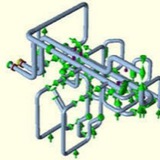
Piping designers traditionally route piping by layout, process, flow constraints (such as pressure drop) and other constraints but often do not take vibratory service into consideration. Pipe stresses are often not sufficiently considered while routing and supporting dynamics piping systems, especially when providing adequate flexibility to absorb thermal expansion/contraction of pipes. Upon completion of this analysis, Compression Dynamics will present you with proper modifications to bring piping systems into API or ASME codes.
A tower with a guided flexible pipe connection. The guided connection allows the flexibility required in the nozzle while limiting the loads applied to the vessel nozzle. Modelling the flexibility of the nozzle and accounting for the different possible temperatures of the piping system and tower is required for successful analysis.
Stress analysis of a pump skid from storage towers to dual pumps. The temperature distribution of the piping varies depending on which pump or pumps are running. Here the pipes leading to the operating pump are hotter than the standby pipes. Multiple load cases are required to ensure the piping design is acceptable.
جزوه لوله کشی.pdf
783.3 KB
جزوه لوله کشی.pdf
Forwarded from Amir Hassimi
This media is not supported in your browser
VIEW IN TELEGRAM
Pipeline Repairing by using Smart Flange
Forwarded from Amir Hassimi
This media is not supported in your browser
VIEW IN TELEGRAM
قرار دادن یک شیر روی خط لوله درحال جریان
Forwarded from Piping Stress Analysis (PSA Group)
Forwarded from Piping Stress Analysis (PSA Group)
Forwarded from Piping Stress Analysis (PSA Group)
Piping Flexibility Thermal Expansion of Pipe
Abstract
One major requirement in piping design is to provide adequate flexibility for absorbing the thermal expansion of the pipe. However, due to lack of quick method of checking, pipings are often laid-out to be either too stiff or too flexible. In either case, valuable time and material are wasted.
This article presents some of the quick methods for checking piping flexibility. These methods include visual, hand calculation, and micro computer approaches. They are all quick and easy for designers to use in planning their layouts. Once the designers have taken care of the flexibility problem, the iterative procedure between the stress engineers and the designers become simpler. The project schedule can also be improved.
Abstract
One major requirement in piping design is to provide adequate flexibility for absorbing the thermal expansion of the pipe. However, due to lack of quick method of checking, pipings are often laid-out to be either too stiff or too flexible. In either case, valuable time and material are wasted.
This article presents some of the quick methods for checking piping flexibility. These methods include visual, hand calculation, and micro computer approaches. They are all quick and easy for designers to use in planning their layouts. Once the designers have taken care of the flexibility problem, the iterative procedure between the stress engineers and the designers become simpler. The project schedule can also be improved.
Piping flexibility
As the pipe temperature changes from the installation condition to the operating condition, it expands or contracts. In the general term, both expansion and contraction are called thermal expansion. When a pipe expands it has the potential of generating enormous force and stress in the system. However, if the piping is flexible enough, the expansion can be absorbed without creating undue force or stress. Providing the proper flexibility is one of the major tasks in the design of piping system.
Piping is used to convey a certain amount of fluid from one point to another. It is obvious that the shorter the pipe is used the lesser the capital expenditure is required. The long pipe may also generate excessive pressure drop making it unsuitable for the proper operation. However, the direct shortest layout generally is not acceptable for absorbing the thermal expansion.
Figure 1 shows what will happen when a straight pipe is directly connected from one point to another. First, consider that only one end is connected and the other end is loose. The loose end will expands an amount equal to Δ = e L
However, since the other end is not loose, this expansion is to be absorbed by the piping. This is equivalent to squeezing the pipe to move the end back an ~ distance. This amount of squczzing creates a stress of the magnitude S = E (Δ/L) = E e
As the pipe temperature changes from the installation condition to the operating condition, it expands or contracts. In the general term, both expansion and contraction are called thermal expansion. When a pipe expands it has the potential of generating enormous force and stress in the system. However, if the piping is flexible enough, the expansion can be absorbed without creating undue force or stress. Providing the proper flexibility is one of the major tasks in the design of piping system.
Piping is used to convey a certain amount of fluid from one point to another. It is obvious that the shorter the pipe is used the lesser the capital expenditure is required. The long pipe may also generate excessive pressure drop making it unsuitable for the proper operation. However, the direct shortest layout generally is not acceptable for absorbing the thermal expansion.
Figure 1 shows what will happen when a straight pipe is directly connected from one point to another. First, consider that only one end is connected and the other end is loose. The loose end will expands an amount equal to Δ = e L
However, since the other end is not loose, this expansion is to be absorbed by the piping. This is equivalent to squeezing the pipe to move the end back an ~ distance. This amount of squczzing creates a stress of the magnitude S = E (Δ/L) = E e