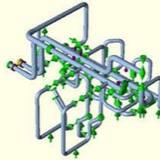
We perform static analysis for the following loading conditions:
Pressure:
Operating pressure or upset condition pressures.
Operating pressure or upset condition pressures.
Deadweight:
This loading condition consists of the weight of pipe, medium, insulation and any attachment to the pipelines.
This loading condition consists of the weight of pipe, medium, insulation and any attachment to the pipelines.
Wind Loads:
This loading condition is a dynamic condition but normally analysed as equivalent static condition.
This loading condition is a dynamic condition but normally analysed as equivalent static condition.
Thermal Loads:
This loading condition is induced by different thermal transients.
This loading condition is induced by different thermal transients.
Thermal Stratification:
This loading condition occurs in the connecting pipes in a horizontal plane between two reservoirs with fluid at different temperatures with small flow rates. This initiates an extra bending stress and creates local stresses in the pipe cross section due to a nonlinear circumferential metal temperature distribution. Pressurizers’ surge lines are one of the places where thermal stratification occurs.
This loading condition occurs in the connecting pipes in a horizontal plane between two reservoirs with fluid at different temperatures with small flow rates. This initiates an extra bending stress and creates local stresses in the pipe cross section due to a nonlinear circumferential metal temperature distribution. Pressurizers’ surge lines are one of the places where thermal stratification occurs.
Equipment Movements:
This loading condition causes the movement of pipes due to thermal movement of the equipment or pressure vessels and the movement of the pipe supports due to seismic loads.
This loading condition causes the movement of pipes due to thermal movement of the equipment or pressure vessels and the movement of the pipe supports due to seismic loads.
⬇️ Dynamic analyses are performed for the following occasional loading conditions:
⬇️ Water Hammer/Steam Hammer Loads (Transient slug analysis):
This loading condition occurs as a result of events that trigger hydraulic transients (like as operational changes). These events may be due to valve opening/closure, pump start-up or a pump trip. Such events result in pressure waves which travel through the piping systems in a complicated manner including reflected waves, etc.
This loading condition occurs as a result of events that trigger hydraulic transients (like as operational changes). These events may be due to valve opening/closure, pump start-up or a pump trip. Such events result in pressure waves which travel through the piping systems in a complicated manner including reflected waves, etc.
⬇️ Vessel Vibrations:
Induced by pipe breaks in pressure vessels, pumps, and valves.
Induced by pipe breaks in pressure vessels, pumps, and valves.
⬇️ Seismic (Earthquake) and Other Building Induced Loads:
This is constituted by the dynamic pipe support movements, during a seismic event, and the response to these movements depends on the dynamic characteristics of the considered piping systems and their attachments in relation to the characteristics of the loading.
This is constituted by the dynamic pipe support movements, during a seismic event, and the response to these movements depends on the dynamic characteristics of the considered piping systems and their attachments in relation to the characteristics of the loading.
We perform Finite Element Analysis for the following occasional loading conditions (earthquake, water hammer, etc.).
Transient dynamic analysis yields the response of the piping system, if the dynamic excitations are known in terms of time histories of support movements.
Response spectrum analysis is used in the assessment of structural integrity, if the loads are given in terms of the floor response spectrum. If not, we can even provide the floor response spectrum too, based on the ground motion at the site location.
Equivalent static analysis can be used when just the ground movements are available, based on ASCE 7-10.
Response spectrum analysis is used in the assessment of structural integrity, if the loads are given in terms of the floor response spectrum. If not, we can even provide the floor response spectrum too, based on the ground motion at the site location.
Equivalent static analysis can be used when just the ground movements are available, based on ASCE 7-10.
Structural Analysis of Pipe Supports
PSA Piping performs the Pipe Support Stress Analysis based on ASME and AISC codes (American Institute of Steel Construction). We perform the structural analyses based on ASME section VIII for the supporting structures of the piping systems evaluated by ASME B31 codes (power and process pipelines). We use ASME section III for the analysis of pipe supports of power piping systems.
PSA Piping performs the Pipe Support Stress Analysis based on ASME and AISC codes (American Institute of Steel Construction). We perform the structural analyses based on ASME section VIII for the supporting structures of the piping systems evaluated by ASME B31 codes (power and process pipelines). We use ASME section III for the analysis of pipe supports of power piping systems.
This media is not supported in your browser
VIEW IN TELEGRAM
Relief Valve Failure
⬇️⬇️ Stress Analysis of a Pressure Relief Valve
A pressure relief valve (PRV) or safety relief valve (SRV) is used to increase safety of thermo-hydraulic plants. The functionality of a relief valve is quite simple: it automatically releases the substance (liquid or gas) from pressure vessels, boilers etc. when the prescribed pressure limit is reached. Common industries using this type of valve include petrochemical, natural gas processing, petroleum refining, food, drinks, cosmetics, pharmaceuticals etc.
In this project, the stresses in a working PRV were analysed.