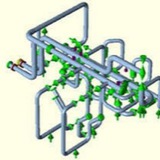
- Failure analysis under cyclic loading (Low / high cycle fatigue analysis):
We perform fatigue analysis on piping systems, pressure vessels, components and welded structures to investigate the cyclic damage and the minimum life cycles and the possibility of the crack initiation.
We perform fatigue analysis on piping systems, pressure vessels, components and welded structures to investigate the cyclic damage and the minimum life cycles and the possibility of the crack initiation.
- Mechanical ratcheting analysis:
We perform ratcheting analysis on the piping systems and pressure vessels to investigate the ratcheting failure mode. This failure mode is due to the accumulation of plastic strains due to cyclic loading. The stress level should be severe enough to reach such a plastic accumulation. The driving force of the ratcheting distortion is primary membrane stress and then alternating stresses is needed.
We perform ratcheting analysis on the piping systems and pressure vessels to investigate the ratcheting failure mode. This failure mode is due to the accumulation of plastic strains due to cyclic loading. The stress level should be severe enough to reach such a plastic accumulation. The driving force of the ratcheting distortion is primary membrane stress and then alternating stresses is needed.
- Thermal ratcheting analysis:
We perform thermal ratcheting analysis too. Thermal ratcheting failure mode is the progressive growth of pipe-diameter when the constant pressure, hoop stress, and alternating thermal gradient are applied through the thickness of the piping systems or pressure vessels.
We perform thermal ratcheting analysis too. Thermal ratcheting failure mode is the progressive growth of pipe-diameter when the constant pressure, hoop stress, and alternating thermal gradient are applied through the thickness of the piping systems or pressure vessels.
- Shake down analysis:
We check the possibility of occurrence of the material shake down on the pressure vessels, piping systems and components under structural and thermal transient loads.
Elastic shake-down occurs if the material accumulates plastic strain in the first few cycles but subsequently behaves completely elastically.
We check the possibility of occurrence of the material shake down on the pressure vessels, piping systems and components under structural and thermal transient loads.
Elastic shake-down occurs if the material accumulates plastic strain in the first few cycles but subsequently behaves completely elastically.
Shake-down occurs if the material accumulates plastic strain on the first few cycles and behaves plastic for each subsequent cycles – no accumulating plastic strain. This means that there is a plastic strain amplitude in each cycle but the level of plastic strains does not increase.
The next case is when the material accumulates plastic strain on the first few cycles and this continues for each subsequent cycle. In this case shake-down does not occur. However, Based on ASME section III the accumulated plastic strain in the entire component life is limited to maximum of 5 %.
- Fracture mechanics analysis (LEFM & EPFM):
We perform crack propagation analysis on pressure vessels, piping systems and supporting structures by stress intensification factor, VCC, J-integral and C*-integral methods to study the behavior of existing cracks, utilizing advanced finite element analysis.
We perform crack propagation analysis on pressure vessels, piping systems and supporting structures by stress intensification factor, VCC, J-integral and C*-integral methods to study the behavior of existing cracks, utilizing advanced finite element analysis.
- Creep crack growth analysis:
We perform nonlinear finite element analysis to study the crack propagation of the existing cracks in the components operating under the elevated temperature to estimate the remaining life of the cracked components.
We perform nonlinear finite element analysis to study the crack propagation of the existing cracks in the components operating under the elevated temperature to estimate the remaining life of the cracked components.
- Stability analysis:
We perform stability analysis on pressure vessels, piping systems and supporting structures, utilizing finite element analysis.
We perform stability analysis on pressure vessels, piping systems and supporting structures, utilizing finite element analysis.
Slug Flow Analysis:
slug flow analysis using dynamic methods.
slug flow analysis using dynamic methods.
For dynamic analysis Caesar II software provides a very nice module, dynamic module where we have to simply provide the input parameters to get the output result. Before you start the dynamic analysis you have to perform conventional static analysis of the system (without using any slug force) and qualify the system from all criteria. To open the dynamic module in Caesar II click on dynamic analysis button as shown in Fig.1.
When you click on the dynamic analysis button following window (Fig.2) will open. Select Slug Flow (Spectrum) from drop down menu. The window will be filled with some pre-existing data. For clarity simply select all those and delete. Now we have to provide inputs for analysis.
During dynamic analysis our first input will be the generation of spectrum profile. Slug load is one type of impulse load. So the magnitude of load varies from zero to some maximum value, remains constant for a time and then reduces to zero again. The force profile can be represented by a curve as shown in Fig. 3.