1.3 WHAT PIPING IS MOST AT RISK?
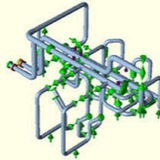
Around 80% of vibration-induced failures are associated with small-bore connections (SBCs). This is due to several reasons:
Stress concentrations at the weld to the main pipe or vesselLarge unsupported valvesLack of evaluation of vibration and fatigue risk, beyond a reactive approach after a failureDisconnects between the SBC design intent and site fabrication, particularly regarding local support/bracing
The remaining 20% are generally associated with parent pipe girth weld failure.
Around 80% of vibration-induced failures are associated with small-bore connections (SBCs). This is due to several reasons:
Stress concentrations at the weld to the main pipe or vesselLarge unsupported valvesLack of evaluation of vibration and fatigue risk, beyond a reactive approach after a failureDisconnects between the SBC design intent and site fabrication, particularly regarding local support/bracing
The remaining 20% are generally associated with parent pipe girth weld failure.
🔼⬆️ Small-bore connections are high-risk locations for piping vibration
1.4 WHERE DOES PIPING VIBRATION COME FROM?
Two main factors affect vibration: the strength of the excitation and the flexibility of the piping system. Therefore, there are always two methods to solve piping vibration problems: reduce the level of excitation to which the piping system is exposed or support the piping systemso that it can withstand the applied dynamic forces.
The excitation mechanisms that cause vibration originate from three main sources:
Acoustic/pulsation – time-varying changes in fluid pressure
Momentum – time-varying changes in fluid density and velocity
Machinery – unbalanced forces from operating machinery.
Two main factors affect vibration: the strength of the excitation and the flexibility of the piping system. Therefore, there are always two methods to solve piping vibration problems: reduce the level of excitation to which the piping system is exposed or support the piping systemso that it can withstand the applied dynamic forces.
The excitation mechanisms that cause vibration originate from three main sources:
Acoustic/pulsation – time-varying changes in fluid pressure
Momentum – time-varying changes in fluid density and velocity
Machinery – unbalanced forces from operating machinery.
ANSYS Workbench Tutorial - Pipe Stress Analysis - Beam Modeling ⬇️⬇️