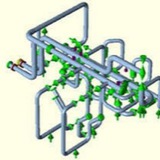
⬆️⬆️⬆️⬆️The piping system should be divided into sections by means of fix points, guides or restraining tie rods in order to have only one expansion joint per section of straight pipe system. The fix points and other restraining devices should be designed for the full pressure thrust from the bellows eRective area plus the bellows displacement force. Additionally, the forces generated by the friction within the guides should also be considered.
⬆️⬆️⬆️⬆️Typifies good practice in the use of a single expansion joint to absorb axial pipeline expansion.
Note the use of one expansion joint between the two fix points, the distance between the expansion joint and a fix point, the proximity of the first guide (G1), the spacing between the first guide and the second guide (G2), and the spacing of guides (Gn) along the remainder of the pipe system.
Note the use of one expansion joint between the two fix points, the distance between the expansion joint and a fix point, the proximity of the first guide (G1), the spacing between the first guide and the second guide (G2), and the spacing of guides (Gn) along the remainder of the pipe system.
⬆️⬆️⬆️⬆️Typifies good practice in the use of expansion joints to absorb axial expansion in a pipe system with a branch connection. The fix point at the junction, which in this case is a tee, is designed to absorb the thrust from the expansion joint in the branch line. Note the proximity of each expansion joint to a fix point, the closeness of each first guide (G1), the spacing between the first guide (G1) and the second guide (G2) and the spacing of guides (Gn) along the remainder of each pipe section.
Flexible rubber expansion joints⏬
Flexible rubber expansion joints are a key part in piping systems, since they provide the necessary flexibility to absorb system dynamics associated with vibration, temperature and pressure changes within the pipeline. Therefore, the careful material and design selection of flexible rubber expansion joints for a given application, as well as properly engineered installation, are so important factors for determining performance. By routine inspections, we can easily check the signs of fatigue and premature failure in the flexible rubber expansion joint s, long before the actual failure occurs.
Flexible rubber expansion joints are a key part in piping systems, since they provide the necessary flexibility to absorb system dynamics associated with vibration, temperature and pressure changes within the pipeline. Therefore, the careful material and design selection of flexible rubber expansion joints for a given application, as well as properly engineered installation, are so important factors for determining performance. By routine inspections, we can easily check the signs of fatigue and premature failure in the flexible rubber expansion joint s, long before the actual failure occurs.
Rubber expansion joints have been specified and successfully used for many years to accommodate pressure loads, relieve movement stresses, reduce noise, isolate vibration, compensate for misalignment after plants go on stream and prolong the life of pumps and other motive equipment. Once in service, the flexible rubber expansion joint should be protected from any ozone generating processes such as nearby welding. Proper storage in a cool dry location prior to installation will help lengthen service life.
Note:
In a properly designed pipeline, only one axial expansion joint between 2 fixed points must be provided. The spring rate of the metal bellows cannot withstand the pressure reaction force, caused by the internal pressure. If the fixed point is not dimensioned correctly, then the piping system is pushed apart.
In a properly designed pipeline, only one axial expansion joint between 2 fixed points must be provided. The spring rate of the metal bellows cannot withstand the pressure reaction force, caused by the internal pressure. If the fixed point is not dimensioned correctly, then the piping system is pushed apart.