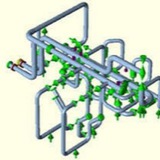
The flexibility model for reciprocating compressor and pump packages must include simulation of the
effect of the piping outside the package limits. The typical approach of conducting separate flexibility
studies by splitting the piping system at the point where responsibility changes between parties does
not give reliable results, or will result in a conservative and more costly system design.
effect of the piping outside the package limits. The typical approach of conducting separate flexibility
studies by splitting the piping system at the point where responsibility changes between parties does
not give reliable results, or will result in a conservative and more costly system design.
The flexibility model does not need to be a model of the complete piping system. The compressor
packager’s stress analyst shall generate a detailed model of their piping and a simplified model of a
portion of the EC’s piping to evaluate the interaction between the piping system. The packager’s stress
analyst does not need to model the complete pipe system designed by the EC. Knowing how to
simplify the model of the EC piping takes the understanding of an experienced pipe stress analyst.
packager’s stress analyst shall generate a detailed model of their piping and a simplified model of a
portion of the EC’s piping to evaluate the interaction between the piping system. The packager’s stress
analyst does not need to model the complete pipe system designed by the EC. Knowing how to
simplify the model of the EC piping takes the understanding of an experienced pipe stress analyst.
Similarly, the EC’s stress analyst shall generate a detailed model of their piping and a simplified
model of the compressor packager’s piping to evaluate the interaction of the overall piping system.
model of the compressor packager’s piping to evaluate the interaction of the overall piping system.
The owner may wish to specify that a single party conduct the flexibility analysis of the complete
system rather than separate parties duplicating their efforts. The approach of a single party doing the
flexibility analysis parallels the API 618, 5th Edition recommendation that a single party conduct the
flexibility analysis and the vibration analysis. The effort to model the piping is minimized when these
studies are done by the same party. Also, the competing interests of the flexibility and vibration
analysis can be best resolved when these studies are done by one party.
system rather than separate parties duplicating their efforts. The approach of a single party doing the
flexibility analysis parallels the API 618, 5th Edition recommendation that a single party conduct the
flexibility analysis and the vibration analysis. The effort to model the piping is minimized when these
studies are done by the same party. Also, the competing interests of the flexibility and vibration
analysis can be best resolved when these studies are done by one party.
Spring hanger selection and design guidelines for a Piping engineer using Caesar II
Spring hangers are an integrated part of Piping Industry. The use of spring hangers for supporting pipe weights is well-known to every piping engineer. Whenever some rigid supports are not taking load due to its thermal movement or rigid supports are creating bad effect to equipment connection Piping engineers suggest the use of a spring hanger to share some of the loads and to keep the piping system safe.
Selection of the appropriate type of hanger support for any given application is governed by the individual piping configuration and job requirements.
Selection of the appropriate type of hanger support for any given application is governed by the individual piping configuration and job requirements.
a) Variable Spring Hanger: Loads vary throughout its operating range
b) Constant Spring hanger: Load remains constant throughout its operating range.
The following write up will provide a simple guideline for selection of both Variable and constant spring hanger while analyzing a piping system using Caesar II:
Selection Procedure of Variable Effort Springs:
1. Determine the hot load required and the pipe movement (up or down).
2. Estimate the travel range from the catalogue.
3. Select the smallest spring size which has the hot load within the working travel (mid range).
4. Ensure that the cold load lies within the working range of the spring i.e. between the two dark black lines shown in the selection chart.
Calculate the cold load as follows:
Cold Load = Operating Load + Movement x Spring Rate (For pipe movement up)
Cold Load = Operating Load – Movement x Spring Rate (For pipe movement down)
5. If the Cold load lies beyond the working range in the selection chart, then select higher spring size or the next travel range.
6. Check the variability in selected spring
1. Determine the hot load required and the pipe movement (up or down).
2. Estimate the travel range from the catalogue.
3. Select the smallest spring size which has the hot load within the working travel (mid range).
4. Ensure that the cold load lies within the working range of the spring i.e. between the two dark black lines shown in the selection chart.
Calculate the cold load as follows:
Cold Load = Operating Load + Movement x Spring Rate (For pipe movement up)
Cold Load = Operating Load – Movement x Spring Rate (For pipe movement down)
5. If the Cold load lies beyond the working range in the selection chart, then select higher spring size or the next travel range.
6. Check the variability in selected spring