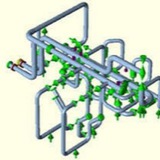
Impact Explicit Finite Element Solver Sample Buckle Pipe
Surge Analysis ⏬
When your process or production system is at continuous operation, the pressures and flow rates are constant. For normal operating conditions, the piping system is able to withstand the resulting stresses.
However, when a sudden event occurs, like valve operations, a tripping pump or failure of equipment, the steady-state fluid flow is disturbed. One consequence may be excessive surge pressures and consequently an increase in pipe stress and loads.
When your process or production system is at continuous operation, the pressures and flow rates are constant. For normal operating conditions, the piping system is able to withstand the resulting stresses.
However, when a sudden event occurs, like valve operations, a tripping pump or failure of equipment, the steady-state fluid flow is disturbed. One consequence may be excessive surge pressures and consequently an increase in pipe stress and loads.
Without careful timing of valves, the occurring surge pressures can easily reach tens of bars. For fiberglass systems such overpressure may cause the pipe to fail, especially joints and flanges are sensitive for overpressure. During a transient event low (negative) pressures may also occur. Large diameter fiberglass systems are especially sensitive to low or sub-atmospheric pressures as they are prone to buckling.
Possible mitigation measures for non-vacuum resistant piping are changes to how the system is operated or the introduction of adequately sized buckling rings.
We can act as a very capable partner to analyze your system from a dynamical perspective considering water hammer and pressure surges. When problems are found we closely discuss how to resolve the issues by carefully selecting any counter measures like the incorporation of surge vessels, vacuum breakers, air valve or a rerouting of a part of the piping system.