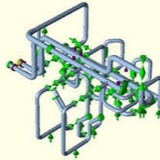
Today’s state of the art riser support design simplifies these problems by incorporating multiple spring mounts strategically placed to support the riser and allow expansion and contraction with small and easily calculable load changes. (Figure C)
The spring support systems can be designed to utilize a central isolated anchor which remains neutral during operation, or a totally free-floating system with spring support only. If a single anchor is used, it is located as close as possible to the middle of the riser to direct the pipe to expand away or contract towards the anchor point. By locating the anchor in the center of the riser the expansion and contraction at each end is cut in half. The anchor is designed to withstand the “worst case” forces generated when the water weight is removed for maintenance of equipment without the need to access and re-adjust the mountings.
Unanchored or totally free-floating systems are designed to expand or contract from the center as well, but control is far more difficult as branch off and end stiffnesses are difficult to calculate and installations must be closely watched to avoid accidental movement restrictions at branch offs. In addition, when water weight is removed for equipment maintenance, an alternate restraint method or individual mounting readjustment may be required.
Depending on the support structures strength, the number and location of spring mounts may vary from one set on every floor for maximum load distribution or they may be spaced at greater intervals. Isolated pipe guides should be used in most systems to maintain alignment of anchored or unanchored spring support systems. Risers can be butt welded when installed to assure integrity. They are easy to install and require no maintenance.
Most importantly, the load at each support point is known under all conditions, i.e., installed, empty, full and operating at both temperature extremes. An added benefit is that the riser is not only supported with minor load changes throughout its expansion and contraction, but it is also effectively isolated from the building as the springs provide low natural frequency support.
All negative aspects of the obsolete systems are avoided with properly designed spring supported riser systems.
All negative aspects of the obsolete systems are avoided with properly designed spring supported riser systems.