
And the final really big projects are:
- Node Builder:
It’s an npm package linked to an AI that can build any n8n node from Postman, OpenAPI, or Swagger into a fully functional n8n node. It’s trained on the n8n project itself, and the npm package and its CLI generate all files from A to Z for future node development. Even GitHub issue reports are generated. The user only pays for AI credits and provides the node’s SVG logo and the collection URL or file, then comes back after about 15 minutes to get a fully tested node. (I’ll release a node built with this CLI soon, and I believe it will be better than any node we’ve created before.) It’s linked to a web UI because the Node Builder needs some input, like GitHub and npm tokens. We’ll make it very interactive for newbies, so the n8n community can create nodes every day, just like they create workflows.
- Docker Builder:
A CLI that installs n8n fully configured with one click. where you can build your one line link to share with client to install
- Node Builder:
It’s an npm package linked to an AI that can build any n8n node from Postman, OpenAPI, or Swagger into a fully functional n8n node. It’s trained on the n8n project itself, and the npm package and its CLI generate all files from A to Z for future node development. Even GitHub issue reports are generated. The user only pays for AI credits and provides the node’s SVG logo and the collection URL or file, then comes back after about 15 minutes to get a fully tested node. (I’ll release a node built with this CLI soon, and I believe it will be better than any node we’ve created before.) It’s linked to a web UI because the Node Builder needs some input, like GitHub and npm tokens. We’ll make it very interactive for newbies, so the n8n community can create nodes every day, just like they create workflows.
- Docker Builder:
A CLI that installs n8n fully configured with one click. where you can build your one line link to share with client to install
NodeMation By Nskha
- Data Manager VS Code: an IDE extension that helps you deeply vibe-code and fix workflows. It converts n8n workflows into a framework where every part of the n8n workflow is treated as a file, giving the AI low context to work with, saving your budget and getting better results.
Converting n8n workflows into files gives you the ability to use an IDE at its full power to edit complex n8n workflows. I already stated before that we should feed the AI with the n8n files.
reddit.com/r/n8n/comments/1q4qx4f/two_years_ago_i_began_asking_people_to_give_ai/
I don’t care if they feed it or not because we own the #1 GPT for n8n. We almost have control over prompting for millions of users, so once all our projects are done, I will change the GPT to fully promote the new tools and push the n8n framework into daily use.
Why do I believe it’s going to be a used?
- It solves a real problem if you’re dealing with A.I + n8n workflows.
- It optimizes the cost of investigating workflows.
- There are already baked-in tools to help you do it.
🤟- Everything is free, nothing is paid. nskha is just community users, we got our money from our clients not community users, though it still will benefit us getting clients so somehow we are getting paid in other ways while you free user will not get paywall.
reddit.com/r/n8n/comments/1q4qx4f/two_years_ago_i_began_asking_people_to_give_ai/
I don’t care if they feed it or not because we own the #1 GPT for n8n. We almost have control over prompting for millions of users, so once all our projects are done, I will change the GPT to fully promote the new tools and push the n8n framework into daily use.
Why do I believe it’s going to be a used?
- It solves a real problem if you’re dealing with A.I + n8n workflows.
- It optimizes the cost of investigating workflows.
- There are already baked-in tools to help you do it.
🤟- Everything is free, nothing is paid. nskha is just community users, we got our money from our clients not community users, though it still will benefit us getting clients so somehow we are getting paid in other ways while you free user will not get paywall.
❤1
Why is the n8n framework going to save budget? Is it only about minifying files before sending them to the AI, as stated: reddit.com/r/n8n/comments/1q47uai/newbies_reminder_sharing_n8n_workflows_with_ai/
No, it’s called a framework because it treats the workflow as a framework. There are no expressions or JS code inside the workflow file. Instead, there are only $ref pointing to files that contain the actual data.
This is going to give you:
- Savings in cache budget. If the IDE sees that a file hasn’t been edited, it won’t send it again as new context code.
- Smarter IDE indexing by focusing only on the real data you care about. On each edit, there’s a history for that file, so the AI can know exactly what was updated and where.
- A final step of data minification, where the IDE already safely supports Python and JavaScript minification, allowing the AI to work with a much smaller context.
- All of this without even mentioning the linked skills and npm scripts + linting, which the AI should always check.
No, it’s called a framework because it treats the workflow as a framework. There are no expressions or JS code inside the workflow file. Instead, there are only $ref pointing to files that contain the actual data.
This is going to give you:
- Savings in cache budget. If the IDE sees that a file hasn’t been edited, it won’t send it again as new context code.
- Smarter IDE indexing by focusing only on the real data you care about. On each edit, there’s a history for that file, so the AI can know exactly what was updated and where.
- A final step of data minification, where the IDE already safely supports Python and JavaScript minification, allowing the AI to work with a much smaller context.
- All of this without even mentioning the linked skills and npm scripts + linting, which the AI should always check.
👏1
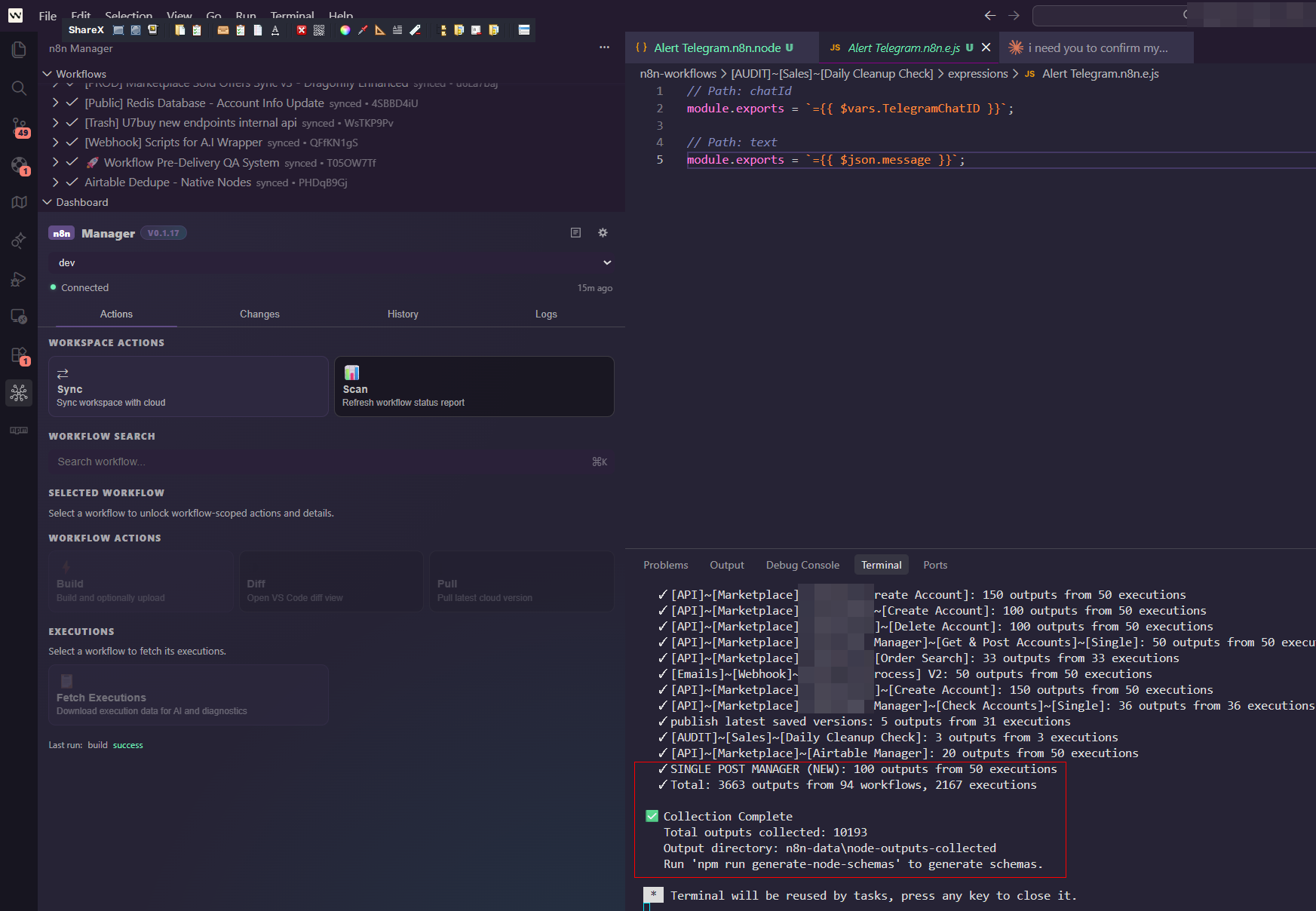
Today I built a prototype of what an n8n competitor does.
You know there’s a competitor to n8n that many enterprise companies move to called Airbyte. This n8n competitor has a very smart and advanced idea: it updates the workflow based on historical data.
Let’s say you’re mapping automation data between two services, for example Airtable to Google Sheets. The data is dynamic, and on each request, new fields can be added or removed. Airbyte can generate a mapping schema based on all tested data from previous executions. This avoids errors or workflow stops when something changes between the two sources.
This feature honestly made me sad about why n8n doesn’t have it, even though it feels like a basic idea. You just grab execution data, generate a schema of all possible keys, and build a final full schema. That schema can then be used to build expressions or JS code that accepts all possible keys, along with their types and other metadata.
I cloned this idea into n8n-manager. I fetch all workflow inputs and outputs, then generate multiple schema types for each node’s operation output. In the end, I get schema files for each node. When an AI developer looks at this, it can automate the most accurate results for that workflow without reading tons of raw data or repeatedly tracking executions.
If there’s a problem in a specific node, you can get all its outputs as a compact schema of keys, plus an example of the latest schema with real data. The AI can see the actual output values, but in a combined form from multiple workflow executions. This gives much better debugging for AI, and its answers become way more accurate and cover more edge cases.
This isn’t fully integrated into n8n-manager yet. For now, I’ve made npm scripts for live testing on a real client project.
You know there’s a competitor to n8n that many enterprise companies move to called Airbyte. This n8n competitor has a very smart and advanced idea: it updates the workflow based on historical data.
Let’s say you’re mapping automation data between two services, for example Airtable to Google Sheets. The data is dynamic, and on each request, new fields can be added or removed. Airbyte can generate a mapping schema based on all tested data from previous executions. This avoids errors or workflow stops when something changes between the two sources.
This feature honestly made me sad about why n8n doesn’t have it, even though it feels like a basic idea. You just grab execution data, generate a schema of all possible keys, and build a final full schema. That schema can then be used to build expressions or JS code that accepts all possible keys, along with their types and other metadata.
I cloned this idea into n8n-manager. I fetch all workflow inputs and outputs, then generate multiple schema types for each node’s operation output. In the end, I get schema files for each node. When an AI developer looks at this, it can automate the most accurate results for that workflow without reading tons of raw data or repeatedly tracking executions.
If there’s a problem in a specific node, you can get all its outputs as a compact schema of keys, plus an example of the latest schema with real data. The AI can see the actual output values, but in a combined form from multiple workflow executions. This gives much better debugging for AI, and its answers become way more accurate and cover more edge cases.
This isn’t fully integrated into n8n-manager yet. For now, I’ve made npm scripts for live testing on a real client project.
🔥3👍1
By just using the VS Code extension, I built an auto AI configuration for the MCP.
- Skills
- Rules
- MCP tools
- workflows
For all IDEs based on vscode and all CLI known like Codex, Gemini, Claude.
What i did today I improved the MCP tools and extended them to support many tools that interact with workflows only.
The MCP is installed and configured automatically by simply installing the VS Code extension from the Marketplace, with the n8n settings synced directly to the MCP config. This feature was released by VS Code only two months ago, so not many people know this trick, where you get the MCP through the extension tools. In the end, the AI can interact with and control the extension 🥺
- Skills
- Rules
- MCP tools
- workflows
For all IDEs based on vscode and all CLI known like Codex, Gemini, Claude.
What i did today I improved the MCP tools and extended them to support many tools that interact with workflows only.
The MCP is installed and configured automatically by simply installing the VS Code extension from the Marketplace, with the n8n settings synced directly to the MCP config. This feature was released by VS Code only two months ago, so not many people know this trick, where you get the MCP through the extension tools. In the end, the AI can interact with and control the extension 🥺
🔥2
This media is not supported in your browser
VIEW IN TELEGRAM
don’t update to 2.11.1 if you’re on an arm64 server. n8n is currently broken on arm servers with that version.
2.11.0 safe.
2.11.0 safe.
🥰1😐1
Just built an internal Perplexity extension that gives any AI model MCP access to a personal Perplexity account.
🙃 If we get a chance to have a private Discord server, I’m gonna share it there. For a public release, we can’t, since this could cause a lot of trademark issues. So I’m just letting you know it’s possible for educational purposes.
The Perplexity Pro plan gives Claude Opus computer usage, which could save you around $140 for every $20 you pay.
Currently i am using
- Claude Code
- Windsurf 1M opus 4.6
- Codex 5.4
All them linked to Perplexity computer MCP as tools where they can manage my account to do search about things and getting advanced results that could save a lot for them.
🙃 If we get a chance to have a private Discord server, I’m gonna share it there. For a public release, we can’t, since this could cause a lot of trademark issues. So I’m just letting you know it’s possible for educational purposes.
The Perplexity Pro plan gives Claude Opus computer usage, which could save you around $140 for every $20 you pay.
Currently i am using
- Claude Code
- Windsurf 1M opus 4.6
- Codex 5.4
All them linked to Perplexity computer MCP as tools where they can manage my account to do search about things and getting advanced results that could save a lot for them.
🔥4🤔1
NodeMation By Nskha
Just built an internal Perplexity extension that gives any AI model MCP access to a personal Perplexity account. 🙃 If we get a chance to have a private Discord server, I’m gonna share it there. For a public release, we can’t, since this could cause a lot…
One thing made me work like a slave before, delivering Airtable updates to our clients.
Because of shitty Airtable API limitations, they do not allow or support updating fields called “Computed Fields,” like formulas, buttons, currency, etc.
The only possible way was to do this manually. I had to open a remote session and copy-paste each updated field, which is a totally painful task. It has always been on my TODO list to fix this issue, and today it was time. I finished the first part, which was completing the MCP code.
I lost all my time bypassing their fingerprint login. Thanks to the amazing Asian security reverse engineers for bringing the best captcha solutions that saved me a lot of time bypassing the internal APIs for automation.
+Will integrate the mcp into this project
Because of shitty Airtable API limitations, they do not allow or support updating fields called “Computed Fields,” like formulas, buttons, currency, etc.
The only possible way was to do this manually. I had to open a remote session and copy-paste each updated field, which is a totally painful task. It has always been on my TODO list to fix this issue, and today it was time. I finished the first part, which was completing the MCP code.
I lost all my time bypassing their fingerprint login. Thanks to the amazing Asian security reverse engineers for bringing the best captcha solutions that saved me a lot of time bypassing the internal APIs for automation.
For example the Airtable login has a security captcha called PerimeterX, and there is already an active project to bypass this captcha for free. There is also an undetected Playwright called “patchright,” aka a patched browser.
+Will integrate the mcp into this project
👍3
NodeMation By Nskha
One thing made me work like a slave before, delivering Airtable updates to our clients. Because of shitty Airtable API limitations, they do not allow or support updating fields called “Computed Fields,” like formulas, buttons, currency, etc. The only possible…
So now it’s up to 32 tools, and I made an extension dashboard for it just like perplexity.
The AI files are the real headache. I have to set up each AI prompt, skill, and rule by hand for every agent. That’s why it’s taking forever. I can’t just leave it vibecoded without testing the prompts. To test them I need to run live projects to make sure everything works.
The bright side is I’ve got a bunch of Airtable projects that use formulas and views and need better table structure. This extension plus MCP is gonna let Claude Code do some magic with those bases.
While testing on a live project it actually found a real bug in one formula, a tiny typo that was causing big problems in that table. Claude Code spotted it because MCP has a tool to get the table schema, so Claude Code can read formulas in bulk easily. Especially now since Claude Code is running a 2x promo and includes the 1M context Opus model, it’s the perfect time to burn those Claude credits on testing.
The AI files are the real headache. I have to set up each AI prompt, skill, and rule by hand for every agent. That’s why it’s taking forever. I can’t just leave it vibecoded without testing the prompts. To test them I need to run live projects to make sure everything works.
The bright side is I’ve got a bunch of Airtable projects that use formulas and views and need better table structure. This extension plus MCP is gonna let Claude Code do some magic with those bases.
While testing on a live project it actually found a real bug in one formula, a tiny typo that was causing big problems in that table. Claude Code spotted it because MCP has a tool to get the table schema, so Claude Code can read formulas in bulk easily. Especially now since Claude Code is running a 2x promo and includes the 1M context Opus model, it’s the perfect time to burn those Claude credits on testing.
NodeMation By Nskha
- Node Builder:
It’s an npm package linked to an AI that can build any n8n node from Postman, OpenAPI, or Swagger into a fully functional n8n node. It’s trained on the n8n project itself, and the npm package and its CLI generate all files from A to Z for future node development. Even GitHub issue reports are generated. The user only pays for AI credits and provides the node’s SVG logo and the collection URL or file, then comes back after about 15 minutes to get a fully tested node. (I’ll release a node built with this CLI soon, and I believe it will be better than any node we’ve created before.) It’s linked to a web UI because the Node Builder needs some input, like GitHub and npm tokens. We’ll make it very interactive for newbies, so the n8n community can create nodes every day, just like they create workflows.
It’s an npm package linked to an AI that can build any n8n node from Postman, OpenAPI, or Swagger into a fully functional n8n node. It’s trained on the n8n project itself, and the npm package and its CLI generate all files from A to Z for future node development. Even GitHub issue reports are generated. The user only pays for AI credits and provides the node’s SVG logo and the collection URL or file, then comes back after about 15 minutes to get a fully tested node. (I’ll release a node built with this CLI soon, and I believe it will be better than any node we’ve created before.) It’s linked to a web UI because the Node Builder needs some input, like GitHub and npm tokens. We’ll make it very interactive for newbies, so the n8n community can create nodes every day, just like they create workflows.
just made the first usable version of the "Node Builder". this project has used all my CC credits during the last 3 months.
sent it to my team, and i’m expecting they can generate nodes with ~15 mins of work until it reaches production.
it supports Postman/OpenAPI/Swagger as sources for API docs
once this project is stable, i’m expecting we can build ~100 nodes a year at least. and the big part is this project isn’t meant just to create, it’s used to track, maintain, update, and warn if there are any changes in the API, with changelog generation and a lot of actions to track each source. amount of private APIs used in this service makes it not possible to share it publicly. we’ll keep working on it until we decide it’s ready for OS
either i share it without APIs, which wouldn’t be very useful since users would have to buy or create a lot of configs, or i create a front end for it where you can generate nodes using. i don’t need to make any paywall, so maybe we can make it fully free but using our credits.
sent it to my team, and i’m expecting they can generate nodes with ~15 mins of work until it reaches production.
it supports Postman/OpenAPI/Swagger as sources for API docs
once this project is stable, i’m expecting we can build ~100 nodes a year at least. and the big part is this project isn’t meant just to create, it’s used to track, maintain, update, and warn if there are any changes in the API, with changelog generation and a lot of actions to track each source. amount of private APIs used in this service makes it not possible to share it publicly. we’ll keep working on it until we decide it’s ready for OS
either i share it without APIs, which wouldn’t be very useful since users would have to buy or create a lot of configs, or i create a front end for it where you can generate nodes using. i don’t need to make any paywall, so maybe we can make it fully free but using our credits.
NodeMation By Nskha
just made the first usable version of the "Node Builder". this project has used all my CC credits during the last 3 months. sent it to my team, and i’m expecting they can generate nodes with ~15 mins of work until it reaches production. it supports Post…
I did research before working on it. One of the n8n core team already tried to make this project: https://github.com/ivov/nodewriter
There are also some people trying to vibecode a similar idea: https://github.com/jongan69/n8n-node-builder (https://n8n-node-builder.vercel.app/)
There are also some people trying to vibecode a similar idea: https://github.com/jongan69/n8n-node-builder (https://n8n-node-builder.vercel.app/)
GitHub
GitHub - ivov/nodewriter: Generate n8n nodes from OpenAPI specs. Experimental.
Generate n8n nodes from OpenAPI specs. Experimental. - ivov/nodewriter
NodeMation By Nskha
By just using the VS Code extension, I built an auto AI configuration for the MCP. - Skills - Rules - MCP tools - workflows For all IDEs based on vscode and all CLI known like Codex, Gemini, Claude. What i did today I improved the MCP tools and extended…
n8n already announced an update replacing this project. Now it officially has the ability to create workflows using native MCP in the instance settings 😐 i will keep continue on mine as it's already made for only complex workflows.
https://www.reddit.com/r/n8n/comments/1s6aytd/n8n_214_finally_ships_createupdate_workflow_via/
https://www.reddit.com/r/n8n/comments/1s6aytd/n8n_214_finally_ships_createupdate_workflow_via/
Reddit
From the n8n community on Reddit: n8n 2.14 finally ships create/update workflow via official MCP
Explore this post and more from the n8n community