“I will not force my children...”
Someone said: “I will not force my children to pray, nor will I impose the hijab upon them. Acts of worship must come from conviction, sincerity for the sake of Allah, and love for Him, and without it, it is unnecessary.”
We reply:
But when it comes to their worldly lives, you will wake them early for school, make them study, complete their assignments, and even give them medicine despite their dislike.
These are temporary matters, and you strive for them so they may succeed in this life.
As for striving to save them from the punishment of the Hereafter and guiding them toward eternal success, does that not also require care, effort, and a sense of responsibility?
Someone said: “I will not force my children to pray, nor will I impose the hijab upon them. Acts of worship must come from conviction, sincerity for the sake of Allah, and love for Him, and without it, it is unnecessary.”
We reply:
But when it comes to their worldly lives, you will wake them early for school, make them study, complete their assignments, and even give them medicine despite their dislike.
These are temporary matters, and you strive for them so they may succeed in this life.
As for striving to save them from the punishment of the Hereafter and guiding them toward eternal success, does that not also require care, effort, and a sense of responsibility?
💯31👍9
Kindness to Parents & Jihād
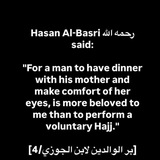
Al-Hassan Al-Basrī رحمه اللّٰه:
"Nothing in voluntary acts of worship compares to kindness to one's parents, not Hajj, nor Jihād."
[Adab Al-Hasan Al-Basri Dar An-Nawadir (p133) Trans: Abu Maryam]
Al-Hassan Al-Basrī رحمه اللّٰه:
"Nothing in voluntary acts of worship compares to kindness to one's parents, not Hajj, nor Jihād."
[Adab Al-Hasan Al-Basri Dar An-Nawadir (p133) Trans: Abu Maryam]
💯24
Learn Manners before taking Knowledge
Malik ibn Anas, may Allah have mercy on him, said:
تَعَلَّمِ الأَدَبَ قَبْلَ أَنْ تَتَعَلَّمَ الْعِلْمَ
Learn good manners before seeking knowledge.
Source: Gharāʼib Mālik ibn Anas 45
And Malik said:
كانت أمي تعممني وتقول لي اذهب إلى ربيعة فتعلم من أدبه قبل علمه
My mother would dress me up and say to me: Go to Sheikh Rabi’ah and learn from his manners before his knowledge.
Source: Tartīb al-Madārik 1/130
Ibn Al-Mubarak, may Allah have mercy on him, said to the people of hadīth:
أنتم إِلَى قَلِيلٍ مِنَ الْأَدَبِ أَحْوَجُ منكم إِلَى كَثِيرٍ مِنَ الْعِلْمِ
You are in greater need of a little manners than a great deal of knowledge.
Source: Tārīkh Dimashq 32918
And Ibn Al-Mubarak said:
طلبت الأدب ثلاثين سنة وطلبت العلم عشرين سنة وكانوا يطلبون الأدب ثم العلم
I sought manners for thirty years and I sought knowledge for twenty years. The righteous predecessors would seek manners and then seek knowledge.
Source: Ghāyat al-Nihāyah 1/446
Sufyan Ath-Thawri, may Allah have mercy on him, said:
كَانَ الرَّجُلُ إِذَا أَرَادَ أَنْ يَكْتُبَ الْحَدِيثَ تَأَدَّبَ وَتَعَبَّدَ قَبْلَ ذَلِكَ بِعِشْرِينَ سَنَةً
If a man intended to write the hadīth, he would study good manners and worship for twenty years before doing so.
Source: Hilyat al-Awliyā 361
Al-Laith ibn Sa’d, may Allah have mercy on him, said to the people of hadīth:
تَعَلَّمُوا الْحِلْمَ قَبْلَ الْعِلْمِ
Learn forbearance before seeking knowledge.
Source: Jāmi’ Bayān al-‘Ilm 581
In fact, the righteous predecessors would learn more from a scholar’s manners than they would from his knowledge.
Az-Zuhri, may Allah have mercy on him, said:
كُنَّا نَأْتِي الْعَالِمَ فَمَا نَتَعَلَّمُ مِنْ أَدَبِهِ أَحَبُّ إِلَيْنَا مِنْ عِلْمِهِ
We would come to a scholar and what we learned from his manners was more beloved to us than his knowledge.
Source: Hilyat al-Awliyā 4575
Ibn Wahb, may Allah have mercy on him, said:
مَا تَعَلَّمْتُ مِنْ أَدَبِ مَالِكٍ أَفْضَلَ مِنْ عِلْمِهِ
What I learned from the manners of Malik was better than his knowledge.
Source: Jāmi’ Bayān al-‘Ilm 581
Malik ibn Anas, may Allah have mercy on him, said:
تَعَلَّمِ الأَدَبَ قَبْلَ أَنْ تَتَعَلَّمَ الْعِلْمَ
Learn good manners before seeking knowledge.
Source: Gharāʼib Mālik ibn Anas 45
And Malik said:
كانت أمي تعممني وتقول لي اذهب إلى ربيعة فتعلم من أدبه قبل علمه
My mother would dress me up and say to me: Go to Sheikh Rabi’ah and learn from his manners before his knowledge.
Source: Tartīb al-Madārik 1/130
Ibn Al-Mubarak, may Allah have mercy on him, said to the people of hadīth:
أنتم إِلَى قَلِيلٍ مِنَ الْأَدَبِ أَحْوَجُ منكم إِلَى كَثِيرٍ مِنَ الْعِلْمِ
You are in greater need of a little manners than a great deal of knowledge.
Source: Tārīkh Dimashq 32918
And Ibn Al-Mubarak said:
طلبت الأدب ثلاثين سنة وطلبت العلم عشرين سنة وكانوا يطلبون الأدب ثم العلم
I sought manners for thirty years and I sought knowledge for twenty years. The righteous predecessors would seek manners and then seek knowledge.
Source: Ghāyat al-Nihāyah 1/446
Sufyan Ath-Thawri, may Allah have mercy on him, said:
كَانَ الرَّجُلُ إِذَا أَرَادَ أَنْ يَكْتُبَ الْحَدِيثَ تَأَدَّبَ وَتَعَبَّدَ قَبْلَ ذَلِكَ بِعِشْرِينَ سَنَةً
If a man intended to write the hadīth, he would study good manners and worship for twenty years before doing so.
Source: Hilyat al-Awliyā 361
Al-Laith ibn Sa’d, may Allah have mercy on him, said to the people of hadīth:
تَعَلَّمُوا الْحِلْمَ قَبْلَ الْعِلْمِ
Learn forbearance before seeking knowledge.
Source: Jāmi’ Bayān al-‘Ilm 581
In fact, the righteous predecessors would learn more from a scholar’s manners than they would from his knowledge.
Az-Zuhri, may Allah have mercy on him, said:
كُنَّا نَأْتِي الْعَالِمَ فَمَا نَتَعَلَّمُ مِنْ أَدَبِهِ أَحَبُّ إِلَيْنَا مِنْ عِلْمِهِ
We would come to a scholar and what we learned from his manners was more beloved to us than his knowledge.
Source: Hilyat al-Awliyā 4575
Ibn Wahb, may Allah have mercy on him, said:
مَا تَعَلَّمْتُ مِنْ أَدَبِ مَالِكٍ أَفْضَلَ مِنْ عِلْمِهِ
What I learned from the manners of Malik was better than his knowledge.
Source: Jāmi’ Bayān al-‘Ilm 581
💯9👍3
You can be successful, respected, and admired by people… but if you’ve failed your parents, you’ve missed something huge.
They carried you before you could walk, fed you before you could earn, and loved you when you had nothing to offer in return.
Now roles reverse… and suddenly patience becomes “too much,” calls become “later,” and time becomes “when I’m free.”
Allah didn’t just recommend kindness to parents — He placed it right after His worship.
Not just obedience… but ihsaan — excellence.
Lower your voice.
Watch your tone.
Show up for them — not when it’s convenient, but when it matters. Because one day, that door will close… and no amount of regret will bring it back.
#Parents #RespectParents #LoveYourParents #FamilyFirst #IslamicReminder
https://www.instagram.com/reel/DWPTH4iDJl_/?igsh=MXNwc2dwazh0MnhkdA==
They carried you before you could walk, fed you before you could earn, and loved you when you had nothing to offer in return.
Now roles reverse… and suddenly patience becomes “too much,” calls become “later,” and time becomes “when I’m free.”
Allah didn’t just recommend kindness to parents — He placed it right after His worship.
Not just obedience… but ihsaan — excellence.
Lower your voice.
Watch your tone.
Show up for them — not when it’s convenient, but when it matters. Because one day, that door will close… and no amount of regret will bring it back.
#Parents #RespectParents #LoveYourParents #FamilyFirst #IslamicReminder
https://www.instagram.com/reel/DWPTH4iDJl_/?igsh=MXNwc2dwazh0MnhkdA==
💯6👍4
Dear parents, know this.
Mobile is the world of your child (unfortunately) and if you take away his world, he/she will become crazy, aggressive, maniac, and what not and will make you an enemy.
All the rage, aggression and negative behaviors he/she exhibits is associated to their fear, anxiety and anger of being stopped, being surveilled. Their brain constantly releases dopamine and blocks their prefrontal cortex (which is the part of brain responsible for seeing consequences of an action. So literally they are a zombie at that time. And with the fear, anxiety and pressure of being stopped and watched, cortisol keeps releasing, which is the stress chemical, and adds to their rage and aggression.
So, your child does not hate religion.
Your child does not have mental health issue.
Your child does not have Nazar.
Your child does not have black magic.
He/she is simply being controlled by the strings that were designed 20 year ago to control and manipulate minds, and he/she is exactly the target of that and they have got trapped. Consider them as patients needing help, not normal. Forget about 20th century parenting methods. Research yourself about how to do parenting in the digital world. You will find lots and lots of stuff.
Mobile is the world of your child (unfortunately) and if you take away his world, he/she will become crazy, aggressive, maniac, and what not and will make you an enemy.
All the rage, aggression and negative behaviors he/she exhibits is associated to their fear, anxiety and anger of being stopped, being surveilled. Their brain constantly releases dopamine and blocks their prefrontal cortex (which is the part of brain responsible for seeing consequences of an action. So literally they are a zombie at that time. And with the fear, anxiety and pressure of being stopped and watched, cortisol keeps releasing, which is the stress chemical, and adds to their rage and aggression.
So, your child does not hate religion.
Your child does not have mental health issue.
Your child does not have Nazar.
Your child does not have black magic.
He/she is simply being controlled by the strings that were designed 20 year ago to control and manipulate minds, and he/she is exactly the target of that and they have got trapped. Consider them as patients needing help, not normal. Forget about 20th century parenting methods. Research yourself about how to do parenting in the digital world. You will find lots and lots of stuff.
💯13👍2
This generation is growing old before its time.
Parents think their children are fine, while the children are destroying themselves trying to live up to their parents’ expectations.
Some fall into the pain of love at a very young age, some are becoming mentally broken because of their parents’ constant fights, and some are only staying alive because suicide is forbidden.
Parents think their children are fine, while the children are destroying themselves trying to live up to their parents’ expectations.
Some fall into the pain of love at a very young age, some are becoming mentally broken because of their parents’ constant fights, and some are only staying alive because suicide is forbidden.
👍9💯2
WISDOM FOR PARENTING
1- Avoid Giving your child everything he asks for. He will grow up believing that he has the right to get everything he wants.
2-Avoid laughing when your child speaks insulting words. He will grow up thinking that disrespect is entertainment.
3-Avoid remaining insensitive to bad behavior that he can display without scolding him for his bad behavior. He will grow up thinking that there are no rules in society.
4- Avoid picking up anything that your child messes up. He will grow up believing that others must take responsibility for his responsibilities.
5- Avoid letting him watch any program on TV. He will grow up thinking that there is no difference between being a child and being an adult.
6- Avoid giving your child all the money he asks for. He will grow up thinking that getting money is easy and will not hesitate to steal for it.
7- Always avoid putting yourself on his side when he is wrong against the neighbors, his teachers, the police. He will grow up thinking that everything he does is right, it is the others who are wrong.
8- Avoid leaving him alone at home when you go to the place of worship, otherwise he will grow up thinking that God does not exist.
May our labour over our children not be in vain.
1- Avoid Giving your child everything he asks for. He will grow up believing that he has the right to get everything he wants.
2-Avoid laughing when your child speaks insulting words. He will grow up thinking that disrespect is entertainment.
3-Avoid remaining insensitive to bad behavior that he can display without scolding him for his bad behavior. He will grow up thinking that there are no rules in society.
4- Avoid picking up anything that your child messes up. He will grow up believing that others must take responsibility for his responsibilities.
5- Avoid letting him watch any program on TV. He will grow up thinking that there is no difference between being a child and being an adult.
6- Avoid giving your child all the money he asks for. He will grow up thinking that getting money is easy and will not hesitate to steal for it.
7- Always avoid putting yourself on his side when he is wrong against the neighbors, his teachers, the police. He will grow up thinking that everything he does is right, it is the others who are wrong.
8- Avoid leaving him alone at home when you go to the place of worship, otherwise he will grow up thinking that God does not exist.
May our labour over our children not be in vain.
💯14👍5
🖤 OH MUSLIMS, DO NOT SHARE PICTURES OF YOUR CHILDREN ON SOCIAL MEDIA 🖤
People don’t take this seriously enough…
Allah says in the Qur’an:
“And from the evil of the envier when he envies.”
(Surah Al-Falaq 113:5)
Not everybody that looks at your child loves your child.
Not everybody that smiles at your baby wishes them well.
Some people carry jealousy in their hearts…
and that jealousy can harm—by the permission of Allah.
When you constantly post your children, expose their beauty, their milestones, their happiness to the world… you are opening a door.
A door for envy.
A door for the evil eye.
The Prophet ﷺ said:
“The evil eye is real.”
Children are innocent.
They don’t protect themselves.
YOU are their protection.
So when your child suddenly becomes sick, irritable, drained…
ask yourself:
Who has been looking at them?
What have I exposed them to?
Not everything is meant to be shared.
Some blessings are meant to be protected.
Say: Masha’Allah. TabarakAllah.
Recite protection over your children.
Keep some things private.
Because not every eye that sees…
comes with love.
& Allahu is our source of strength. Ameen
People don’t take this seriously enough…
Allah says in the Qur’an:
“And from the evil of the envier when he envies.”
(Surah Al-Falaq 113:5)
Not everybody that looks at your child loves your child.
Not everybody that smiles at your baby wishes them well.
Some people carry jealousy in their hearts…
and that jealousy can harm—by the permission of Allah.
When you constantly post your children, expose their beauty, their milestones, their happiness to the world… you are opening a door.
A door for envy.
A door for the evil eye.
The Prophet ﷺ said:
“The evil eye is real.”
Children are innocent.
They don’t protect themselves.
YOU are their protection.
So when your child suddenly becomes sick, irritable, drained…
ask yourself:
Who has been looking at them?
What have I exposed them to?
Not everything is meant to be shared.
Some blessings are meant to be protected.
Say: Masha’Allah. TabarakAllah.
Recite protection over your children.
Keep some things private.
Because not every eye that sees…
comes with love.
& Allahu is our source of strength. Ameen
💯11
𝗬𝗼𝘂 𝗕𝗲𝗰𝗼𝗺𝗲 𝗪𝗵𝗮𝘁 𝗬𝗼𝘂 𝗠𝗼𝗰𝗸
Aishah رَضِ اللَّهُ عَنْهُا said:
"مَرَّ رَجُلٌ مُصَابٌ عَلَى نِسْوَةٍ، فَتَضَاحَكْنَ بِهِ يَسْخَرْنَ، فَأُصِيبَ بَعْضُهُنَّ"
"A man suffering from an affliction passed by a group of women and they laughed at him, mocking him. Then some of them were afflicted (with a similar affliction)."
🎙 Shaykh 'Abd al-Razzaq al-Badr commented:
"Allah punished some of those women with an immediate punishment. If the mocker is spared an immediate punishment, then in the Hereafter there is a severe punishment. People in this matter fall into two categories: either a repentant person who turns back to Allah, or a wrongdoer who transgresses against his brothers through mockery and ridicule.
So why belittle? Why ridicule? Why mock? Why backbite? Where is the brotherhood, when Allah says, "Indeed, the believers are brothers.."?
A person may mock another, while the one being mocked is actually better, more virtuous, and of higher rank than the mocker. The mocker may in fact be far inferior to him. For this reason, mockery does not come from people with pure hearts, good hearts, sincere hearts, humble hearts; rather, it comes from a heart that carries some sickness."
📖 al-Badr, 'Abd al-Razzaq ibn 'Abd al-Muhsin. Sharh al-Adab al-Mufrad. Lesson no. 118.
Aishah رَضِ اللَّهُ عَنْهُا said:
"مَرَّ رَجُلٌ مُصَابٌ عَلَى نِسْوَةٍ، فَتَضَاحَكْنَ بِهِ يَسْخَرْنَ، فَأُصِيبَ بَعْضُهُنَّ"
"A man suffering from an affliction passed by a group of women and they laughed at him, mocking him. Then some of them were afflicted (with a similar affliction)."
🎙 Shaykh 'Abd al-Razzaq al-Badr commented:
"Allah punished some of those women with an immediate punishment. If the mocker is spared an immediate punishment, then in the Hereafter there is a severe punishment. People in this matter fall into two categories: either a repentant person who turns back to Allah, or a wrongdoer who transgresses against his brothers through mockery and ridicule.
So why belittle? Why ridicule? Why mock? Why backbite? Where is the brotherhood, when Allah says, "Indeed, the believers are brothers.."?
A person may mock another, while the one being mocked is actually better, more virtuous, and of higher rank than the mocker. The mocker may in fact be far inferior to him. For this reason, mockery does not come from people with pure hearts, good hearts, sincere hearts, humble hearts; rather, it comes from a heart that carries some sickness."
📖 al-Badr, 'Abd al-Razzaq ibn 'Abd al-Muhsin. Sharh al-Adab al-Mufrad. Lesson no. 118.
💯10👍2
LOVING YOUR CHILD DOES NOT MEAN CLOSING YOUR EYES WHILE THEY DESTROY OTHERS.
A parent’s heart may ache for their son or daughter, but Islām does not allow love to become an excuse for sin. When you remain silent while your child breaks homes, betrays trusts, and harms innocent families—especially children—you are not protecting them. You are abandoning your duty.
Allah warns us with words that should shake every believing heart:
﴿يَا أَيُّهَا الَّذِينَ آمَنُوا قُوا أَنفُسَكُمْ وَأَهْلِيكُمْ نَارًا﴾
O you who believe, protect yourselves and your families from the Fire.
Ask yourself: how can a parent watch their child walk toward the Fire and still call it love?
True love restrains.
True love corrects.
True love says “stop” even when it breaks the heart.
Allowing your child to become a home wrecker is not mercy—it is cruelty. Not only to the family being destroyed, but to your own child whose soul is being darkened, whose ākhirah is being placed at risk. The tears of abandoned spouses and confused children do not go unheard by Allāh.
A parent who truly loves their child will stand between them and sin, even if the child becomes angry, even if the world calls it harsh. Because love that leads to Jahannam is not love—it is betrayal.
If you think you are loving your child by tolerating their wrongdoing, then know this:
You are not loving them.
You are losing them.
اللَّهُمَّ احْفَظْنَا وَأَهْلِينَا مِنَ الْفِتَنِ مَا ظَهَرَ مِنْهَا وَمَا بَطَنَ، وَاهْدِ أَبْنَاءَنَا وَبَنَاتِنَا إِلَى طَاعَتِكَ، وَاصْرِفْ عَنْهُمُ السُّوءَ وَالْحَرَامَ، وَاجْعَلْهُمْ قُرَّةَ أَعْيُنٍ لَنَا فِي الدُّنْيَا وَالْآخِرَةِ، وَقِنَا وَإِيَّاهُمْ عَذَابَ النَّارِ.
O Allāh, protect us and our families from trials—those that are apparent and those that are hidden. Guide our sons and daughters to obedience to You, turn away from them all evil and what is unlawful, and make them a comfort to our eyes in this world and the Hereafter. Protect us and them from the punishment of the Fire.
A parent’s heart may ache for their son or daughter, but Islām does not allow love to become an excuse for sin. When you remain silent while your child breaks homes, betrays trusts, and harms innocent families—especially children—you are not protecting them. You are abandoning your duty.
Allah warns us with words that should shake every believing heart:
﴿يَا أَيُّهَا الَّذِينَ آمَنُوا قُوا أَنفُسَكُمْ وَأَهْلِيكُمْ نَارًا﴾
O you who believe, protect yourselves and your families from the Fire.
Ask yourself: how can a parent watch their child walk toward the Fire and still call it love?
True love restrains.
True love corrects.
True love says “stop” even when it breaks the heart.
Allowing your child to become a home wrecker is not mercy—it is cruelty. Not only to the family being destroyed, but to your own child whose soul is being darkened, whose ākhirah is being placed at risk. The tears of abandoned spouses and confused children do not go unheard by Allāh.
A parent who truly loves their child will stand between them and sin, even if the child becomes angry, even if the world calls it harsh. Because love that leads to Jahannam is not love—it is betrayal.
If you think you are loving your child by tolerating their wrongdoing, then know this:
You are not loving them.
You are losing them.
اللَّهُمَّ احْفَظْنَا وَأَهْلِينَا مِنَ الْفِتَنِ مَا ظَهَرَ مِنْهَا وَمَا بَطَنَ، وَاهْدِ أَبْنَاءَنَا وَبَنَاتِنَا إِلَى طَاعَتِكَ، وَاصْرِفْ عَنْهُمُ السُّوءَ وَالْحَرَامَ، وَاجْعَلْهُمْ قُرَّةَ أَعْيُنٍ لَنَا فِي الدُّنْيَا وَالْآخِرَةِ، وَقِنَا وَإِيَّاهُمْ عَذَابَ النَّارِ.
O Allāh, protect us and our families from trials—those that are apparent and those that are hidden. Guide our sons and daughters to obedience to You, turn away from them all evil and what is unlawful, and make them a comfort to our eyes in this world and the Hereafter. Protect us and them from the punishment of the Fire.
💯8⚡2
Forwarded from Muslim Marriage Tips
YOU WILL CRY WHEN YOU READ
THIS
~A parent's home is always a child's home. But a child's home is not always a place their parents are welcome to stay.
~A parent's money is always for their children. But a child's money is not always set aside for their parents
~A parent's wealth will surely be enjoyed by their children. But a child's wealth is not always shared with their parents
So love your parents while you still can. Because in this world, there is no love more sincere than the love of your parents.
THIS
~A parent's home is always a child's home. But a child's home is not always a place their parents are welcome to stay.
~A parent's money is always for their children. But a child's money is not always set aside for their parents
~A parent's wealth will surely be enjoyed by their children. But a child's wealth is not always shared with their parents
So love your parents while you still can. Because in this world, there is no love more sincere than the love of your parents.
👍12💯8⚡4
Please parents monitor your child on laptop Ipads and phones. Its NOT spying it's your duty to protect them from harm and to not misuse these devices.
I've personally seen mothers let their 5 year old daughters watch Tiktok videos, what effect will this have on your child's Haya if you let them access these kind of apps? Technology should be used for learning and seeking beneficial knowledge.
I've personally seen mothers let their 5 year old daughters watch Tiktok videos, what effect will this have on your child's Haya if you let them access these kind of apps? Technology should be used for learning and seeking beneficial knowledge.
💯14
A righteous child is a blessing from Allaah....may Allah سُبْحَانَهُ وَتَعَالَى grant us righteous children
The Prophet (ﷺ) said: “When the son of Aadam dies, his (good) deeds come to an end except for three: A recurring charity, a knowledge that is beneficial or a righteous child that supplicates for him.” [Reported by Muslim]
The Prophet (ﷺ) also said: "Indeed a man may ascend a level in Paradise and ask: ‘How did this happen?’ So it will be said to him: ‘By your child’s asking forgiveness for you.”' [Reported by Ahmad and Ibn Maajah]
The Prophet (ﷺ) said: “There are seven things of which their reward continue to pass on to the servant after he dies while he is in his grave: He who taught some knowledge, or allowed a river to flow, or dug a well, or planted a date-palm tree, or built a masjid, or bequeathed a mus-haf, or left behind a child that seeks forgiveness for him (from Allaah) after he dies." [A sound hadeeth reported by Ibn Maajah and Ibn Khuzaimah]
So based on this, the fathers and mothers are obligated to focus on raising their children upon uprightness so that they may serve as righteous deeds for them during their lifetime as well as after their death.
Book: Raising Children in Light of the Qur’an and Sunnah by Shaikh Saalih Al-Fawzaan, p. 13/14 | Translated by Isma’eel Alarcon | Al-lbaanah Book Publishing, USA
The Prophet (ﷺ) said: “When the son of Aadam dies, his (good) deeds come to an end except for three: A recurring charity, a knowledge that is beneficial or a righteous child that supplicates for him.” [Reported by Muslim]
The Prophet (ﷺ) also said: "Indeed a man may ascend a level in Paradise and ask: ‘How did this happen?’ So it will be said to him: ‘By your child’s asking forgiveness for you.”' [Reported by Ahmad and Ibn Maajah]
The Prophet (ﷺ) said: “There are seven things of which their reward continue to pass on to the servant after he dies while he is in his grave: He who taught some knowledge, or allowed a river to flow, or dug a well, or planted a date-palm tree, or built a masjid, or bequeathed a mus-haf, or left behind a child that seeks forgiveness for him (from Allaah) after he dies." [A sound hadeeth reported by Ibn Maajah and Ibn Khuzaimah]
So based on this, the fathers and mothers are obligated to focus on raising their children upon uprightness so that they may serve as righteous deeds for them during their lifetime as well as after their death.
Book: Raising Children in Light of the Qur’an and Sunnah by Shaikh Saalih Al-Fawzaan, p. 13/14 | Translated by Isma’eel Alarcon | Al-lbaanah Book Publishing, USA
💯8
𝐁𝐞𝐟𝐨𝐫𝐞 𝐒𝐨𝐜𝐢𝐞𝐭𝐲 𝐖𝐫𝐢𝐭𝐞𝐬 𝐨𝐧 𝐘𝐨𝐮𝐫 𝐂𝐡𝐢𝐥𝐝’𝐬 𝐇𝐞𝐚𝐫𝐭, 𝐖𝐫𝐢𝐭𝐞 𝐆𝐨𝐨𝐝𝐧𝐞𝐬𝐬 𝐅𝐢𝐫𝐬𝐭
Al-Ghazālī, may Allah have mercy on him, says:
الصبي أمانة عند والديه، وقلبه الطاهر جوهرة نفيسة ساذجة خالية من كل نقش وصورة، وهو قابل لكل نقش ومائل إلى كل ما يمال إليه، فإن عُوِّد الخير وعُلِّمه نشأ عليه وسعد في الدنيا والآخرة، وشاركه في ثوابه أبواه، وكل معلم له ومؤدب. وإن عُوِّد الشر وأهمل إهمال البهائم شقي وهلك، وكان الوزر في رقبة القيِّم عليه والوالي له
(إحياء علوم الدين:106/4)
“𝘈 𝘤𝘩𝘪𝘭𝘥 𝘪𝘴 𝘢 𝘴𝘢𝘤𝘳𝘦𝘥 𝘵𝘳𝘶𝘴𝘵 𝘱𝘭𝘢𝘤𝘦𝘥 𝘪𝘯 𝘵𝘩𝘦 𝘩𝘢𝘯𝘥𝘴 𝘰𝘧 𝘩𝘪𝘴 𝘱𝘢𝘳𝘦𝘯𝘵𝘴. 𝘏𝘪𝘴 𝘩𝘦𝘢𝘳𝘵 𝘪𝘴 𝘱𝘶𝘳𝘦, 𝘱𝘳𝘦𝘤𝘪𝘰𝘶𝘴, 𝘢𝘯𝘥 𝘶𝘯𝘧𝘰𝘳𝘮𝘦𝘥 — 𝘶𝘯𝘵𝘰𝘶𝘤𝘩𝘦𝘥 𝘣𝘺 𝘢𝘯𝘺 𝘭𝘢𝘴𝘵𝘪𝘯𝘨 𝘪𝘮𝘱𝘳𝘪𝘯𝘵 𝘰𝘳 𝘪𝘮𝘢𝘨𝘦. 𝘐𝘵 𝘪𝘴 𝘳𝘦𝘢𝘥𝘺 𝘵𝘰 𝘳𝘦𝘤𝘦𝘪𝘷𝘦 𝘸𝘩𝘢𝘵𝘦𝘷𝘦𝘳 𝘪𝘴 𝘱𝘭𝘢𝘤𝘦𝘥 𝘶𝘱𝘰𝘯 𝘪𝘵, 𝘢𝘯𝘥 𝘪𝘵 𝘯𝘢𝘵𝘶𝘳𝘢𝘭𝘭𝘺 𝘪𝘯𝘤𝘭𝘪𝘯𝘦𝘴 𝘵𝘰𝘸𝘢𝘳𝘥 𝘸𝘩𝘢𝘵𝘦𝘷𝘦𝘳 𝘥𝘪𝘳𝘦𝘤𝘵𝘪𝘰𝘯 𝘪𝘵 𝘪𝘴 𝘨𝘶𝘪𝘥𝘦𝘥. 𝘐𝘧 𝘵𝘩𝘦 𝘤𝘩𝘪𝘭𝘥 𝘪𝘴 𝘳𝘢𝘪𝘴𝘦𝘥 𝘶𝘱𝘰𝘯 𝘨𝘰𝘰𝘥𝘯𝘦𝘴𝘴 𝘢𝘯𝘥 𝘵𝘢𝘶𝘨𝘩𝘵 𝘸𝘩𝘢𝘵 𝘪𝘴 𝘳𝘪𝘨𝘩𝘵, 𝘩𝘦 𝘸𝘪𝘭𝘭 𝘨𝘳𝘰𝘸 𝘶𝘱𝘰𝘯 𝘵𝘩𝘢𝘵 𝘱𝘢𝘵𝘩 𝘢𝘯𝘥 𝘢𝘵𝘵𝘢𝘪𝘯 𝘩𝘢𝘱𝘱𝘪𝘯𝘦𝘴𝘴 𝘪𝘯 𝘵𝘩𝘪𝘴 𝘭𝘪𝘧𝘦 𝘢𝘯𝘥 𝘵𝘩𝘦 𝘯𝘦𝘹𝘵. 𝘏𝘪𝘴 𝘱𝘢𝘳𝘦𝘯𝘵𝘴, 𝘢𝘭𝘰𝘯𝘨 𝘸𝘪𝘵𝘩 𝘦𝘷𝘦𝘳𝘺 𝘵𝘦𝘢𝘤𝘩𝘦𝘳 𝘢𝘯𝘥 𝘦𝘥𝘶𝘤𝘢𝘵𝘰𝘳 𝘸𝘩𝘰 𝘤𝘰𝘯𝘵𝘳𝘪𝘣𝘶𝘵𝘦𝘥 𝘵𝘰 𝘩𝘪𝘴 𝘶𝘱𝘣𝘳𝘪𝘯𝘨𝘪𝘯𝘨, 𝘸𝘪𝘭𝘭 𝘴𝘩𝘢𝘳𝘦 𝘪𝘯 𝘵𝘩𝘦 𝘳𝘦𝘸𝘢𝘳𝘥. 𝘉𝘶𝘵 𝘪𝘧 𝘩𝘦 𝘪𝘴 𝘵𝘳𝘢𝘪𝘯𝘦𝘥 𝘪𝘯 𝘦𝘷𝘪𝘭, 𝘰𝘳 𝘯𝘦𝘨𝘭𝘦𝘤𝘵𝘦𝘥 𝘢𝘴 𝘢𝘯𝘪𝘮𝘢𝘭𝘴 𝘢𝘳𝘦 𝘯𝘦𝘨𝘭𝘦𝘤𝘵𝘦𝘥, 𝘩𝘦 𝘸𝘪𝘭𝘭 𝘣𝘦𝘤𝘰𝘮𝘦 𝘭𝘰𝘴𝘵 𝘢𝘯𝘥 𝘳𝘶𝘪𝘯𝘦𝘥. 𝘐𝘯 𝘵𝘩𝘢𝘵 𝘤𝘢𝘴𝘦, 𝘵𝘩𝘦 𝘣𝘶𝘳𝘥𝘦𝘯 𝘰𝘧 𝘳𝘦𝘴𝘱𝘰𝘯𝘴𝘪𝘣𝘪𝘭𝘪𝘵𝘺 𝘧𝘢𝘭𝘭𝘴 𝘶𝘱𝘰𝘯 𝘵𝘩𝘰𝘴𝘦 𝘸𝘩𝘰 𝘸𝘦𝘳𝘦 𝘦𝘯𝘵𝘳𝘶𝘴𝘵𝘦𝘥 𝘸𝘪𝘵𝘩 𝘩𝘪𝘴 𝘤𝘢𝘳𝘦 𝘢𝘯𝘥 𝘢𝘶𝘵𝘩𝘰𝘳𝘪𝘵𝘺."
(Iḥyāʾ ʿUlūm al-Dīn, 4:106)
Al-Ghazālī, may Allah have mercy on him, says:
الصبي أمانة عند والديه، وقلبه الطاهر جوهرة نفيسة ساذجة خالية من كل نقش وصورة، وهو قابل لكل نقش ومائل إلى كل ما يمال إليه، فإن عُوِّد الخير وعُلِّمه نشأ عليه وسعد في الدنيا والآخرة، وشاركه في ثوابه أبواه، وكل معلم له ومؤدب. وإن عُوِّد الشر وأهمل إهمال البهائم شقي وهلك، وكان الوزر في رقبة القيِّم عليه والوالي له
(إحياء علوم الدين:106/4)
“𝘈 𝘤𝘩𝘪𝘭𝘥 𝘪𝘴 𝘢 𝘴𝘢𝘤𝘳𝘦𝘥 𝘵𝘳𝘶𝘴𝘵 𝘱𝘭𝘢𝘤𝘦𝘥 𝘪𝘯 𝘵𝘩𝘦 𝘩𝘢𝘯𝘥𝘴 𝘰𝘧 𝘩𝘪𝘴 𝘱𝘢𝘳𝘦𝘯𝘵𝘴. 𝘏𝘪𝘴 𝘩𝘦𝘢𝘳𝘵 𝘪𝘴 𝘱𝘶𝘳𝘦, 𝘱𝘳𝘦𝘤𝘪𝘰𝘶𝘴, 𝘢𝘯𝘥 𝘶𝘯𝘧𝘰𝘳𝘮𝘦𝘥 — 𝘶𝘯𝘵𝘰𝘶𝘤𝘩𝘦𝘥 𝘣𝘺 𝘢𝘯𝘺 𝘭𝘢𝘴𝘵𝘪𝘯𝘨 𝘪𝘮𝘱𝘳𝘪𝘯𝘵 𝘰𝘳 𝘪𝘮𝘢𝘨𝘦. 𝘐𝘵 𝘪𝘴 𝘳𝘦𝘢𝘥𝘺 𝘵𝘰 𝘳𝘦𝘤𝘦𝘪𝘷𝘦 𝘸𝘩𝘢𝘵𝘦𝘷𝘦𝘳 𝘪𝘴 𝘱𝘭𝘢𝘤𝘦𝘥 𝘶𝘱𝘰𝘯 𝘪𝘵, 𝘢𝘯𝘥 𝘪𝘵 𝘯𝘢𝘵𝘶𝘳𝘢𝘭𝘭𝘺 𝘪𝘯𝘤𝘭𝘪𝘯𝘦𝘴 𝘵𝘰𝘸𝘢𝘳𝘥 𝘸𝘩𝘢𝘵𝘦𝘷𝘦𝘳 𝘥𝘪𝘳𝘦𝘤𝘵𝘪𝘰𝘯 𝘪𝘵 𝘪𝘴 𝘨𝘶𝘪𝘥𝘦𝘥. 𝘐𝘧 𝘵𝘩𝘦 𝘤𝘩𝘪𝘭𝘥 𝘪𝘴 𝘳𝘢𝘪𝘴𝘦𝘥 𝘶𝘱𝘰𝘯 𝘨𝘰𝘰𝘥𝘯𝘦𝘴𝘴 𝘢𝘯𝘥 𝘵𝘢𝘶𝘨𝘩𝘵 𝘸𝘩𝘢𝘵 𝘪𝘴 𝘳𝘪𝘨𝘩𝘵, 𝘩𝘦 𝘸𝘪𝘭𝘭 𝘨𝘳𝘰𝘸 𝘶𝘱𝘰𝘯 𝘵𝘩𝘢𝘵 𝘱𝘢𝘵𝘩 𝘢𝘯𝘥 𝘢𝘵𝘵𝘢𝘪𝘯 𝘩𝘢𝘱𝘱𝘪𝘯𝘦𝘴𝘴 𝘪𝘯 𝘵𝘩𝘪𝘴 𝘭𝘪𝘧𝘦 𝘢𝘯𝘥 𝘵𝘩𝘦 𝘯𝘦𝘹𝘵. 𝘏𝘪𝘴 𝘱𝘢𝘳𝘦𝘯𝘵𝘴, 𝘢𝘭𝘰𝘯𝘨 𝘸𝘪𝘵𝘩 𝘦𝘷𝘦𝘳𝘺 𝘵𝘦𝘢𝘤𝘩𝘦𝘳 𝘢𝘯𝘥 𝘦𝘥𝘶𝘤𝘢𝘵𝘰𝘳 𝘸𝘩𝘰 𝘤𝘰𝘯𝘵𝘳𝘪𝘣𝘶𝘵𝘦𝘥 𝘵𝘰 𝘩𝘪𝘴 𝘶𝘱𝘣𝘳𝘪𝘯𝘨𝘪𝘯𝘨, 𝘸𝘪𝘭𝘭 𝘴𝘩𝘢𝘳𝘦 𝘪𝘯 𝘵𝘩𝘦 𝘳𝘦𝘸𝘢𝘳𝘥. 𝘉𝘶𝘵 𝘪𝘧 𝘩𝘦 𝘪𝘴 𝘵𝘳𝘢𝘪𝘯𝘦𝘥 𝘪𝘯 𝘦𝘷𝘪𝘭, 𝘰𝘳 𝘯𝘦𝘨𝘭𝘦𝘤𝘵𝘦𝘥 𝘢𝘴 𝘢𝘯𝘪𝘮𝘢𝘭𝘴 𝘢𝘳𝘦 𝘯𝘦𝘨𝘭𝘦𝘤𝘵𝘦𝘥, 𝘩𝘦 𝘸𝘪𝘭𝘭 𝘣𝘦𝘤𝘰𝘮𝘦 𝘭𝘰𝘴𝘵 𝘢𝘯𝘥 𝘳𝘶𝘪𝘯𝘦𝘥. 𝘐𝘯 𝘵𝘩𝘢𝘵 𝘤𝘢𝘴𝘦, 𝘵𝘩𝘦 𝘣𝘶𝘳𝘥𝘦𝘯 𝘰𝘧 𝘳𝘦𝘴𝘱𝘰𝘯𝘴𝘪𝘣𝘪𝘭𝘪𝘵𝘺 𝘧𝘢𝘭𝘭𝘴 𝘶𝘱𝘰𝘯 𝘵𝘩𝘰𝘴𝘦 𝘸𝘩𝘰 𝘸𝘦𝘳𝘦 𝘦𝘯𝘵𝘳𝘶𝘴𝘵𝘦𝘥 𝘸𝘪𝘵𝘩 𝘩𝘪𝘴 𝘤𝘢𝘳𝘦 𝘢𝘯𝘥 𝘢𝘶𝘵𝘩𝘰𝘳𝘪𝘵𝘺."
(Iḥyāʾ ʿUlūm al-Dīn, 4:106)
⚡3👍1
Precious, Precious Daughters
The shaikh, Dr. Muḥammad ibn Ghālib Al-ʿUmarī, may Allāh protect him, said:
Some fathers rejoice at having male offspring; they haven’t realized, along the same lines, the excellence of daughters and raising them.
How many a daughter tells the story of her father’s [good] work in raising her–through her good manners, her beautiful self-control, her true chastity and self-restraint.
She pays no attention to temptations, doesn’t get weak in the face of distractions, or become lax about matters concerning good behavior and conduct.
Daughters are the precious ones, the ones who give us much needed company, as our Prophet ﷺ said.
Source: @m_g_alomari. 21 May 21.
Translator: Mikail ibn Mahboob Ariff
Date published: May 21st, 2021
The shaikh, Dr. Muḥammad ibn Ghālib Al-ʿUmarī, may Allāh protect him, said:
Some fathers rejoice at having male offspring; they haven’t realized, along the same lines, the excellence of daughters and raising them.
How many a daughter tells the story of her father’s [good] work in raising her–through her good manners, her beautiful self-control, her true chastity and self-restraint.
She pays no attention to temptations, doesn’t get weak in the face of distractions, or become lax about matters concerning good behavior and conduct.
Daughters are the precious ones, the ones who give us much needed company, as our Prophet ﷺ said.
Source: @m_g_alomari. 21 May 21.
Translator: Mikail ibn Mahboob Ariff
Date published: May 21st, 2021
💯5
Conceal Your Child’s Beauty to Prevent the Evil Eye
al-Baghawī (رحمه الله) said:
“ʿUthmān once saw a beautiful child and said:
‘Cover the dimple on his chin so that he will not be affected by the evil eye.’”
Ibn ʿUthaymīn (رحمه الله) said:
“If a person dresses his children in worn or unattractive clothing out of fear of the evil eye, there is no harm in that…”
References:
• al-Baghawī, Sharḥ al-Sunnah, Vol. 12, p. 166
• Ibn ʿUthaymīn, Al-Qawl al-Mufīd ʿalā Kitāb al-Tawḥīd, Vol. 1, p. 180 — Ṣalāḥ al-Irānī.
al-Baghawī (رحمه الله) said:
“ʿUthmān once saw a beautiful child and said:
‘Cover the dimple on his chin so that he will not be affected by the evil eye.’”
Ibn ʿUthaymīn (رحمه الله) said:
“If a person dresses his children in worn or unattractive clothing out of fear of the evil eye, there is no harm in that…”
References:
• al-Baghawī, Sharḥ al-Sunnah, Vol. 12, p. 166
• Ibn ʿUthaymīn, Al-Qawl al-Mufīd ʿalā Kitāb al-Tawḥīd, Vol. 1, p. 180 — Ṣalāḥ al-Irānī.
👍12
Imagine you are a Muslim and a child asks you: Why do we pray Dhuhr and Asr silently while we recite aloud in Maghrib and Isha
(And you don't know the answer)
1. Historical Wisdom Protecting the Early Muslims:
In the early days of Islam in Makkah, Muslims were heavily persecuted.
If the Quran was recited loudly during the day, the disbelievers would mock the Quran and harm the believers. So Allah made some daytime prayers silent, helping Muslims worship safely and protect the message of Islam.
2. Psychological Wisdom - Calm During a Busy Day:
Dhuhr and Asr happen during the busiest hours of the day.
People are working, moving around, thinking about responsibilities, and surrounded by noise. Silent prayer creates a private moment of peace between a servant and Allah.
It helps the heart disconnect from worldly distractions and regain focus.
3. The Peace of the Night:
Fajr, Maghrib, and Isha happen during quieter times of the day.
At night and early morning, the environment is calmer and the heart is naturally more reflective.
Reciting the Quran aloud during these prayers increases concentration, prevents distraction, and brings a deeper feeling of tranquility and khushu.
4. Variety Prevents Routine:
If every prayer were exactly the same, people could fall into habit and lose attentiveness.
This beautiful balance between silent and loud prayers keeps the worshipper spiritually awake and mindful throughout the day.
Explanation for a Child:
Allah gave us quiet prayers during the busy day so we can find peace away from noise, and louder prayers during calm times so our hearts can deeply feel the beauty of the Quran.
We pray this way because the Prophet ﷺ prayed this way.
Allah says:
“Indeed in the Messenger of Allah you have an excellent example.” (Qur’an 33:21)
And the Prophet ﷺ said:
Pray as you have seen me praying.
(Sahih al-Bukhari 631)
(And you don't know the answer)
1. Historical Wisdom Protecting the Early Muslims:
In the early days of Islam in Makkah, Muslims were heavily persecuted.
If the Quran was recited loudly during the day, the disbelievers would mock the Quran and harm the believers. So Allah made some daytime prayers silent, helping Muslims worship safely and protect the message of Islam.
2. Psychological Wisdom - Calm During a Busy Day:
Dhuhr and Asr happen during the busiest hours of the day.
People are working, moving around, thinking about responsibilities, and surrounded by noise. Silent prayer creates a private moment of peace between a servant and Allah.
It helps the heart disconnect from worldly distractions and regain focus.
3. The Peace of the Night:
Fajr, Maghrib, and Isha happen during quieter times of the day.
At night and early morning, the environment is calmer and the heart is naturally more reflective.
Reciting the Quran aloud during these prayers increases concentration, prevents distraction, and brings a deeper feeling of tranquility and khushu.
4. Variety Prevents Routine:
If every prayer were exactly the same, people could fall into habit and lose attentiveness.
This beautiful balance between silent and loud prayers keeps the worshipper spiritually awake and mindful throughout the day.
Explanation for a Child:
Allah gave us quiet prayers during the busy day so we can find peace away from noise, and louder prayers during calm times so our hearts can deeply feel the beauty of the Quran.
We pray this way because the Prophet ﷺ prayed this way.
Allah says:
“Indeed in the Messenger of Allah you have an excellent example.” (Qur’an 33:21)
And the Prophet ﷺ said:
Pray as you have seen me praying.
(Sahih al-Bukhari 631)
👍21💯6
Forwarded from Authentic Duas
Ibn Rajab رحمه الله:
Many of the Salaf recommended making
an abundance of supplication on the days of at-Tashriq.
'Akramah said: It is recommended to supplicate on the days of at-Tashriq:
رَبَّنَآ ءَاتِنَا فِى ٱلدُّنْيَا حَسَنَةًۭ وَفِى ٱلْـَٔاخِرَةِ حَسَنَةًۭ وَقِنَا عَذَابَ ٱلنَّارِ
(Our Lord, give us in this world [that which is] good and in the Hereafter [that which is] good and protect us from the punishment of the Fire)
[al-Baqarah: 201]
This supplication is from the most comprehensive of supplications of good. The Prophet ﷺ used to supplicate with it abundantly.
It is narrated that he ﷺ would supplicate with it the most, and when he be would supplicate [with other supplications], he ﷺ would combine it with them.
The supplication combines the good of this life and the hereafter.
al-Hasan said: The good in this life is knowledge and worship and in the hereafter, paradise.
Sufyan said: The good in this life is knowledge and good, wholesome provisions, and in the hereafter, paradise.
📖لطائف المعارف 505
Many of the Salaf recommended making
an abundance of supplication on the days of at-Tashriq.
'Akramah said: It is recommended to supplicate on the days of at-Tashriq:
رَبَّنَآ ءَاتِنَا فِى ٱلدُّنْيَا حَسَنَةًۭ وَفِى ٱلْـَٔاخِرَةِ حَسَنَةًۭ وَقِنَا عَذَابَ ٱلنَّارِ
(Our Lord, give us in this world [that which is] good and in the Hereafter [that which is] good and protect us from the punishment of the Fire)
[al-Baqarah: 201]
This supplication is from the most comprehensive of supplications of good. The Prophet ﷺ used to supplicate with it abundantly.
It is narrated that he ﷺ would supplicate with it the most, and when he be would supplicate [with other supplications], he ﷺ would combine it with them.
The supplication combines the good of this life and the hereafter.
al-Hasan said: The good in this life is knowledge and worship and in the hereafter, paradise.
Sufyan said: The good in this life is knowledge and good, wholesome provisions, and in the hereafter, paradise.
📖لطائف المعارف 505
⚡5💯1
Dear Parents
Raising teenagers today cannot be left to chance. It requires us to be proactive, intentional and deliberate in our strategies. Most importantly, it requires our fervent du'a.
We have an immense task ahead of us if we are to raise morally upright, intellectually sound and spiritually grounded individuals.
To groom a generation that excels brilliantly in this duniya while keeping their focus firmly on Jannah, we must refuse to condone misbehaviour, whether at home or in school. Raising children with barakah is a joint effort. We need you to help us help you.
Never underestimate the small, consistent investments you make in your children today. Your time and attention, your firm chastisement and boundaries, your deliberate character building efforts - these are the exact bricks our teenagers need to build unshakable habits for success in both worlds.
Please, give the children what it takes, however taxing it seems. We cannot afford any laxity. Let us do this hard work together. Let us leave a legacy of grounded Muslim youth who will not only raise the banner of Islam with pride but also build honourable names for their families.
Remember, you are creating memories today. These teenagers will soon become adults. They will refer back to your actions tomorrow. Even if your discipline seems harsh to them now, they will be deeply grateful in later years when they understand it was done in good faith, out of pure love and for the good of their future.
Let's do the hard task today. Let's have that tough conversation today, so that we can rest and enjoy the returns tomorrow.
May we never cry or regret over our efforts in later years. May our children and students make us proud in this world and the next.
Aameen.
Raising teenagers today cannot be left to chance. It requires us to be proactive, intentional and deliberate in our strategies. Most importantly, it requires our fervent du'a.
We have an immense task ahead of us if we are to raise morally upright, intellectually sound and spiritually grounded individuals.
To groom a generation that excels brilliantly in this duniya while keeping their focus firmly on Jannah, we must refuse to condone misbehaviour, whether at home or in school. Raising children with barakah is a joint effort. We need you to help us help you.
Never underestimate the small, consistent investments you make in your children today. Your time and attention, your firm chastisement and boundaries, your deliberate character building efforts - these are the exact bricks our teenagers need to build unshakable habits for success in both worlds.
Please, give the children what it takes, however taxing it seems. We cannot afford any laxity. Let us do this hard work together. Let us leave a legacy of grounded Muslim youth who will not only raise the banner of Islam with pride but also build honourable names for their families.
Remember, you are creating memories today. These teenagers will soon become adults. They will refer back to your actions tomorrow. Even if your discipline seems harsh to them now, they will be deeply grateful in later years when they understand it was done in good faith, out of pure love and for the good of their future.
Let's do the hard task today. Let's have that tough conversation today, so that we can rest and enjoy the returns tomorrow.
May we never cry or regret over our efforts in later years. May our children and students make us proud in this world and the next.
Aameen.
👍10💯6
Have you ever seen a millionaire with righteous children? It's very rare. Despite having enough wealth to afford the best education and tarbiyah, their children often end up secular and unreligious.
On the other hand, most of the righteous people we know of grew up in poorer households and neighbourhoods.
However, the opposite can also be true. Sometimes, people who grow up in poorer households end up uninterested in Deen.
The point is, money is not the most important factor in raising righteous children. Money helps, without a doubt. But whoever wants to raise righteous children will find a way to do it, whether they live in a mansion or a tent. It's mainly about mindset and priorities.
The first step is to choose a righteous spouse who shares the same goals and values as you do. With the right person beside you, you'll be able to raise righteous children, whether you're rich or poor.
On the other hand, most of the righteous people we know of grew up in poorer households and neighbourhoods.
However, the opposite can also be true. Sometimes, people who grow up in poorer households end up uninterested in Deen.
The point is, money is not the most important factor in raising righteous children. Money helps, without a doubt. But whoever wants to raise righteous children will find a way to do it, whether they live in a mansion or a tent. It's mainly about mindset and priorities.
The first step is to choose a righteous spouse who shares the same goals and values as you do. With the right person beside you, you'll be able to raise righteous children, whether you're rich or poor.
💯20👍4