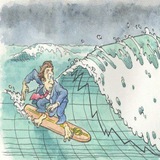
US market rebound as I am anticipated, but the futures go down beyond the support level I defined!
Monday I will focus on Bank sectors which released good quarter results this week ! CIMB is one of it as I anticipating it should make new high
Henyuan is another counters I bought in yesterday ! Reason was the panics sell down was over and support level i define was validate by VSA ! Let monitor it and traders can take advantage on the ride ! I stop loss below <$11.00
Pls invite your friend to join me by click the Link below ! My stock pick base in Technical analysis https://t.me/KLSETA
三毛的文章(很棒! 必看)
運動與不運動的人,隔一天。看,沒有任何區別;隔一個月看,差異甚微;隔一年看,差距明顯,也似乎沒有實質區別;隔五年看的時候,就是身體和精神狀態上的巨大差別;等到十年之後再看,也許就是兩種不同的人生。所以,人生就像走路,不得慢一步!
三毛說:「書讀多了,容顏自然改變,很多時候,自己可能以為許多看過的書籍都成為過眼煙雲,不復記憶,其實它們仍是潛在的氣質里、在談吐上、在胸襟的無涯,當然也可能顯露在生活和文字中。」
運動也一樣,你運動過的從來都不會欺騙你,你健康的身體、樂觀的精神、旺盛的精力,誰都可以感受到。所以,要麼讀書,要麼運動,身體和靈魂,必須有一個在路上。
懶惰是很奇怪的東西,它使你以為那是安逸,是休息,是福氣;但實際上它所給你的是無聊,是倦怠,是消沈;它剝奪你對前途的希望,割斷你和別人之間的友情,使你心胸日漸狹窄,對人生也越來越懷疑。
時光很奇特,它給了你閱歷、經驗、福氣,同時也給了你衰老、皺紋和消沈;它剝奪你對青春的渴望,拉深了你和照片之間的鴻溝。你開始明白,你的容顏終究會敗給時間。
請不要說:等我有時間了,就能運動了;等我賺夠錢了,就能孝敬父母了;等我有空了,就能陪你了;等我發達了,就能行善了。
因為,等到我們有錢了,健康已經沒了;等到我們賺夠錢了,父母已經等不及了;等到我們真正有空了,愛人已經離開了;等到我們發達了,心態已經變了。健身、孝老、陪伴、行善,任何時候都可以,不必等!
運動重在自強不息,速度和距離只是表面,更重要的是鍛鍊人的意志力、自制力、承受力、自信心,表達一種堅韌不拔的人生態度。走路,是你一生的朋友,也是你一輩子的財富!
生活和工作中別逢人就低頭,別逢人就訴苦,旁人終歸是旁人,沒幾個人真把你的傷口當作自己的痛處。自己選擇的路就向前走,再苦再累也別停下。這一生你只需要認真努力地工作,堅持鍛鍊身體,心安理得地生活。
最後請記住:清醒時做事,糊塗時運動,大怒時休息,獨處時思考,時間會在你身上刻畫出努力的痕跡。
給此生,真心的朋友!
The Dow theory on stock price movement is a form of technical analysis that includes some aspects of sector rotation. The theory was derived from 255 Wall Street Journal editorials written by Charles H. Dow (1851–1902), journalist, founder and first editor of The Wall Street Journal and co-founder of Dow Jones and Company. Following Dow's death, William Peter Hamilton, Robert Rhea and E. George Schaefer organized and collectively represented Dow theory, based on Dow's editorials. Dow himself never used the term Dow theory nor presented it as a trading system.
The six basic tenets of Dow theory as summarized by Hamilton, Rhea, and Schaefer are described below.
Six basic tenets of Dow theory
The market has three movements
(1) The "main movement", primary movement or major trend may last from less than a year to several years. It can be bullish or bearish. (2) The "medium swing", secondary reaction or intermediate reaction may last from ten days to three months and generally retraces from 33% to 66% of the primary price change since the previous medium swing or start of the main movement. (3) The "short swing" or minor movement varies with opinion from hours to a month or more. The three movements may be simultaneous, for instance, a daily minor movement in a bearish secondary reaction in a bullish primary movement.
Market trends have three phases
Dow theory asserts that major market trends are composed of three phases: an accumulation phase, a public participation (or absorption) phase, and a distribution phase. The accumulation phase (phase 1) is a period when investors "in the know" are actively buying (selling) stock against the general opinion of the market. During this phase, the stock price does not change much because these investors are in the minority demanding (absorbing) stock that the market at large is supplying (releasing). Eventually, the market catches on to these astute investors and a rapid price change occurs (phase 2). This occurs when trend followers and other technically oriented investors participate. This phase continues until rampant speculation occurs. At this point, the astute investors begin to distribute their holdings to the market (phase 3).
The stock market discounts all news
Stock prices quickly incorporate new information as soon as it becomes available. Once news is released, stock prices will change to reflect this new information. On this point, Dow theory agrees with one of the premises of the efficient-market hypothesis.
Stock market averages must confirm each other
In Dow's time, the US was a growing industrial power. The US had population centers but factories were scattered throughout the country. Factories had to ship their goods to market, usually by rail. Dow's first stock averages were an index of industrial (manufacturing) companies and rail companies. To Dow, a bull market in industrials could not occur unless the railway average rallied as well, usually first. According to this logic, if manufacturers' profits are rising, it follows that they are producing more. If they produce more, then they have to ship more goods to consumers. Hence, if an investor is looking for signs of health in manufacturers, he or she should look at the performance of the companies that ship their output to market, the railroads. The two averages should be moving in the same direction. When the performance of the averages diverge, it is a warning that change is in the air.
Both Barron's Magazine and the Wall Street Journal still publish the daily performance of the Dow Jones Transportation Average in chart form. The index contains major railroads, shipping companies, and air freight carriers in the US.
Trends are confirmed by volume
Dow believed that volume confirmed price trends. When prices move on low volume, there could be many different explanations. An overly aggressive seller could be present for example. But when price movements are accompanied by high volume, Dow believed this represented the "true" market view. If many participants are active in a particular security, and the price moves significantly in one direction, Dow maintained that this was the direction in which the market anticipated continued movement. To him, it was a signal that a trend is developing.
Trends exist until definitive signals prove that they have ended
Dow believed that trends existed despite "market noise". Markets might temporarily move in the direction opposite to the trend, but they will soon resume the prior move. The trend should be given the benefit of the doubt during these reversals. Determining whether a reversal is the start of a new trend or a temporary movement in the current trend is not easy. Dow Theorists often disagree in this determination. Technical a
nalysis tools attempt to clarify this but they can be interpreted differently by different investors.
Analysis
Pls invite your friend to join me by click the Link below ! My stock pick base in Technical analysis https://t.me/KLSETA
Stock I am anticipating making new high is CIMB
Rebound hengyuan
Stock I look to buy is
Fgv
Armada
Drb
DJ30 future: Wave 2 correction; running flat was developed and it near to ending, wave 3 up trend will kickstart in near term ! I long Dow
30 future ! SL below 24000, TP 25200/26200
Current level 24755
DJ30 : it rebound as I anticipated because of wave 2 ending(running flat was developed) current level 24900
KLSE stock to watch:
1. FGV
2. AAX
3. SAPNG(rebound)