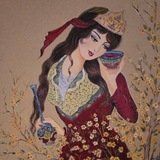
Young Iranian women from Kordestan tribes wearing traditional costumes.
1❤8
Panther-headed throne arm with ram’s head and opium poppies aside, 7th c. BC.
Gold, amber, glass-paste, found at Kelermes mound, district of Adygea in Russia.
Hermitage museum, St Petersburg
Gold, amber, glass-paste, found at Kelermes mound, district of Adygea in Russia.
Hermitage museum, St Petersburg
❤9
Around 800 years ago in Isfahan, Iran, a craftsman built a four-dial combination lock with over 4.2 billion possible combos — centuries ahead of its time.
Signed by astrolabe maker Muhammad ibn Hamid al-Asturlabi, it fused mechanical precision with striking artistry.
Signed by astrolabe maker Muhammad ibn Hamid al-Asturlabi, it fused mechanical precision with striking artistry.
❤9
Sheath for three knives, from Tillya Tepe, 1st century A.D. Bronze, gold, turquoise (within the sheath is the iron blade of a dagger with a worked ivory handle).
Decorated with Swastika, Derafsh Kavian, heart shaped symbols and turquoises styling clovers around the golden dragons and goats on the sides.
National Museum of Afghanistan
Decorated with Swastika, Derafsh Kavian, heart shaped symbols and turquoises styling clovers around the golden dragons and goats on the sides.
National Museum of Afghanistan
❤9
Sassanid stucco bust, discovered at Tall-e Sefidak in Iran during excavations of a Sasanian palace. The bust displays fine craftsmanship, with neatly patterned curls in the hair and beard and a carefully modeled crown and cloth. Features of the lord's crown (spherical crowns and stepped edges) and the shape of the face match it with the Middle Sassanid kings likely Shapur II (r. 309–379 CE).
National Museum of Iran, Tehran
National Museum of Iran, Tehran
❤6🏆2🫡1