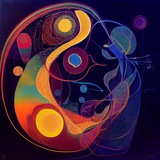
Brigid represents the essence of an inner dawn, and the healing that comes from knowing that the best is yet to come. Brigid is the goddess of pre-Christian Ireland. She is associated with the Indo-European dawn goddess and the coming of spring. She is celebrated in a Gaelic festival called Imbolc that takes place half way between the winter and spring solstice. It is said that at the moment between dusk and daybreak, Brigid arose into the sky with
flames like rays of the sun blazing in her hair. There’s a shrine near Kildare in Ireland that is sacred to the druids because it was believed to have been a place where Brigid’s priestesses tended to her eternal flame. This is where they learned the ancient healing practices that are associated with Brigid. And this is where in 480 CE, Saint Brigid built a monastery in honor of the goddess and created a communal and consecrated center for women’s religious life and learning.
Brigid is associated with poetry, and with all things elevated: states of being, high rising flames, lofty dimensions, elevated wisdom. She is said to have created the whistle for calling out from one to another while walking through the night, which lifts the wanderer with its levity and reminds her she’s not alone.
When your soul selects her card:
There’s that moment when you’re making your way through the dark and suddenly (after what feels like days, or months, or even years) a ray of light comes through to you. A lightening happens. Each step isn’t quite as hard to make as the one before. And you feel a great shift begin, as if now you’re headed toward something new. Something even brighter. Brigid is the essence of that first flame, that first ray of light.
Brigid reminds us that the darkness never lasts.Brigid’s eternal flame represents the truth that the light never leaves us and can never be extinguished. It simply gets obscured, or blocked from us. She reminds us that every day is actually filled with light; there are many days (and times in our lives) when we endure thick cloud cover. When that flame that exists within us is blocked by pain or confusion. Brigid is the sweet sound that reaches us in the dark and reminds us that we have never been on this journey alone. Brigid is our sign that the dawn is here because we have made it through the dark winter. We can lift our head. The healing has happened. And now each next day is bound to be brighter.
- Excerpted from “The Divine Feminine Oracle” by Meggan Watterson, Art by Lisbeth Cheever-Gessaman
“Brigid”
flames like rays of the sun blazing in her hair. There’s a shrine near Kildare in Ireland that is sacred to the druids because it was believed to have been a place where Brigid’s priestesses tended to her eternal flame. This is where they learned the ancient healing practices that are associated with Brigid. And this is where in 480 CE, Saint Brigid built a monastery in honor of the goddess and created a communal and consecrated center for women’s religious life and learning.
Brigid is associated with poetry, and with all things elevated: states of being, high rising flames, lofty dimensions, elevated wisdom. She is said to have created the whistle for calling out from one to another while walking through the night, which lifts the wanderer with its levity and reminds her she’s not alone.
When your soul selects her card:
There’s that moment when you’re making your way through the dark and suddenly (after what feels like days, or months, or even years) a ray of light comes through to you. A lightening happens. Each step isn’t quite as hard to make as the one before. And you feel a great shift begin, as if now you’re headed toward something new. Something even brighter. Brigid is the essence of that first flame, that first ray of light.
Brigid reminds us that the darkness never lasts.Brigid’s eternal flame represents the truth that the light never leaves us and can never be extinguished. It simply gets obscured, or blocked from us. She reminds us that every day is actually filled with light; there are many days (and times in our lives) when we endure thick cloud cover. When that flame that exists within us is blocked by pain or confusion. Brigid is the sweet sound that reaches us in the dark and reminds us that we have never been on this journey alone. Brigid is our sign that the dawn is here because we have made it through the dark winter. We can lift our head. The healing has happened. And now each next day is bound to be brighter.
- Excerpted from “The Divine Feminine Oracle” by Meggan Watterson, Art by Lisbeth Cheever-Gessaman
“Brigid”
‘Akhilanda represents the essence of the Phoenix; she’s the indestructible energy that embraces change. Her full name is Akhilandaishvari. Ishvari in Sanskrit means female power or goddess and Akhilanda means never not broken, so she is the goddess of never not broken. She can never be broken, because she always is. She is the embodiment of what we try to avoid–the dissolution of our ego’s identity. She radiates the potent light and joy that’s the goal of change, transformation, or pain. There is very little written about her; she is meant to be known through experience. She is an intimate, interior goddess that we meet when we are in the darkest moments of grief and heartbreak. She shows us where our energy is trapped; where we have been stifled in routines or other’s expectations of us. And she whispers the liberation we will experience once we let ourselves break open, and allow the new expression of our self to come blazing through. She reminds us that we always have the power to choose to see every event as yet another opportunity to become more light, to become more of the radiant soul we are here to be.
When your soul selects her card:
Many of us exert tremendous energy in the effort to not break or fall apart. We resist our grief. Our heartbreak. Or we deny the need to change until the choice no longer feels like it’s ours. Something side swipes us from our ordinary life and shatters who we think we are and how we identify ourselves. Here’s what Akhilanda reminds us: vulnerability is our greatest strength. If we are always broken, we can never break. Akhilanda is the most intimate, and personally powerful goddess because she meets us in those moments when we can feel most alone, most exposed, and most afraid. She models how to thrive in the midst of change; she uses pain to joyfully and purposefully transform. She sees everything as an opportunity to release what isn’t serving her. And she knows that being broken isn’t a failure, or something we should avoid, it’s actually the whole point. We are here to let our ideas of ourselves go up in flames, so that beneath the ashes, the soft core of who we truly are arises. And so that we remember that it’s not the heart that ever breaks; it’s the ego. The heart only ever expands. ‘
- Excerpted from “The Divine Feminine Oracle” by Meggan Watterson
https://web.facebook.com/shewhoisart
When your soul selects her card:
Many of us exert tremendous energy in the effort to not break or fall apart. We resist our grief. Our heartbreak. Or we deny the need to change until the choice no longer feels like it’s ours. Something side swipes us from our ordinary life and shatters who we think we are and how we identify ourselves. Here’s what Akhilanda reminds us: vulnerability is our greatest strength. If we are always broken, we can never break. Akhilanda is the most intimate, and personally powerful goddess because she meets us in those moments when we can feel most alone, most exposed, and most afraid. She models how to thrive in the midst of change; she uses pain to joyfully and purposefully transform. She sees everything as an opportunity to release what isn’t serving her. And she knows that being broken isn’t a failure, or something we should avoid, it’s actually the whole point. We are here to let our ideas of ourselves go up in flames, so that beneath the ashes, the soft core of who we truly are arises. And so that we remember that it’s not the heart that ever breaks; it’s the ego. The heart only ever expands. ‘
- Excerpted from “The Divine Feminine Oracle” by Meggan Watterson
https://web.facebook.com/shewhoisart
Facebook
She Who Is
She Who Is. 151,708 likes · 795 talking about this. Artist, enchanter, inkslinger. Disciple of the dark, deep divine. Curator of mysteries, Ecstatic wanderer. Scar Clan. Love.
etsy.com/shop/shewhoisart
etsy.com/shop/shewhoisart
Mary Magdalene embodies the capacity we all have to merge with the soul and receive divine guidance through a love that never ends. Mary was born in the first century in Magdala, Israel. She was the first to witness the resurrection, and for this reason is revered in Christianity as the Apostle to the Apostles. Author and Episcopal priest Cynthia Bourgeault relates that the Gospels of Thomas, Philip, and Mary Magdalene all reveal Mary not only as Jesus’s beloved companion, koinonos, but also as an equal partner in teaching and transmission. (p.42, The Meaning of Mary Magdalene.) Bourgeault believes that Mary Magdalene’s gospel contains a secret teaching that Christ gave to Mary so that she could pass though the seven stages to reach the soul, or the nous, which is the highest point of the soul. And it is this union with her soul that allows Mary to see the risen Christ.
In classic iconography Mary Magdalene is associated with an egg and the color red because of an Eastern Orthodox legend. It says that she used an egg to teach the court of Tiberius Caesar about resurrection. Caesar doubted her and responded that a person could no more rise from the dead than the egg in her hand turn red. The egg turned red immediately. Legends relate that Mary then traveled to the south of France to escape persecution and to continue her ministry. It is believed she lived the last thirty years of her life in the caves at St. Baume. There she met with Christ with a love that inhabits the human heart but that lives on beyond it.
When your soul selects her card:
Mary Magdalene represents the fierce, unwavering love that we all have access to within our own vulnerable hearts. It’s a love that renders all things sacred from the animals to the angels, from the poorest to the most powerful. It’s a love that sees the inherent worth of all things. And it’s a love that remains, even through the darkest times, even through death; her love is the one that resurrects.
The Gospel of Mary Magdalene relates that Jesus came to unite us, to demonstrate to us a “true human being,” an “Anthropos,” meaning a person who is both fully human, and fully divine. This is what Mary became and it’s why she was so beloved to Jesus. She didn’t seek to follow him; she sought instead to become her true self.
Mary Magdalene reminds us that we have the power to receive vision from within. We are worthy of such proximity to the divine because that’s the other half of what it means to be truly human. She reminds us that there’s a bridge between heaven and earth, and that we are that bridge. And she wants us to remember that the truest church we can ever enter is in the heart. This is where our true power rests and where love never ends. “
- Excerpted from “The Divine Feminine Oracle
In classic iconography Mary Magdalene is associated with an egg and the color red because of an Eastern Orthodox legend. It says that she used an egg to teach the court of Tiberius Caesar about resurrection. Caesar doubted her and responded that a person could no more rise from the dead than the egg in her hand turn red. The egg turned red immediately. Legends relate that Mary then traveled to the south of France to escape persecution and to continue her ministry. It is believed she lived the last thirty years of her life in the caves at St. Baume. There she met with Christ with a love that inhabits the human heart but that lives on beyond it.
When your soul selects her card:
Mary Magdalene represents the fierce, unwavering love that we all have access to within our own vulnerable hearts. It’s a love that renders all things sacred from the animals to the angels, from the poorest to the most powerful. It’s a love that sees the inherent worth of all things. And it’s a love that remains, even through the darkest times, even through death; her love is the one that resurrects.
The Gospel of Mary Magdalene relates that Jesus came to unite us, to demonstrate to us a “true human being,” an “Anthropos,” meaning a person who is both fully human, and fully divine. This is what Mary became and it’s why she was so beloved to Jesus. She didn’t seek to follow him; she sought instead to become her true self.
Mary Magdalene reminds us that we have the power to receive vision from within. We are worthy of such proximity to the divine because that’s the other half of what it means to be truly human. She reminds us that there’s a bridge between heaven and earth, and that we are that bridge. And she wants us to remember that the truest church we can ever enter is in the heart. This is where our true power rests and where love never ends. “
- Excerpted from “The Divine Feminine Oracle
This media is not supported in your browser
VIEW IN TELEGRAM
This media is not supported in your browser
VIEW IN TELEGRAM
This media is not supported in your browser
VIEW IN TELEGRAM
This media is not supported in your browser
VIEW IN TELEGRAM
This media is not supported in your browser
VIEW IN TELEGRAM
·
Parvati embodies the divine strength of devotion; she is the mountain that love becomes when we devote ourselves to another and to our own soul. Parvati is the Hindu goddess of fertility, of love and devotion, and of divine strength and power. She is the gentle, nurturing aspect of Shakti, or feminine energy. She is part of the Tridevi, a trinity of
powerful Hindu goddesses together with Lakshmi and Saraswati.
Parvati’s name means “she of the mountain.” Her icons and depictions date back to 400 BC. She is Shiva’s wife, and holds his trident, and she is the mother of Ganesha, the Hindu god who removes all obstacles. Shiva lives with Parvati in her house on Mount Kailash. Their favorite pastime is discussing Hindu theology. Traditionally in India women go to live with their husband’s family, so this reversal reveals Parvati’s priority and power. By living on Mount Kailash, Shiva becomes a part of Parvati’s lineage. She is the bond that connects all human beings, a bond of love that helps our souls evolve.
When your soul selects her card:
What is soft, gentle, and nurturing like water can be far more powerful than what is inflexible and fierce. The energy of this mountain goddess is about the strength we can give and receive when we devote ourselves to the healthy bonds of love. Parvati is about the divine feminine potency of being a calm, benevolent presence especially when
something seems to threaten a deeply meaningful relationship. Transformation with this goddess calls for a softening. When a situation is hard, even moments when our ego has typically fled infuses us with the capacity to transform all of our relationships. Devotion is not attachment. It’s letting go of the illusion that you and this lover, this
friend, this child, or family member, this soul within you can ever really be separate from you. Devotion brings us home to the point and purpose of every relationship; love. A love that can never leave, and that like a mountain can never move. A love that evolves the soul. “
- Excerpted from “The Divine Feminine Oracle” by Meggan Watterson, Illustrated by Lisbeth Cheever-Gessaman
Parvati embodies the divine strength of devotion; she is the mountain that love becomes when we devote ourselves to another and to our own soul. Parvati is the Hindu goddess of fertility, of love and devotion, and of divine strength and power. She is the gentle, nurturing aspect of Shakti, or feminine energy. She is part of the Tridevi, a trinity of
powerful Hindu goddesses together with Lakshmi and Saraswati.
Parvati’s name means “she of the mountain.” Her icons and depictions date back to 400 BC. She is Shiva’s wife, and holds his trident, and she is the mother of Ganesha, the Hindu god who removes all obstacles. Shiva lives with Parvati in her house on Mount Kailash. Their favorite pastime is discussing Hindu theology. Traditionally in India women go to live with their husband’s family, so this reversal reveals Parvati’s priority and power. By living on Mount Kailash, Shiva becomes a part of Parvati’s lineage. She is the bond that connects all human beings, a bond of love that helps our souls evolve.
When your soul selects her card:
What is soft, gentle, and nurturing like water can be far more powerful than what is inflexible and fierce. The energy of this mountain goddess is about the strength we can give and receive when we devote ourselves to the healthy bonds of love. Parvati is about the divine feminine potency of being a calm, benevolent presence especially when
something seems to threaten a deeply meaningful relationship. Transformation with this goddess calls for a softening. When a situation is hard, even moments when our ego has typically fled infuses us with the capacity to transform all of our relationships. Devotion is not attachment. It’s letting go of the illusion that you and this lover, this
friend, this child, or family member, this soul within you can ever really be separate from you. Devotion brings us home to the point and purpose of every relationship; love. A love that can never leave, and that like a mountain can never move. A love that evolves the soul. “
- Excerpted from “The Divine Feminine Oracle” by Meggan Watterson, Illustrated by Lisbeth Cheever-Gessaman
https://www.youtube.com/watch?v=Kis-8p0bS2o
TheaterRaven said:
2:22--"When the Gods send you a blessing, you don't ask why it was sent." (An instrumental of Moses' mother's lullaby floats in)
I love that bit. For all the credit and praise people give Moses for his role in the story, it all started with his two mothers--his biological one and the one who raised him. Those two women lived in a world dominated and ruled by men, existed in completely separate social spheres, and had different ethnic and religious backgrounds, yet they transcended all those things for their love of the same child. Beautiful. It just goes to show how powerful the Feminine, in both human and divine form, can be. Blessed be. )O(
https://www.youtube.com/watch?v=Kis-8p0bS2o
https://en.wikipedia.org/wiki/Asiya
https://en.wikipedia.org/wiki/Pharaoh's_daughter_(Exodus)
Her many names...
https://en.wikipedia.org/wiki/Jochebed Moses birth mother seems to be remembered by one name, Jochebed, though sometimes also identified with Shiprah
TheaterRaven said:
2:22--"When the Gods send you a blessing, you don't ask why it was sent." (An instrumental of Moses' mother's lullaby floats in)
I love that bit. For all the credit and praise people give Moses for his role in the story, it all started with his two mothers--his biological one and the one who raised him. Those two women lived in a world dominated and ruled by men, existed in completely separate social spheres, and had different ethnic and religious backgrounds, yet they transcended all those things for their love of the same child. Beautiful. It just goes to show how powerful the Feminine, in both human and divine form, can be. Blessed be. )O(
https://www.youtube.com/watch?v=Kis-8p0bS2o
https://en.wikipedia.org/wiki/Asiya
https://en.wikipedia.org/wiki/Pharaoh's_daughter_(Exodus)
Her many names...
https://en.wikipedia.org/wiki/Jochebed Moses birth mother seems to be remembered by one name, Jochebed, though sometimes also identified with Shiprah
YouTube
All I Ever Wanted (with Queen's Reprise)- Prince of Egypt Soundtrack
Copyright DreamWorks Records, 1998. Prince of Egypt Soundtrack.
You're in the movie.
How do you write the movie?
How do you write the movie?
30. Intuitive Space Show, Comms Repair • https://anchor.fm/intuitive/episodes/30--Intuitive-Space-Show--Comms-Repair-e178k4q • https://t.me/IntuitiveSpace/25 • https://t.me/IntuitivePublicRadio/8715 •••
Anchor
30. Intuitive Space Show, Comms Repair by Intuitive Public Radio • A podcast on Anchor
30. Intuitive Space Show, Comms Repair • https://anchor.fm/intuitive/episodes/30--Intuitive-Space-Show--Comms-Repair-e178k4q • https://t.me/IntuitiveSpace/25 • https://t.me/IntuitivePublicRadio/8715 •••
Our lives are made of stories that manifest in and around us. At first, they may seem like complete (incomplete) nonsense. What is this substrate we’re swimming in? Rhymes? Poetry?
Relaxing into the flow of it, there is no doubt that it supports us in expression and absorption; it is nourishing.
We have sometimes thought of it as a foil; if onlookers might somehow detest our naturally strengthening substrate, we will not broach the most important subjects. It wouldn’t be safe to do so.
But if our substrate endears us to others, if our substrate is curious and nourishing to others --- then we will be able to talk about what really matters.
One step can lead us to another.
What substrate supports you best?
What is your substrate energizing?
What do you need to talk about in safety, support, and belonging?
What really matters?
What’s resonating?
https://t.me/IntuitiveStory/398
Relaxing into the flow of it, there is no doubt that it supports us in expression and absorption; it is nourishing.
We have sometimes thought of it as a foil; if onlookers might somehow detest our naturally strengthening substrate, we will not broach the most important subjects. It wouldn’t be safe to do so.
But if our substrate endears us to others, if our substrate is curious and nourishing to others --- then we will be able to talk about what really matters.
One step can lead us to another.
What substrate supports you best?
What is your substrate energizing?
What do you need to talk about in safety, support, and belonging?
What really matters?
What’s resonating?
https://t.me/IntuitiveStory/398
Forwarded from 🔊 Dreamseum • Gut Media • Intuitive Public Radio • IPR •••
this weakness is a valuable catalyst