The Sandman
The Devil Wears Prada
Dark Journalist
The Solari Report
The Devil Wears Prada
Dark Journalist
The Solari Report
Forwarded from Space Weather Today
Solar wind
speed: 427.7 km/sec
density: 8.70 protons/cm3
more data: ACE, DSCOVR
Updated: Today at 0730 UT
X-ray Solar Flares
6-hr max: C3 0710 UT Aug17
24-hr: M5 0758 UT Aug16
explanation | more data
Updated: Today at: 0735 UT
speed: 427.7 km/sec
density: 8.70 protons/cm3
more data: ACE, DSCOVR
Updated: Today at 0730 UT
X-ray Solar Flares
6-hr max: C3 0710 UT Aug17
24-hr: M5 0758 UT Aug16
explanation | more data
Updated: Today at: 0735 UT
Forwarded from Space Weather Today
Daily Sun: 17 Aug 22
Sunspot AR3078 has a delta-class magnetic field that poses a threat for X-class solar flares. Credit: SDO/HMI
Sunspot AR3078 has a delta-class magnetic field that poses a threat for X-class solar flares. Credit: SDO/HMI
Forwarded from Space Weather Today
Current Auroral Oval:
Planetary K-index
Now: Kp= 3 quiet
24-hr max: Kp= 3 quiet
explanation | more data
Interplanetary Mag. Field
Btotal: 13.84 nT
Bz: 3.29 nT north
more data: ACE, DSCOVR
Updated: Today at 0730 UT
Planetary K-index
Now: Kp= 3 quiet
24-hr max: Kp= 3 quiet
explanation | more data
Interplanetary Mag. Field
Btotal: 13.84 nT
Bz: 3.29 nT north
more data: ACE, DSCOVR
Updated: Today at 0730 UT
Forwarded from Space Weather Today
Coronal Holes: 17 Aug 22
Solar wind flowing from this long equatorial coronal hole should reach Earth on August 18-19. Credit: SDO/AIA
Solar wind flowing from this long equatorial coronal hole should reach Earth on August 18-19. Credit: SDO/AIA
Forwarded from Space Weather Today
THE IMPACTS HAVE BEGUN: A minor CME hit Earth's magnetic field on Aug. 17th (0303 UT). It could be the first of several CME strikes in the days ahead. NOAA forecasters say their cumulative effect could cause strong G3-class geomagnetic storms, especially on Aug. 18-19. During such storms naked-eye auroras can descend into the USA as far south as Illinois and Oregon (geomagnetic latitude 50 degrees). Cameras with sensitive night-sky settings may record auroras even farther south than that.
Forwarded from Space Weather Today
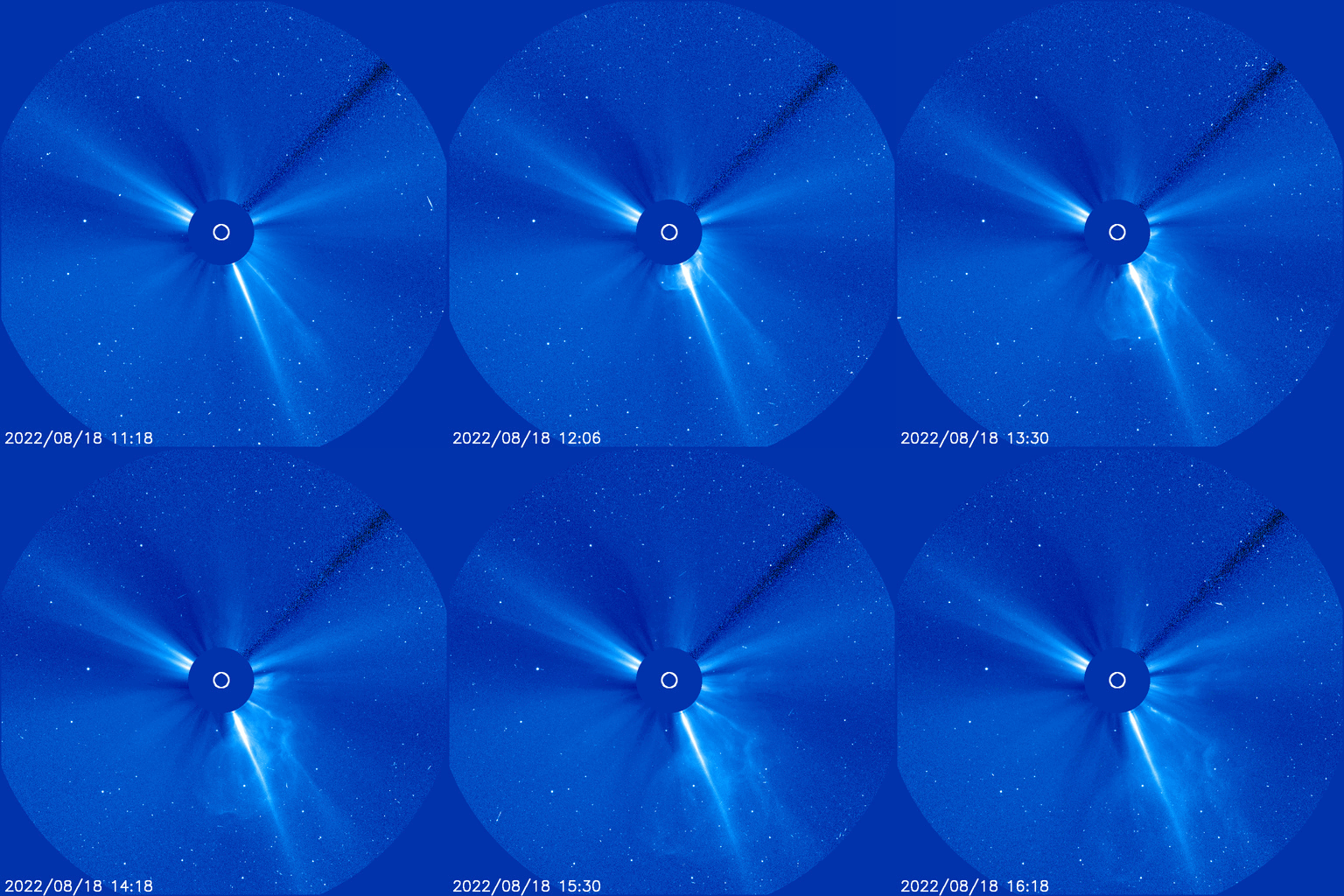
A CME JUST HIT EARTH: A coronal mass ejection (CME) hit Earth's magnetic field on Aug. 20th at approximately 1800 UT. This is the first of two CMEs (#1, #2) expected to arrive in the Aug. 20-21 time frame. Minor G1-class geomagnetic storms are possible in the hours ahead, possibly intensifying to category G2 when the second CME arrives.
Forwarded from Space Weather Today
GEOMAGNETIC UNREST: A CME hit Earth's magnetic field on Aug. 20th at 1812 UT. The weak impact caused an episode of geomagnetic unrest (Kp=4) but not a full-fledged geomagnetic storm. Another similar CME is expected to arrive on Aug. 21st, and it could push Earth's magnetosphere over the threshold of minor G1-class storming. High-latitude sky watchers should remain alert for auroras.
Forwarded from Space Weather Today
Solar wind
speed: 553.6 km/sec
density: 8.90 protons/cm3
X-ray Solar Flares
6-hr max: C3 0459 UT Aug21
24-hr: C3 0459 UT Aug21
speed: 553.6 km/sec
density: 8.90 protons/cm3
X-ray Solar Flares
6-hr max: C3 0459 UT Aug21
24-hr: C3 0459 UT Aug21
Forwarded from Space Weather Today
Solar wind
speed: 445.7 km/sec
density: 3.79 protons/cm3
more data: ACE, DSCOVR
Updated: Today at 0155 UT
X-ray Solar Flares
6-hr max: B7 0902 UT Aug23
24-hr: C5 1409 UT Aug22
explanation | more data
Updated: Today at: 1400 UT
speed: 445.7 km/sec
density: 3.79 protons/cm3
more data: ACE, DSCOVR
Updated: Today at 0155 UT
X-ray Solar Flares
6-hr max: B7 0902 UT Aug23
24-hr: C5 1409 UT Aug22
explanation | more data
Updated: Today at: 1400 UT
Forwarded from Space Weather Today
Forwarded from Space Weather Today
Forwarded from Space Weather Today
FAST-GROWING SUNSPOT: Two days ago sunspot AR3085 barely existed. Since then it has grown more than 10-fold, turning itself into a double sunspot group with cores nearly as wide as Earth. Watch this movie. The active region is directly facing Earth and crackling with C-class solar flares.https://www.spaceweather.com/images2022/22aug22/newsunspot_crop2.gif
