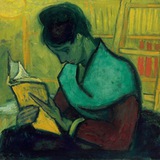
“The tears stream down my cheeks from my unblinking eyes. What makes me weep so? There is nothing saddening here. Perhaps it is liquefied brain.”
❤4
Marcel Proust (French writer)
_________
Born : July 10, 1871
Died : November 18, 1922
_________
The entire climate of the 20th-century novel was affected by À la recherche du temps perdu, which is one of the supreme achievements of modern fiction. Taking as raw material the author’s past life, À la recherche is ostensibly about the irrecoverability of time lost, about the forfeiture of innocence through experience, the emptiness of love and friendship, the vanity of human endeavour, and the triumph of sin and despair; but Proust’s conclusion is that the life of every day is supremely important, full of moral joy and beauty, which, though they may be lost through faults inherent in human nature, are indestructible and recoverable. Proust’s style is one of the most original in all literature and is unique in its union of speed and protraction, precision and iridescence, force and enchantment, classicism and symbolism.
[Know More]
_________
Born : July 10, 1871
Died : November 18, 1922
_________
The entire climate of the 20th-century novel was affected by À la recherche du temps perdu, which is one of the supreme achievements of modern fiction. Taking as raw material the author’s past life, À la recherche is ostensibly about the irrecoverability of time lost, about the forfeiture of innocence through experience, the emptiness of love and friendship, the vanity of human endeavour, and the triumph of sin and despair; but Proust’s conclusion is that the life of every day is supremely important, full of moral joy and beauty, which, though they may be lost through faults inherent in human nature, are indestructible and recoverable. Proust’s style is one of the most original in all literature and is unique in its union of speed and protraction, precision and iridescence, force and enchantment, classicism and symbolism.
[Know More]
“Let us be grateful to the people who make us happy; they are the charming gardeners who make our souls blossom.”
❤4
“The real voyage of discovery consists not in seeking new landscapes, but in having new eyes.”
“Remembrance of things past is not necessarily the remembrance of things as they were.”
👍2
“Happiness is beneficial for the body, but it is grief that develops the powers of the mind.”
❤1
“We don't receive wisdom; we must discover it for ourselves after a journey that no one can take for us or spare us.”
“Desire makes everything blossom; possession makes everything wither and fade. ”
❤3
“Now there is one thing I can tell you: you will enjoy certain pleasures you would not fathom now. When you still had your mother you often thought of the days when you would have her no longer. Now you will often think of days past when you had her. When you are used to this horrible thing that they will forever be cast into the past, then you will gently feel her revive, returning to take her place, her entire place, beside you. At the present time, this is not yet possible. Let yourself be inert, wait till the incomprehensible power ... that has broken you restores you a little, I say a little, for henceforth you will always keep something broken about you. Tell yourself this, too, for it is a kind of pleasure to know that you will never love less, that you will never be consoled, that you will constantly remember more and more.”
❤2👍1
“The bonds between ourselves and another person exists only in our minds. Memory as it grows fainter loosens them, and notwithstanding the illusion by which we want to be duped and which, out of love, friendship, politeness, deference, duty, we dupe other people, we exist alone. Man is the creature who cannot escape from himself, who knows other people only in himself, and when he asserts the contrary, he is lying.”
❤11👍1
Susan Sontag (American writer)
__________
Born : January 16, 1933
Died : December 28, 2004
__________
American intellectual and writer best known for her essays on modern culture.
Sontag’s essays are characterized by a serious philosophical approach to various aspects and personalities of modern culture. She first came to national attention in 1964 with an essay entitled “Notes on ‘Camp,’ ” in which she discussed the attributes of taste within the gay community. She also wrote on such subjects as theatre and film and such figures as writer Nathalie Sarraute, director Robert Bresson, and painter Francis Bacon. In addition to criticism and fiction, she wrote screenplays and edited selected writings of Roland Barthes and Antonin Artaud. Some of her later writings and speeches were collected in At the Same Time: Essays and Speeches (2007).
__________
Born : January 16, 1933
Died : December 28, 2004
__________
American intellectual and writer best known for her essays on modern culture.
Sontag’s essays are characterized by a serious philosophical approach to various aspects and personalities of modern culture. She first came to national attention in 1964 with an essay entitled “Notes on ‘Camp,’ ” in which she discussed the attributes of taste within the gay community. She also wrote on such subjects as theatre and film and such figures as writer Nathalie Sarraute, director Robert Bresson, and painter Francis Bacon. In addition to criticism and fiction, she wrote screenplays and edited selected writings of Roland Barthes and Antonin Artaud. Some of her later writings and speeches were collected in At the Same Time: Essays and Speeches (2007).
❤2
“My library is an archive of longings.”
- As Consciousness is Harnessed to Flesh
- As Consciousness is Harnessed to Flesh
❤2
“Do stuff. be clenched, curious. Not waiting for inspiration's shove or society's kiss on your forehead. Pay attention. It's all about paying attention. attention is vitality. It connects you with others. It makes you eager. stay eager.”
❤2
“All photographs are memento mori. To take a photograph is to participate in another person’s (or thing’s) mortality, vulnerability, mutability. Precisely by slicing out this moment and freezing it, all photographs testify to time’s relentless melt.”
👍2❤1
“To photograph people is to violate them, by seeing them as they never see themselves, by having knowledge of them that they can never have; it turns people into objects that can be symbolically possessed. Just as a camera is a sublimation of the gun, to photograph someone is a subliminal murder - a soft murder, appropriate to a sad, frightened time.”
❤2