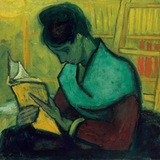
“Ever since I was small I loved feeling somebody comb my hair. It made me go all sleepy and peaceful.”
― The Bell Jar
― The Bell Jar
❤3
T.S. Eliot
_________
Born : September 26, 1888
Died : January 4, 1965
_________
American-English poet, playwright, literary critic, and editor, a leader of the Modernist movement in poetry in such works as The Waste Land (1922) and Four Quartets (1943). Eliot exercised a strong influence on Anglo-American culture from the 1920s until late in the century. His experiments in diction, style, and versification revitalized English poetry, and in a series of critical essays he shattered old orthodoxies and erected new ones. The publication of Four Quartets led to his recognition as the greatest living English poet and man of letters, and in 1948 he was awarded both the Order of Merit and the Nobel Prize for Literature.
[Know More...]
_________
Born : September 26, 1888
Died : January 4, 1965
_________
American-English poet, playwright, literary critic, and editor, a leader of the Modernist movement in poetry in such works as The Waste Land (1922) and Four Quartets (1943). Eliot exercised a strong influence on Anglo-American culture from the 1920s until late in the century. His experiments in diction, style, and versification revitalized English poetry, and in a series of critical essays he shattered old orthodoxies and erected new ones. The publication of Four Quartets led to his recognition as the greatest living English poet and man of letters, and in 1948 he was awarded both the Order of Merit and the Nobel Prize for Literature.
[Know More...]
"Most of the trouble with the world is caused by people wanting to be important."
👍1
"The progress of an artist is a continual self-sacrifice, a continual extinction of personality."
👍1
“Only those who will risk going too far can possibly find out how far one can go.”
👍1
“To do the useful thing, to say the courageous thing, to contemplate the beautiful thing: that is enough for one man's life.”
― The Use of Poetry and the Use of Criticism
― The Use of Poetry and the Use of Criticism
“We die to each other daily. What we know of other people is only our memory of the moments during which we knew them. And they have changed since then. To pretend that they and we are the same is a useful and convenient social convention which must sometimes be broken. We must also remember that at every meeting we are meeting a stranger.”
― The Cocktail Party
― The Cocktail Party
👍1
“What is hell? Hell is oneself.
Hell is alone, the other figures in it
Merely projections. There is nothing to escape from
And nothing to escape to. One is always alone.”
Hell is alone, the other figures in it
Merely projections. There is nothing to escape from
And nothing to escape to. One is always alone.”
👍2
“For last year's words belong to last year's language
And next year's words await another voice.
And to make an end is to make a beginning."
And next year's words await another voice.
And to make an end is to make a beginning."
“Poetry is not a turning loose of emotion, but an escape from emotion; it is not the expression of personality but an escape from personality. But, of course, only those who have personality and emotion know what it means to want to escape from these.”
❤3
“I learn a great deal by merely observing you, and letting you talk as long as you please, and taking note of what you do not say.”
❤3
Naguib Mahfouz (Egyptian writer)
_________
Born : December 11, 1911
Died : August 30, 2006
_________
Egyptian novelist and screenplay writer, who was awarded the Nobel Prize for Literature in 1988, the first Arabic writer to be so honoured.
In subsequent works, Mahfouz offered critical views of the old Egyptian monarchy, British colonialism, and contemporary Egypt. Several of his more notable novels deal with social issues involving women and political prisoners. His novel Awlād ḥāratinā (1959; Children of the Alley) was banned in Egypt for a time because of its controversial treatment of religion and its use of characters based on Muhammad, Moses, and other figures. Islamic militants, partly because of their outrage over the work, later called for his death, and in 1994 Mahfouz was stabbed in the neck.
_________
Born : December 11, 1911
Died : August 30, 2006
_________
Egyptian novelist and screenplay writer, who was awarded the Nobel Prize for Literature in 1988, the first Arabic writer to be so honoured.
In subsequent works, Mahfouz offered critical views of the old Egyptian monarchy, British colonialism, and contemporary Egypt. Several of his more notable novels deal with social issues involving women and political prisoners. His novel Awlād ḥāratinā (1959; Children of the Alley) was banned in Egypt for a time because of its controversial treatment of religion and its use of characters based on Muhammad, Moses, and other figures. Islamic militants, partly because of their outrage over the work, later called for his death, and in 1994 Mahfouz was stabbed in the neck.
You can tell whether a man is clever by his answers. You can tell whether a man is wise by his questions.
❤2
I defend both the freedom of expression and society's right to counter it. I must pay the price for differing. It is the natural way of things.
❤3
I reject any path which rejects life, but I can't help loving Sufism because it sounds so beautiful. It gives relief in the midst of battle.
There are no heroes in most of my stories. I look at our society with a critical eye and find nothing extraordinary in the people I see.
❤2
Home is not where you were born; home is where all your attempts to escape cease.
❤5