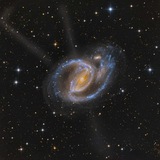
Now, imagine a tiny subatomic particle encountering a seemingly insurmountable barrier—a wall of potential energy taller than it has energy to climb. Classically, it should bounce back. But in the quantum realm, the rules are different. There's a chance, a non-zero probability, that the particle will tunnel right through the barrier, appearing on the other side as if it had simply walked through a doorway. This is quantum tunneling, a ghostly ability that allows particles to escape confinement and traverse energy barriers they shouldn't be able to overcome. It's the reason nuclear fusion occurs in stars, a fundamental process that lights up the universe. Both entanglement and tunneling show us that at the tiniest scales, reality behaves in ways utterly foreign to our everyday experience. They are testaments to the mind-bending strangeness of the quantum world, and yet, they are real.
❤6👍2
Cosy Pages 📖
Photo
Literally me.
How could I explain to you that I'm fluent in writing and very terrible at speaking english? My english speaking skills are almost close to zero because I never had the opportunity to speak english except for presentation classes in highschool💔
Its one of the things about myself that i really want to improve.
Actually, my speaking skills suck in any language but-
How could I explain to you that I'm fluent in writing and very terrible at speaking english? My english speaking skills are almost close to zero because I never had the opportunity to speak english except for presentation classes in highschool💔
Its one of the things about myself that i really want to improve.
Actually, my speaking skills suck in any language but-
😁7👌4
I have a mid exam in a week and here im lying on my bed with no purpose.
The studying havent even kicked off.
The studying havent even kicked off.
😭8👏1
Henok
I have a mid exam in a week and here im lying on my bed with no purpose. The studying havent even kicked off.
The most laziest student out there? Its gotta be me.
😁7
Someone please give me a one week challenge that makes me productive (academic-wise)😭🙏
Im open to take any of it.
Im open to take any of it.
🤗4
Consider the possibility that the fundamental constants of the universe (like the speed of light, gravitational constant, Planck constant, etc.) aren't truly constant, but rather slowly vary over cosmological timescales. What observable effects, if any, might this subtle variation have on the large-scale structure of the universe, the evolution of stars, or even the fundamental forces themselves? And what implications would this have for our understanding of the universe's past, present, and future? Could such variation be a key to unifying quantum mechanics and general relativity, or to understanding the nature of dark energy and dark matter?
🤔6
Henok
https://youtu.be/bCmwCkNY85g
So, there is a plan to construct a bigger and more advanced particle accelerator at CERN which is 2 times deeper and roughly 4 times larger than the large hadron collider (LHC). Some pundits are saying its a waste of money and time but scientists at CERN are a little bit confident that it will unleash something about dark matter or maybe pose another fundamental question about our universe and the grand scheme of reality.
The future circular collider (FCC) could come with a price tag of around 17 billion dollars, but countries are hesitating to invest. Meanwhile, global military spending in 2023 hit a staggering 2 trillion dollars.
The future circular collider (FCC) could come with a price tag of around 17 billion dollars, but countries are hesitating to invest. Meanwhile, global military spending in 2023 hit a staggering 2 trillion dollars.
❤5👍1
This media is not supported in your browser
VIEW IN TELEGRAM
The erratic behavior of double pendulum
🤯5
Time travel. The very concept crackles with impossible energy, a siren song luring physicists and fantasists alike. We've all pondered the implications: altering history, meeting our ancestors, preventing tragedies. But what if the most unsettling aspect of time travel isn't the potential for chaos, but the chilling possibility of inevitability?
Imagine a future where time travel is not just theoretical, but commonplace. Sophisticated algorithms predict the past with astonishing accuracy, charting every sneeze, every whispered secret, every pivotal moment. These predictions aren't merely probabilities; they're deterministic. The past, it seems, is a fixed point, unchangeable, unyielding.
This presents a terrifying paradox. If the past is perfectly predicted, what role does free will play? Did we ever truly have a choice? Did every seemingly spontaneous act, every 'what if' moment, lead inexorably to the present? Or is the very act of predicting the past, a paradoxical anchor that prevents any alteration? The time travelers, armed with their infallible predictions, become mere observers, passive witnesses to a predetermined narrative. Their very existence confirms the unchanging nature of the timeline.
The thrill of altering history dissolves into the cold comfort of knowing everything that will ever happen, already happened. This isn't the exciting adventure of pulp fiction; it's the soul-crushing weight of a universe where even the smallest action is a perfectly orchestrated note in a symphony already played. The question, then, isn't if time travel is possible, but what it truly means to exist within a perfectly predicted past. Is freedom an illusion, or is there a hidden mechanism, a crack in this deterministic facade, waiting to be discovered?
Imagine a future where time travel is not just theoretical, but commonplace. Sophisticated algorithms predict the past with astonishing accuracy, charting every sneeze, every whispered secret, every pivotal moment. These predictions aren't merely probabilities; they're deterministic. The past, it seems, is a fixed point, unchangeable, unyielding.
This presents a terrifying paradox. If the past is perfectly predicted, what role does free will play? Did we ever truly have a choice? Did every seemingly spontaneous act, every 'what if' moment, lead inexorably to the present? Or is the very act of predicting the past, a paradoxical anchor that prevents any alteration? The time travelers, armed with their infallible predictions, become mere observers, passive witnesses to a predetermined narrative. Their very existence confirms the unchanging nature of the timeline.
The thrill of altering history dissolves into the cold comfort of knowing everything that will ever happen, already happened. This isn't the exciting adventure of pulp fiction; it's the soul-crushing weight of a universe where even the smallest action is a perfectly orchestrated note in a symphony already played. The question, then, isn't if time travel is possible, but what it truly means to exist within a perfectly predicted past. Is freedom an illusion, or is there a hidden mechanism, a crack in this deterministic facade, waiting to be discovered?
1❤6👏3🍾1
So, "The Universe in a Nutshell" – that book totally changed things for me. Before I read it, science felt…distant, like something I learned in class but didn't really connect with. It was all formulas and facts. But Hawking, he has a way of making the mind-bending stuff approachable.
I remember picking it up, thinking, "Okay, black holes, the Big Bang – sounds complicated." But then, he'd start with a simple idea, something I could grasp, and build from there. He explained these incredibly complex concepts – string theory, M-theory, even time travel – in a way that made them feel less like abstract equations and more like…possible realities.
The illustrations helped a ton too. They weren't just diagrams; they were visual stories that showed how these theories worked. It was like having a really smart, patient friend explaining the universe.
What really stuck with me wasn't just the science, though. It was the way Hawking presented it – his sense of wonder and curiosity really shone through. He didn't just explain things; he made you want to understand them. He showed how much we don't know, which, surprisingly, made me feel more excited about science, not less. It opened my eyes to how vast and mysterious the universe is.
"The Universe in a Nutshell" isn’t an easy read, but it’s incredibly rewarding. It's not a textbook; it's a journey. And it was the journey that sparked a lifelong passion in me. Now, I'm always looking for ways to understand the world around me a little better, and it all started with that nutty little book. I still go back to it sometimes, just to get a dose of that inspirational awe.
I remember picking it up, thinking, "Okay, black holes, the Big Bang – sounds complicated." But then, he'd start with a simple idea, something I could grasp, and build from there. He explained these incredibly complex concepts – string theory, M-theory, even time travel – in a way that made them feel less like abstract equations and more like…possible realities.
The illustrations helped a ton too. They weren't just diagrams; they were visual stories that showed how these theories worked. It was like having a really smart, patient friend explaining the universe.
What really stuck with me wasn't just the science, though. It was the way Hawking presented it – his sense of wonder and curiosity really shone through. He didn't just explain things; he made you want to understand them. He showed how much we don't know, which, surprisingly, made me feel more excited about science, not less. It opened my eyes to how vast and mysterious the universe is.
"The Universe in a Nutshell" isn’t an easy read, but it’s incredibly rewarding. It's not a textbook; it's a journey. And it was the journey that sparked a lifelong passion in me. Now, I'm always looking for ways to understand the world around me a little better, and it all started with that nutty little book. I still go back to it sometimes, just to get a dose of that inspirational awe.
1❤6🔥2