Forwarded from AstroNexus (Furious Dhanush)
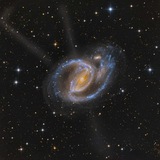
Ever since the Big Bang, most objects in space have been moving away from one another. In fact, the expansion of the Universe is actually accelerating.
As regions of space are whizzing away from one another at an ever-increasing rate, the first population of stars to form in the Universe are now too far away for us to ever hope of spying them – even using the best present or future telescope.
Hope is not lost; we can attempt to spot them indirectly via the energetic bursts of radiation they emit at the end of their lives .
#DAILYFACTS
As regions of space are whizzing away from one another at an ever-increasing rate, the first population of stars to form in the Universe are now too far away for us to ever hope of spying them – even using the best present or future telescope.
Hope is not lost; we can attempt to spot them indirectly via the energetic bursts of radiation they emit at the end of their lives .
#DAILYFACTS
👍4
On behalf of the channel administration we wish all our Subscribers a Happy New Year 2023! 🥂🎇
May it bring you new achievements, happy moments and may people close to you always be there for you!
May it bring you new achievements, happy moments and may people close to you always be there for you!
🔥4❤1🥰1
This media is not supported in your browser
VIEW IN TELEGRAM
'We are all born scientists'
~Michio
~Michio
🔥3❤1🥰1
Quantum Mechanics and Path Integrals by Feynman and Hibbs.pdf
47.9 MB
Quantum Mechanics and Path Integrals
by
From astrophysics to condensed matter theory, nearly all of the modern physics employs the path integral technique. In this presentation, the developer of path integrals and one of the best-known scientists of all time, Nobel Prize–winning physicist Richard P. Feynman, presents unique insights into this method and its applications. Avoiding dense, complicated descriptions, Feynman articulates his celebrated theory in a clear, concise manner, maintaining a perfect balance between mathematics and physics.
by
Richard P. Feynman and Albert R. HibbsFrom astrophysics to condensed matter theory, nearly all of the modern physics employs the path integral technique. In this presentation, the developer of path integrals and one of the best-known scientists of all time, Nobel Prize–winning physicist Richard P. Feynman, presents unique insights into this method and its applications. Avoiding dense, complicated descriptions, Feynman articulates his celebrated theory in a clear, concise manner, maintaining a perfect balance between mathematics and physics.
👍1
"Time is an illusion, our naive perception of its flow doesn’t correspond to physical reality. Reality is just a complex network of events onto which we project sequences of past, present and future. The whole universe obeys the laws of quantum mechanics and thermodynamics, out of which time emerges."
--The Order of Time, Carlo Rovelli
--The Order of Time, Carlo Rovelli
👍1
What is the equation for calculating the de Broglie wavelength of a particle? ⚛️
Anonymous Quiz
14%
λ = mv
72%
λ = h/p
12%
λ = Δx Δp
2%
λ = gt
👍3❤2🔥1👌1
The Smartest Living Mathematical Physicist
Ed Witten discussing with Quantum Pioneer Paul Dirac, Sicily, Italy, 1981.
Image Source: https://www.kyotoprize.org/en/211112
Ed Witten discussing with Quantum Pioneer Paul Dirac, Sicily, Italy, 1981.
Image Source: https://www.kyotoprize.org/en/211112
Dr. Jocelyn Bell Burnell is long overdue a Nobel Prize in the area of Physics.
Her work contributed to the discovery of the pulsar, small sized, their diameters are 20 km or less, spherical objects in space that contain more mass than the sun.
At the time she was a postgraduate at Cambridge and the Nobel Prize in Physics, in 1974, went to her supervisor who was given credit for her discovery. Dr. Burnell has been recognized with many award and honors, including the Special Breakthrough Prize in Fundamental Physics (2018), which carried a cash award of 2.3 million pounds. She donated the money towards charity organizations which help individuals from underrepresented populations become physicists.
Her work contributed to the discovery of the pulsar, small sized, their diameters are 20 km or less, spherical objects in space that contain more mass than the sun.
At the time she was a postgraduate at Cambridge and the Nobel Prize in Physics, in 1974, went to her supervisor who was given credit for her discovery. Dr. Burnell has been recognized with many award and honors, including the Special Breakthrough Prize in Fundamental Physics (2018), which carried a cash award of 2.3 million pounds. She donated the money towards charity organizations which help individuals from underrepresented populations become physicists.