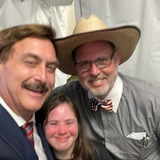
I got to swing by home enroute to my next destination. So I delivered some of the presents the Texas team gave Nellie.
She was quivering with joy. Thank you all for loving Nellie.
She was quivering with joy. Thank you all for loving Nellie.
❤266👍14
“Consider this...”
Just for the sake of discussion, let’s assume that nothing nefarious took place during the 2020 election. That the puppet really did win. I know this is a stretch, but go with me here.
We are nevertheless in a existential crisis, because 60% of public believes the outcome was fraudulent.
The question then becomes, how do we restore faith in our elections?
Some people suggest that I should shut up. Put the past behind, and look to the future. But that accomplishes nothing. Doubt remains.
Instead, to restore faith, the people need to look under the hood. All the records need to be transparently examined.
But *instead*... and this is very important to emphasize... officials across the country are hunkering down, hiding their data, and instructing officials to stonewall public information requests.
And I’M supposedly the one causing our people to lose faith in our elections?
The behavior of our officials only confirms our suspicions.
That’s why we have to Vote Amish. All paper, no machines. With full transparency in every aspect.
You can only trust a process that is fully transparent and fully auditable.
We are miles from this.
But we’re the bad guys for noting it.
Just for the sake of discussion, let’s assume that nothing nefarious took place during the 2020 election. That the puppet really did win. I know this is a stretch, but go with me here.
We are nevertheless in a existential crisis, because 60% of public believes the outcome was fraudulent.
The question then becomes, how do we restore faith in our elections?
Some people suggest that I should shut up. Put the past behind, and look to the future. But that accomplishes nothing. Doubt remains.
Instead, to restore faith, the people need to look under the hood. All the records need to be transparently examined.
But *instead*... and this is very important to emphasize... officials across the country are hunkering down, hiding their data, and instructing officials to stonewall public information requests.
And I’M supposedly the one causing our people to lose faith in our elections?
The behavior of our officials only confirms our suspicions.
That’s why we have to Vote Amish. All paper, no machines. With full transparency in every aspect.
You can only trust a process that is fully transparent and fully auditable.
We are miles from this.
But we’re the bad guys for noting it.
👍164🔥29❤25
“Humility”
Humility is knowing that God made you, and that He designed you with gifts and purpose.
The truly humble person discovers their gifts, explores and nurtures them, and then deploys them vigorously in ways that honor God.
God made me six-foot, one-inch tall. I had nothing to do with it.
He also gave me feet and hands, a voice, and a brain. I had nothing to do with it.
God expects me to use them.
And when I do, I experience great joy.
Thank you God, for joy.
Humility is knowing that God made you, and that He designed you with gifts and purpose.
The truly humble person discovers their gifts, explores and nurtures them, and then deploys them vigorously in ways that honor God.
God made me six-foot, one-inch tall. I had nothing to do with it.
He also gave me feet and hands, a voice, and a brain. I had nothing to do with it.
God expects me to use them.
And when I do, I experience great joy.
Thank you God, for joy.
❤98👍21👎1
"Stanford"
So far, we have two admissions from our Stanford professor.
1. Many states and counties have more people registered than they have eligible people.
2. Many state and county voter rolls contain fewer votes in them than the official number of ballots reported.
3. We are waiting for his estimate of what would be an acceptable discrepancy. Then he will have to explain that discrepancy. Then we will show him how to calculate it.
So far, we have two admissions from our Stanford professor.
1. Many states and counties have more people registered than they have eligible people.
2. Many state and county voter rolls contain fewer votes in them than the official number of ballots reported.
3. We are waiting for his estimate of what would be an acceptable discrepancy. Then he will have to explain that discrepancy. Then we will show him how to calculate it.
👍64❤7🔥1
"Stanford"
Now, our professor is suggesting that people who voted are being removed a month later from the voter rolls for “inactivity.”
Don't laugh... I hear this all the time, from people who are supposed to be managing our elections. It is what they are told to say. But it is dumb, and it reveals a lack of critical thinking.
People who VOTE are not "inactive."
Now, our professor is suggesting that people who voted are being removed a month later from the voter rolls for “inactivity.”
Don't laugh... I hear this all the time, from people who are supposed to be managing our elections. It is what they are told to say. But it is dumb, and it reveals a lack of critical thinking.
People who VOTE are not "inactive."
👍69🔥15
"Follow the Data"
Please note that in my discussion with the Stanford professor that I begin with the DATA.
The DATA tell us what to think, guiding our investigation.
The DATA reveal massive discrepancies, which taken together with canvassing DATA and calculations reveals an election system easily manipulated.
As a recently discovered email between a couple dozen senior election officials reveals, they all knew that our election systems were "a hackers paradise" in 2020.
Please note that in my discussion with the Stanford professor that I begin with the DATA.
The DATA tell us what to think, guiding our investigation.
The DATA reveal massive discrepancies, which taken together with canvassing DATA and calculations reveals an election system easily manipulated.
As a recently discovered email between a couple dozen senior election officials reveals, they all knew that our election systems were "a hackers paradise" in 2020.
🔥49👍8
“Grandma”
Let’s say you are doing a walking tour of a state, and you happen upon a small photograph. You immediately recognize it. “It’s Grandma!” You put the 2” x 3” photo in your pocket and continue along the path.
The next day, in another county, you discover another photograph; this one is bigger, it’s 4” x 6”. But it is still a photo of grandma. You put it in your pocket with the smaller one and continue your expedition.
The next day, in the next county, you come upon yet another photo of grandma, this one is really large. It’s 8” x 12”.
And so it goes, day after day, county after county, finding pictures of grandma. All different sizes.
After your trip you describe to your friends what you found. You explain how you randomly found eighty-eight nearly identical photos of grandma. Your friends demand mathematical proof. So you take photos of each of the prints, scale them, and then superimpose them (lining up the eyes, nose, etc.), calculating the correlation coefficients.
The coefficients are not perfect, but they are really close to one. Someone had stepped on one of the photos, a bug ate the corner off another, and some had creases, etc. But the statistics are overwhelming. You found eighty-eight pictures of grandma.
That ain’t natural, buddy.
Along comes a Stanford professor who challenges your findings. He says that you didn’t really find anything spectacular, because when he compares the unscaled photos the correlation coefficients are not as good.
Well, duh.
And now he has to explain how there are eighty-eight pictures of grandma dispersed all over the state.
The next day you start a trek in the neighboring state, and in the first county you find a picture of Grandpa.
Let’s say you are doing a walking tour of a state, and you happen upon a small photograph. You immediately recognize it. “It’s Grandma!” You put the 2” x 3” photo in your pocket and continue along the path.
The next day, in another county, you discover another photograph; this one is bigger, it’s 4” x 6”. But it is still a photo of grandma. You put it in your pocket with the smaller one and continue your expedition.
The next day, in the next county, you come upon yet another photo of grandma, this one is really large. It’s 8” x 12”.
And so it goes, day after day, county after county, finding pictures of grandma. All different sizes.
After your trip you describe to your friends what you found. You explain how you randomly found eighty-eight nearly identical photos of grandma. Your friends demand mathematical proof. So you take photos of each of the prints, scale them, and then superimpose them (lining up the eyes, nose, etc.), calculating the correlation coefficients.
The coefficients are not perfect, but they are really close to one. Someone had stepped on one of the photos, a bug ate the corner off another, and some had creases, etc. But the statistics are overwhelming. You found eighty-eight pictures of grandma.
That ain’t natural, buddy.
Along comes a Stanford professor who challenges your findings. He says that you didn’t really find anything spectacular, because when he compares the unscaled photos the correlation coefficients are not as good.
Well, duh.
And now he has to explain how there are eighty-eight pictures of grandma dispersed all over the state.
The next day you start a trek in the neighboring state, and in the first county you find a picture of Grandpa.
👍81🔥28😁9❤6
When I predict the voter demographics for 92 Indiana counties, the average R is 0.994.
That ain't natural, buddy!
https://rumble.com/vrbfkp-correlation-coefficient-illustration.html
That ain't natural, buddy!
https://rumble.com/vrbfkp-correlation-coefficient-illustration.html
Rumble
Correlation Coefficient Illustration
A short clip illustrating how well a particular function correlates to a noisy version of the same function. I use the correlation coefficient, R, in many of my analyses. This clip will give people wh
👍40
"Cancer Diagnosis"
Suppose that your family doctor diagnoses you with cancer. It's serious, and the tumors are spreading throughout your whole body.
You want a second opinion, so you take a trip to Stanford medical center.
The Stanford doctor challenges the diagnosis because the tumor in your left arm has a different shape than what your family doctor found.
I think we can agree that the Stanford doctor is missing the point.
Suppose that your family doctor diagnoses you with cancer. It's serious, and the tumors are spreading throughout your whole body.
You want a second opinion, so you take a trip to Stanford medical center.
The Stanford doctor challenges the diagnosis because the tumor in your left arm has a different shape than what your family doctor found.
I think we can agree that the Stanford doctor is missing the point.
👍63❤9
I find it amazing that the Stanford political science professor calls our country a democracy. We're not. We are a Republic. Every elementary child who recites the pledge knows this.
👍119❤15🔥9
"Yes, it's that simple."
After my talk the other day in Texas a young man approached me with some questions. He wanted to reproduce the registration key calculation. He told me he basically lived in Excel every day.
So I gave him a simple set of steps he could execute in Excel to repeat the calculation. When I finished he exclaimed, "It's that easy!?"
I assured him that it was, but there was a slight subtlety to it.
It took some time for him to understand the trick, and those standing around listening were completely lost.
He is not alone. Lots of folks around the country have needed assistance with that last step. The notion of relative proportionality is difficult for most people to grasp, which is why I seldom try to explain it in public during my talks.
The best example I've come up with so far is the "picture of grandma." The relative proportions of her features are always the same regardless of the size of the photo.
And that is why you recognize her.
After my talk the other day in Texas a young man approached me with some questions. He wanted to reproduce the registration key calculation. He told me he basically lived in Excel every day.
So I gave him a simple set of steps he could execute in Excel to repeat the calculation. When I finished he exclaimed, "It's that easy!?"
I assured him that it was, but there was a slight subtlety to it.
It took some time for him to understand the trick, and those standing around listening were completely lost.
He is not alone. Lots of folks around the country have needed assistance with that last step. The notion of relative proportionality is difficult for most people to grasp, which is why I seldom try to explain it in public during my talks.
The best example I've come up with so far is the "picture of grandma." The relative proportions of her features are always the same regardless of the size of the photo.
And that is why you recognize her.
👍56❤2