Scientists find key protein for spinal cord repair
Healing protein bridges severed tissue in fish
A freshwater zebrafish costs less than two bucks at the pet store, but it can do something priceless: Its spinal cord can heal completely after being severed, a paralyzing and often fatal injury for humans. While watching these fish repair their own spinal cord injuries, scientists have found a particular protein important for the process.
Image
Full Story
Brought to you by @EverythingScience
Healing protein bridges severed tissue in fish
A freshwater zebrafish costs less than two bucks at the pet store, but it can do something priceless: Its spinal cord can heal completely after being severed, a paralyzing and often fatal injury for humans. While watching these fish repair their own spinal cord injuries, scientists have found a particular protein important for the process.
Image
Full Story
Brought to you by @EverythingScience

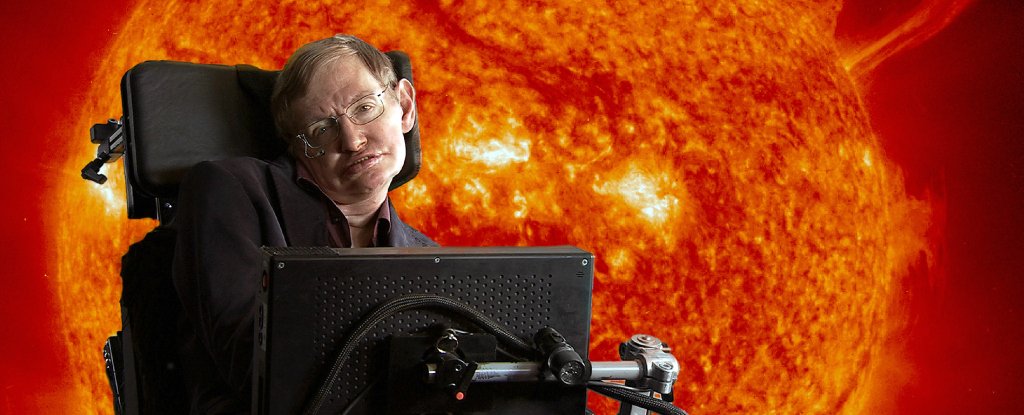
Stephen Hawking warns us to stop reaching out to aliens before it's too late
"I am more convinced than ever that we are not alone."
When the potential of intelligent alien civilisations comes up in conversation, it’s usually about the search. How will we find them? Where are they? Are they there at all? What actions should we take if – or when – we find them, or they find us?
Well, according to physicist Stephen Hawking, we should probably stop trying to contact them at all, because reaching out to advanced civilisations could put humanity and Earth in a pretty risky situation. And the bad news is, we've already been broadcasting our location to the Universe for years.
Hawking’s warning comes in a new online film called Stephen Hawking’s Favourite Places, which shows the famed scientist in a CGI spacecraft called the SS Hawking exploring his favourite places in the Universe.
"As I grow older I am more convinced than ever that we are not alone. After a lifetime of wondering, I am helping to lead a new global effort to find out," Hawking says in the film while exploring Gliese 832c, a planet that lies 16 light-years away and might foster alien life.
"The Breakthrough Listen project will scan the nearest million stars for signs of life, but I know just the place to start looking. One day we might receive a signal from a planet like Gliese 832c, but we should be wary of answering back."
Image
Full Story
Brought to you by @EverythingScience
"I am more convinced than ever that we are not alone."
When the potential of intelligent alien civilisations comes up in conversation, it’s usually about the search. How will we find them? Where are they? Are they there at all? What actions should we take if – or when – we find them, or they find us?
Well, according to physicist Stephen Hawking, we should probably stop trying to contact them at all, because reaching out to advanced civilisations could put humanity and Earth in a pretty risky situation. And the bad news is, we've already been broadcasting our location to the Universe for years.
Hawking’s warning comes in a new online film called Stephen Hawking’s Favourite Places, which shows the famed scientist in a CGI spacecraft called the SS Hawking exploring his favourite places in the Universe.
"As I grow older I am more convinced than ever that we are not alone. After a lifetime of wondering, I am helping to lead a new global effort to find out," Hawking says in the film while exploring Gliese 832c, a planet that lies 16 light-years away and might foster alien life.
"The Breakthrough Listen project will scan the nearest million stars for signs of life, but I know just the place to start looking. One day we might receive a signal from a planet like Gliese 832c, but we should be wary of answering back."
Image
Full Story
Brought to you by @EverythingScience
Physicist demonstrate existence of 'unlikely' new subatomic structure
Researchers have demonstrated the existence of a tetraneutron, a subatomic structure once thought unlikely to exist.
James Vary, a professor of physics and astronomy, and Andrey Shirokov, a visiting scientist, together with an international team, used sophisticated supercomputer simulations to show the quasi-stable existence of a tetraneutron, a structure comprised of four neutrons (subatomic particles with no charge).
For the tetraneutron, this lifetime is only 5×10^(-22) seconds (a tiny fraction of a billionth of a nanosecond). Though this time seems very short, it is long enough to study, and provides a new avenue for exploring the strong forces between neutrons.
"This opens up a whole new line of research," Vary said. "Studying the tetraneutron will help us understand interneutron forces including previously unexplored features of the unstable two-neutron and three-neutron systems."
Image
Full Story
Brought to you by @EverythingScience
Researchers have demonstrated the existence of a tetraneutron, a subatomic structure once thought unlikely to exist.
James Vary, a professor of physics and astronomy, and Andrey Shirokov, a visiting scientist, together with an international team, used sophisticated supercomputer simulations to show the quasi-stable existence of a tetraneutron, a structure comprised of four neutrons (subatomic particles with no charge).
For the tetraneutron, this lifetime is only 5×10^(-22) seconds (a tiny fraction of a billionth of a nanosecond). Though this time seems very short, it is long enough to study, and provides a new avenue for exploring the strong forces between neutrons.
"This opens up a whole new line of research," Vary said. "Studying the tetraneutron will help us understand interneutron forces including previously unexplored features of the unstable two-neutron and three-neutron systems."
Image
Full Story
Brought to you by @EverythingScience

Detour via gravitational lens makes distant galaxy visible
Never before have astrophysicists measured light of such high energy from a celestial object so far away. Around 7 billion years ago, a huge explosion occurred at the black hole in the center of a galaxy. This was followed by a burst of high-intensity gamma rays. A number of telescopes have succeeded in capturing this light. An added bonus: it was thus possible to reconfirm Einstein's General Theory of Relativity, as the light rays encountered a less distant galaxy en route to Earth -- and were deflected by this so-called gravitational lens.
Image
Full Story
Brought to you by @EverythingScience
Never before have astrophysicists measured light of such high energy from a celestial object so far away. Around 7 billion years ago, a huge explosion occurred at the black hole in the center of a galaxy. This was followed by a burst of high-intensity gamma rays. A number of telescopes have succeeded in capturing this light. An added bonus: it was thus possible to reconfirm Einstein's General Theory of Relativity, as the light rays encountered a less distant galaxy en route to Earth -- and were deflected by this so-called gravitational lens.
Image
Full Story
Brought to you by @EverythingScience

How to read a book without opening it
Radiation technique can aid studies of ancient texts
Scientists have devised a way to read without cracking a volume’s spine or risking paper cuts (and no, we’re not talking about e-books). The new method uses terahertz radiation — light with wavelengths that are between microwave and infrared waves — to view the text of a closed book. The technique is not meant for your average bookworm, but for reading rare books that are too fragile to open.
Barmak Heshmat of MIT and colleagues started small, with a nine-page book of thick paper that had one letter inked on each page. By hitting the book with terahertz radiation and looking at the reflected waves, the scientists could read the letters within.
Differences in the way the radiation interacts with ink and paper allowed the researchers to pick out shadowy outlines of the letters, and a letter-recognition algorithm automatically decoded the characters. The scientists could tell one page from another by using precise timing information: On the later pages, the waves penetrated deeper before reflecting and, therefore, took longer to return.
Historians also may be able to use the technique to find an artist’s signature hidden beneath layers of a painting. Sneaking into your sister’s locked diary is another story.
Image
Full Story
Brought to you by @EverythingScience
Radiation technique can aid studies of ancient texts
Scientists have devised a way to read without cracking a volume’s spine or risking paper cuts (and no, we’re not talking about e-books). The new method uses terahertz radiation — light with wavelengths that are between microwave and infrared waves — to view the text of a closed book. The technique is not meant for your average bookworm, but for reading rare books that are too fragile to open.
Barmak Heshmat of MIT and colleagues started small, with a nine-page book of thick paper that had one letter inked on each page. By hitting the book with terahertz radiation and looking at the reflected waves, the scientists could read the letters within.
Differences in the way the radiation interacts with ink and paper allowed the researchers to pick out shadowy outlines of the letters, and a letter-recognition algorithm automatically decoded the characters. The scientists could tell one page from another by using precise timing information: On the later pages, the waves penetrated deeper before reflecting and, therefore, took longer to return.
Historians also may be able to use the technique to find an artist’s signature hidden beneath layers of a painting. Sneaking into your sister’s locked diary is another story.
Image
Full Story
Brought to you by @EverythingScience

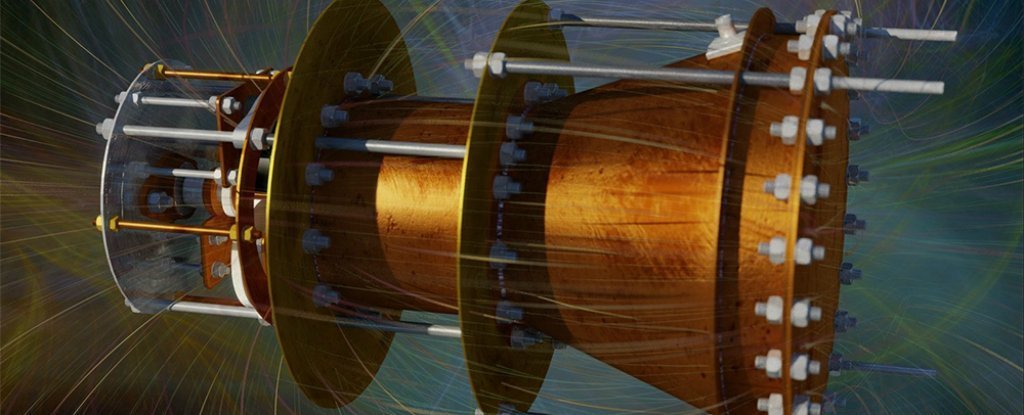
Leaked NASA paper shows the 'impossible' EM Drive really does work
Did we just achieve fuel-less propulsion?
The results of NASA's tests on the 'impossible' EM Drive have been leaked, and they reveal that the controversial propulsion system really does work, and is capable of generating impressive thrust in a vacuum, even after error measurements have been accounted for.
The EM Drive has made headlines over the past year, because it offers the incredible possibility of a fuel-free propulsion system that could potentially get us to Mars in just 70 days. But there's one major problem: according to the current laws of physics, it shouldn't work.
The issue is the fact that the EM Drive defies Newton's third law, which states that everything must have an equal and opposite reaction. So, according to Newton and our current understanding of the world around us, for a system to produce propulsion, it has to push something out the other way (in space, that's usually combusted rocket fuel).
But the EM Drive works without any fuel or propellants at all. It works by simply bouncing microwave photons back and forth inside a cone-shaped closed metal cavity. That motion causes the 'pointy end' of the EM Drive to generate thrust, and propel the drive in the opposite direction.
Despite years of testing and debate, the drive remains controversial. The bottom line is that, on paper, it shouldn't work, according to the laws of physics. And yet, in test after test, the EM Drive just keeps on working.
Last year, NASA's Eagleworks Laboratory got involved to try to independently verify or debunk the EM Drive once and for all. And a new paper on its tests in late 2015 has just been leaked, showing that not only does the EM Drive work - it also generates some pretty impressive thrust.
Image
Full Story
Brought to you by @EverythingScience
Did we just achieve fuel-less propulsion?
The results of NASA's tests on the 'impossible' EM Drive have been leaked, and they reveal that the controversial propulsion system really does work, and is capable of generating impressive thrust in a vacuum, even after error measurements have been accounted for.
The EM Drive has made headlines over the past year, because it offers the incredible possibility of a fuel-free propulsion system that could potentially get us to Mars in just 70 days. But there's one major problem: according to the current laws of physics, it shouldn't work.
The issue is the fact that the EM Drive defies Newton's third law, which states that everything must have an equal and opposite reaction. So, according to Newton and our current understanding of the world around us, for a system to produce propulsion, it has to push something out the other way (in space, that's usually combusted rocket fuel).
But the EM Drive works without any fuel or propellants at all. It works by simply bouncing microwave photons back and forth inside a cone-shaped closed metal cavity. That motion causes the 'pointy end' of the EM Drive to generate thrust, and propel the drive in the opposite direction.
Despite years of testing and debate, the drive remains controversial. The bottom line is that, on paper, it shouldn't work, according to the laws of physics. And yet, in test after test, the EM Drive just keeps on working.
Last year, NASA's Eagleworks Laboratory got involved to try to independently verify or debunk the EM Drive once and for all. And a new paper on its tests in late 2015 has just been leaked, showing that not only does the EM Drive work - it also generates some pretty impressive thrust.
Image
Full Story
Brought to you by @EverythingScience
Harvard scientists think they've pinpointed the physical source of consciousness
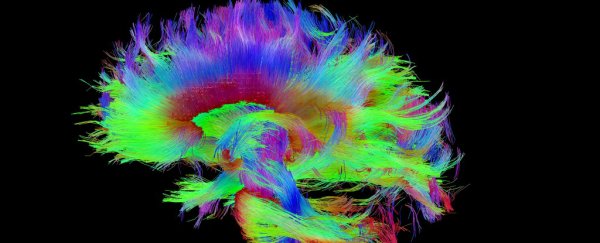
Scientists have struggled for millennia to understand human consciousness - the awareness of one's existence. Despite advances in neuroscience, we still don't really know where it comes from, and how it arises.
But researchers think they might have finally figured out its physical origins, after pinpointing a network of three specific regions in the brain that appear to be crucial to consciousness.
It's a pretty huge deal for our understanding of what it means to be human, and it could also help researchers find new treatments for patients in vegetative states.
"For the first time, we have found a connection between the brainstem region involved in arousal and regions involved in awareness, two prerequisites for consciousness," said lead researcher Michael Fox from the Beth Israel Deaconess Medical Centre at Harvard Medical School.
Image
Full Story
Brought to you by @EverythingScience
Scientists have struggled for millennia to understand human consciousness - the awareness of one's existence. Despite advances in neuroscience, we still don't really know where it comes from, and how it arises.
But researchers think they might have finally figured out its physical origins, after pinpointing a network of three specific regions in the brain that appear to be crucial to consciousness.
It's a pretty huge deal for our understanding of what it means to be human, and it could also help researchers find new treatments for patients in vegetative states.
"For the first time, we have found a connection between the brainstem region involved in arousal and regions involved in awareness, two prerequisites for consciousness," said lead researcher Michael Fox from the Beth Israel Deaconess Medical Centre at Harvard Medical School.
Image
Full Story
Brought to you by @EverythingScience
Early study finds antibody that 'neutralizes' Zika virus
Researchers have isolated a human monoclonal antibody that in a mouse model "markedly reduced" infection by the Zika virus, report scientists. Zika is believed to cause microcephaly, unusually small heads, and other congenital malformations in children born to infected women.
Image
Full Story
Brought to you by @EverythingScience
Researchers have isolated a human monoclonal antibody that in a mouse model "markedly reduced" infection by the Zika virus, report scientists. Zika is believed to cause microcephaly, unusually small heads, and other congenital malformations in children born to infected women.
Image
Full Story
Brought to you by @EverythingScience

A new paper claims our understanding of gravity is totally wrong
What if gravity is just an illusion?
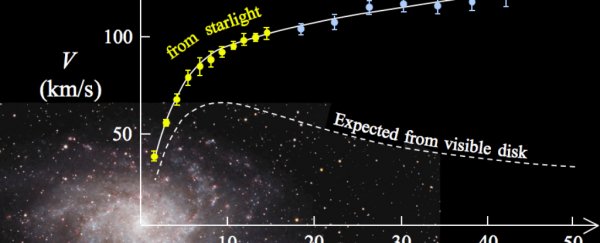
A theoretical physicist has come up with a new hypothesis that could finally explain the mystery of dark matter - the elusive matter that's predicted to make up around 27 percent of the observable Universe.
According to the new paper, all we have to do to explain the weird effects of dark matter in the Universe is take gravity out of the equation.
"Our current ideas about space, time, and gravity urgently need to be re-thought. We have long known that Einstein's theory of gravity can not work with quantum mechanics", the author the new paper, Erik Verlinde from the University of Amsterdam, told Dutch news site NOS.
"Our findings are drastically changing, and I think that we are on the eve of a scientific revolution."
Image
Full Story
Brought to you by @EverythingScience
What if gravity is just an illusion?
A theoretical physicist has come up with a new hypothesis that could finally explain the mystery of dark matter - the elusive matter that's predicted to make up around 27 percent of the observable Universe.
According to the new paper, all we have to do to explain the weird effects of dark matter in the Universe is take gravity out of the equation.
"Our current ideas about space, time, and gravity urgently need to be re-thought. We have long known that Einstein's theory of gravity can not work with quantum mechanics", the author the new paper, Erik Verlinde from the University of Amsterdam, told Dutch news site NOS.
"Our findings are drastically changing, and I think that we are on the eve of a scientific revolution."
Image
Full Story
Brought to you by @EverythingScience
Forwarded from rex 𓁹𖦹𓁹
YouTube
How to think, not what to think | Jesse Richardson | TEDxBrisbane
This talk was given at a local TEDx event, produced independently of the TED Conferences. Jesse is the founder of https://www.schoolofthought.org an online fully immersive learning environment that will be free for students, teachers and universities all…
Genetically engineering disease-fighting cells
The human body produces T cells to recognize and fight disease. Each T cell has a unique T cell receptor (or TCR) on its surface that surveils small fragments of proteins presented by other cells. Upon detecting evidence of cancer or infection, a subset of T cells binds the diseased cells and orchestrates their elimination. When tumors and infections cannot be eradicated naturally, researchers employ immunotherapies to boost the immune system's effectiveness.
By inserting genes encoding a tumor-specific TCR into a patient's T cells, researchers can engineer a large population of T cells to target tumor cells. This approach, called TCR gene therapy, has yielded clinical successes where conventional cancer treatments have failed. However, TCR gene therapy is not without risk. The introduced receptor can become tangled with the resident receptor in each engineered T cell, causing some of these cells to attack healthy cells. A new technique developed by Caltech researchers prevents this from happening, increasing the safety of TCR gene therapy.
Image
Full Story
Brought to you by @EverythingScience
The human body produces T cells to recognize and fight disease. Each T cell has a unique T cell receptor (or TCR) on its surface that surveils small fragments of proteins presented by other cells. Upon detecting evidence of cancer or infection, a subset of T cells binds the diseased cells and orchestrates their elimination. When tumors and infections cannot be eradicated naturally, researchers employ immunotherapies to boost the immune system's effectiveness.
By inserting genes encoding a tumor-specific TCR into a patient's T cells, researchers can engineer a large population of T cells to target tumor cells. This approach, called TCR gene therapy, has yielded clinical successes where conventional cancer treatments have failed. However, TCR gene therapy is not without risk. The introduced receptor can become tangled with the resident receptor in each engineered T cell, causing some of these cells to attack healthy cells. A new technique developed by Caltech researchers prevents this from happening, increasing the safety of TCR gene therapy.
Image
Full Story
Brought to you by @EverythingScience

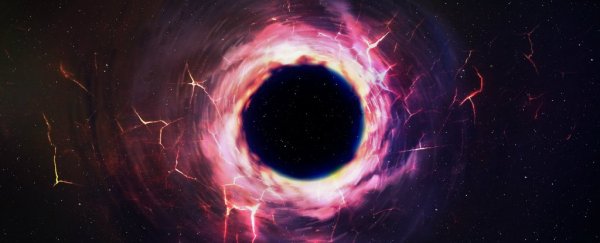
The Universe might rip itself apart until there's nothing left, new study suggests
Is this how it ends?
When it comes to the end of the Universe, most physicists think it will gradually get colder and fade out of existence, at the earliest, 2.8 billion years from now.
But it might not be so simple. Calculations have shown that dark energy could cause the Universe to gradually tear itself apart until there's nothing left. And now a new study has provided a closer examination of what that fate might look like.
It's not the first time that this possibility of the Universe ripping itself apart has been put forward. Our current understanding of the Universe is that around 68 percent of its energy is dark energy - a mysterious force that's gradually accelerating the expansion of the Universe.
Image
Full Story
Brought to you by @EverythingScience
Is this how it ends?
When it comes to the end of the Universe, most physicists think it will gradually get colder and fade out of existence, at the earliest, 2.8 billion years from now.
But it might not be so simple. Calculations have shown that dark energy could cause the Universe to gradually tear itself apart until there's nothing left. And now a new study has provided a closer examination of what that fate might look like.
It's not the first time that this possibility of the Universe ripping itself apart has been put forward. Our current understanding of the Universe is that around 68 percent of its energy is dark energy - a mysterious force that's gradually accelerating the expansion of the Universe.
Image
Full Story
Brought to you by @EverythingScience