Forwarded from زبان و پزشکی(قربانی)
This media is not supported in your browser
VIEW IN TELEGRAM
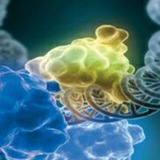
🎥یک ویدیوی فوقالعاده از آنزیم DNA gyrase مشغول کار, و به دنبال اون هم انزیم پلیمراز رو میبینیم که مشغول همانند سازی هست
Dna gyrase at work to uncoil a dna double helix
🎞Dna gyrase
آنزیم باز کننده و ریلکس کننده ی DNA
🎞Uncoil
باز کردن درهم پیچدگی
🎞Double helix
مارپیچ دو رشته ای
@medterms
@cytology
@essential_biochemistry
Dna gyrase at work to uncoil a dna double helix
🎞Dna gyrase
آنزیم باز کننده و ریلکس کننده ی DNA
🎞Uncoil
باز کردن درهم پیچدگی
🎞Double helix
مارپیچ دو رشته ای
@medterms
@cytology
@essential_biochemistry
Media is too big
VIEW IN TELEGRAM
2⃣.2⃣
🔘Label the atoms and bonds in a polypeptide.
🔘Recognize the unique properties of each of the bonds in a polypeptide chain.
🔘Describe a Ramachandran plot and how it is generated.
🔘Identify the three secondary structures of proteins.
🔘Predict the secondary structure of a polypeptide based on its phi and psi angles.
🔘Explain how hydrogen bonding contributes to the formation of secondary structure.
@Medterms
@Essential_Biochemistry
🔘Label the atoms and bonds in a polypeptide.
🔘Recognize the unique properties of each of the bonds in a polypeptide chain.
🔘Describe a Ramachandran plot and how it is generated.
🔘Identify the three secondary structures of proteins.
🔘Predict the secondary structure of a polypeptide based on its phi and psi angles.
🔘Explain how hydrogen bonding contributes to the formation of secondary structure.
@Medterms
@Essential_Biochemistry
Media is too big
VIEW IN TELEGRAM
2⃣.3⃣
🔘Explain the difference between a motif, fold and domain.
🔘Describe why there is a limited diversity of different protein folds.
@Medterms
@Essential_Biochemistry
🔘Explain the difference between a motif, fold and domain.
🔘Describe why there is a limited diversity of different protein folds.
@Medterms
@Essential_Biochemistry
Media is too big
VIEW IN TELEGRAM
2⃣.4⃣
🔘Describe the main #forces that determine the folding of proteins.
🔘Summarize how these forces balance in magnitude to promote #protein #folding.
@Medterms
@Essential_Biochemistry
🔘Describe the main #forces that determine the folding of proteins.
🔘Summarize how these forces balance in magnitude to promote #protein #folding.
@Medterms
@Essential_Biochemistry
Media is too big
VIEW IN TELEGRAM
2⃣.5⃣
🔘Summarize the thermodynamic hypothesis.
🔘Explain how Anfinsen's experiment supports the thermodynamic hypothesis.
🔘Explain how folding funnels are used to visualize protein folding thermodynamics.
@Medterms
@Essential_Biochemistry
🔘Summarize the thermodynamic hypothesis.
🔘Explain how Anfinsen's experiment supports the thermodynamic hypothesis.
🔘Explain how folding funnels are used to visualize protein folding thermodynamics.
@Medterms
@Essential_Biochemistry
Media is too big
VIEW IN TELEGRAM
2⃣.6⃣
🔘Explain the role of cooperativity in protein folding.
🔘Summarize the theoretical basis of Levinthal's paradox.
🔘Describe the diffusion collision and nucleation condensation models of protein folding.
@Medterms
@Essential_Biochemistry
🔘Explain the role of cooperativity in protein folding.
🔘Summarize the theoretical basis of Levinthal's paradox.
🔘Describe the diffusion collision and nucleation condensation models of protein folding.
@Medterms
@Essential_Biochemistry
Media is too big
VIEW IN TELEGRAM
2⃣.7⃣
🔘Explain why there is a risk of aggregate formation for proteins folding in the cytosol.
🔘Summarize how different chaperones function to prevent protein aggregation.
🔘Explain why heat shock causes protein aggregation.
🔘Compare the chaperone function of HSP70 and HSP60.
@Medterms
@Essential_Biochemistry
🔘Explain why there is a risk of aggregate formation for proteins folding in the cytosol.
🔘Summarize how different chaperones function to prevent protein aggregation.
🔘Explain why heat shock causes protein aggregation.
🔘Compare the chaperone function of HSP70 and HSP60.
@Medterms
@Essential_Biochemistry
This media is not supported in your browser
VIEW IN TELEGRAM
3⃣.1⃣
🔘Define reaction equilibrium
🔘Determine if a reaction is spontaneous based on the free energy of the reaction coordinates.
🔘Explain how a catalyst reduces the activation energy to speed the rate of a reaction.
🔘Understand that an enzyme stabilizes a transition state to decrease the activation energy of a reaction.
@Medterms
@Essential_Biochemistry
🔘Define reaction equilibrium
🔘Determine if a reaction is spontaneous based on the free energy of the reaction coordinates.
🔘Explain how a catalyst reduces the activation energy to speed the rate of a reaction.
🔘Understand that an enzyme stabilizes a transition state to decrease the activation energy of a reaction.
@Medterms
@Essential_Biochemistry
Media is too big
VIEW IN TELEGRAM
3⃣.2⃣
🔘Recall that transient covalent bonds position the substrate in the enzyme active site to reduce the entropy of the system.
🔘Explain how weak non-covalent interactions (i.e. binding energy) reduce activation energy.
🔘Contrast Emil Fischer's lock-and-key model of enzyme specificity with the 'induced fit' hypothesis of enzyme catalysis.
🔘Define desolvation as it relates to binding energy.
#Enzyme #Catalysis
@Medterms
@Essential_Biochemistry
🔘Recall that transient covalent bonds position the substrate in the enzyme active site to reduce the entropy of the system.
🔘Explain how weak non-covalent interactions (i.e. binding energy) reduce activation energy.
🔘Contrast Emil Fischer's lock-and-key model of enzyme specificity with the 'induced fit' hypothesis of enzyme catalysis.
🔘Define desolvation as it relates to binding energy.
#Enzyme #Catalysis
@Medterms
@Essential_Biochemistry
Forwarded from Biochemistry (✨Reza)
Media is too big
VIEW IN TELEGRAM
3⃣.3⃣
🔘Explain why enzymes are much bigger than their respective active sites.
🔘Describe the 3-point attachment model of enzyme catalysis.
🔘Recall the role of sequential substrate binding and induced fit in enzyme catalysis.
🔘Understand the role of phosphorylation in enzyme regulation.
♦️PLEASE NOTE: in video at 8:14, and in the slides, the charge sign is missing on the left most oxygen atom of citrate. It should appear as follows.
@Medterms
@Essential_Biochemistry
🔘Explain why enzymes are much bigger than their respective active sites.
🔘Describe the 3-point attachment model of enzyme catalysis.
🔘Recall the role of sequential substrate binding and induced fit in enzyme catalysis.
🔘Understand the role of phosphorylation in enzyme regulation.
♦️PLEASE NOTE: in video at 8:14, and in the slides, the charge sign is missing on the left most oxygen atom of citrate. It should appear as follows.
@Medterms
@Essential_Biochemistry