NCR (Non-Conformance Report) - How to Raise an NCR Effectively
In QA/QC, identifying a non-conformance is only the first step.
The NCR should clearly communicate what is wrong, where it occurred, what requirement was violated, and what action is required.
Key points while raising an NCR:
NCR Number & Date
Exact location / Item / Joint No.
Clear description of non-conformance
Drawing / Specification / WPS reference
Actual condition vs. required condition
Size, location & extent of defect
Sketch / Photograph / Section view, if required
Immediate action taken
Corrective & preventive action
Responsible department & target date
Re-inspection and final closure
Simple flow:
Identify Document →
Raise NCR →
Root Cause
Corrective Action
Re-inspection
Close
A well-documented NCR helps in traceability, corrective action and continuous quality improvement.
#NCR #QAQC #QualityControl #Quality Assurance #WeldingInspection #Fabrication #NDT
❤1
AIR-COOLED CHILLER |
TECHNICAL NOTES
An Air-Cooled Chiller is a self-contained refrigeration system that removes heat from chilled water and rejects it directly to the ambient air through condenser coils and fans.
Key Engineering Points:
Refrigeration Cycle:
Compressor
Condenser
Expansion Valve →
Evaporator
Compressor
Chilled Water Circuit:
Warm return water enters the evaporator heat is transferred to the refrigerant → cooled water leaves the chiller and supplies the building.
Typical CHW Design:
7°C Supply/12°C Return - actual design conditions depend on the project and manufacturer.
Ambient Temperature:
Higher outdoor temperatures can reduce cooling capacity and increase condensing pressure and compressor power.
This media is not supported in the widget
VIEW IN TELEGRAM
Cooling Tower Efficiency Calculation | Chemical Engineering
#ProcessEngineering #DCSOperator #Utilities
#IndustrialSafety
#ProcessEngineering #DCSOperator #Utilities
#IndustrialSafety
👍1
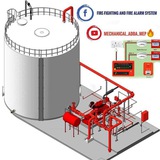
Fire Hose Cabinet (FHC)
A Fire Hose Cabinet doesn't always need a separate piping network.
NFPA 13:2019 permits certain 12-inch (40 mm) hose connections to be supplied directly from the sprinkler system, subject to specific conditions.
According to Sections 16.15.1.3 and 16.15.1.4:
* Wet Pipe System: Connections for fire purposes only are permitted on wet sprinkler systems.
* Connection Location: Permitted arrangements
include sprinkler risers upstream of sprinkler control valves and, under specific conditions, ceiling sprinkler piping.
Fire-fighting and Fire Alarm system 👷🏻🧰
Photo
Discover 12 essential bearing pedestal types every engineer should know! ⚙️ Which one do you use most in your plant? Drop your answer below! 👇
#BearingPedestal #MechanicalEngineering #IndustrialMachinery #MaintenanceEngineering #RotatingEquipment #MachineryMaintenance
#BearingPedestal #MechanicalEngineering #IndustrialMachinery #MaintenanceEngineering #RotatingEquipment #MachineryMaintenance
❤2
PRESSURE VESSEL BASICS - From Design to Safe Operation
A pressure vessel may look like a simple container, but its design, fabrication, inspection, and testing are critical for plant safety.
In this one-page ChemicalWala note, revise:
What is a Pressure Vessel?
Main vessel components & nozzles
ASME BPVC Section VIII basics
Hoop & longitudinal stresses
Common materials of construction
Manufacturing & welding process
Hydrostatic testing
Safety and pressure-relief considerations
❤1
1791651663790.pdf
39.5 MB
Process design Book bundle
Understanding Different Types of Flanges in Piping Engineering
Flanges play a vital role in piping systems by providing reliable connections between pipes, valves, pumps, and other equipment. They also facilitate inspection, maintenance, and equipment replacement.
Here are 12 commonly encountered flange types and related piping components every aspiring piping engineer should understand:
Weld Neck Flange - Ideal for demanding pressure and temperature conditions.
Slip-On Flange - Slides over the pipe and is welded in position.
Blind Flange - Closes the end of a piping system or equipment nozzle.
Socket Weld Flange Commonly used in small-bore piping applications.
Threaded Flange - Connects to threaded pipe without requiring a pipe-to-flange weld.
Lap Joint Flange - Used with a stub end to facilitate alignment and disassembly.
Ring Type Joint (RTJ) Flange - Uses a metallic ring gasket for sealing in suitable high-pressure applications.
❤2